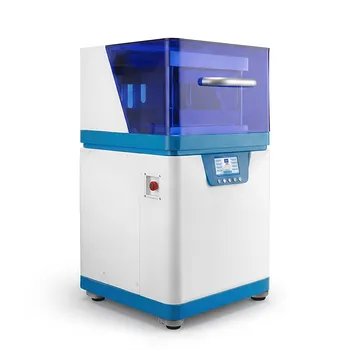
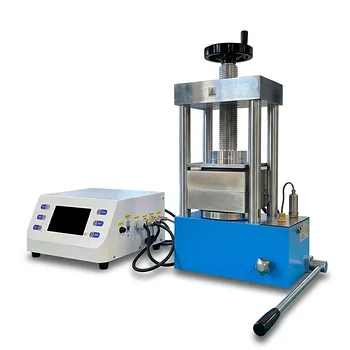
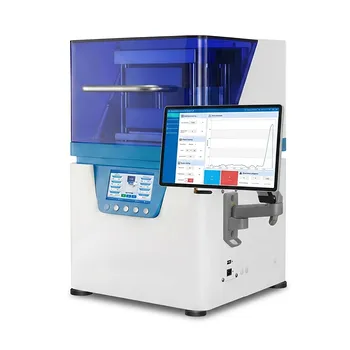
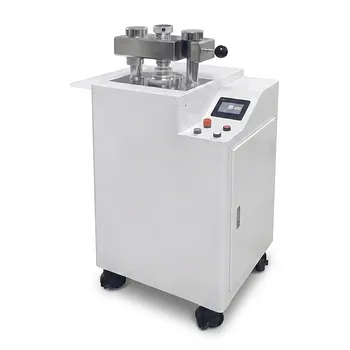
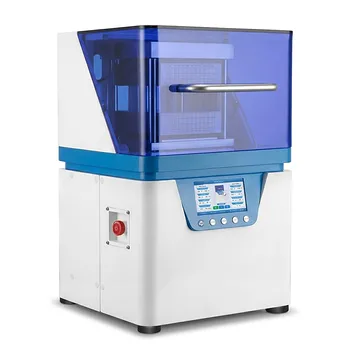
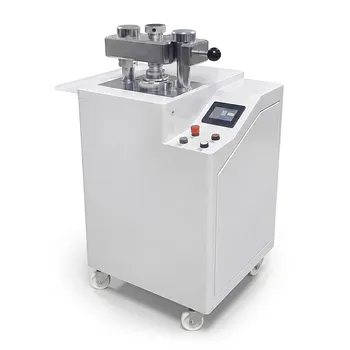
A laboratory hydraulic press is the critical tool for transforming loose $K_4CaSi_6O_{15}$ precursor powders into structurally sound green bodies. It applies precise, controlled axial pressure to uniformly mixed powders within a mold, forcing particles to rearrange and interlock into a cohesive shape. This process results in a compact pellet with defined dimensions, sufficient mechanical strength for handling, and the optimized particle contact required for subsequent chemical reactions.
The laboratory hydraulic press bridges the gap between raw powder and a reactive solid by ensuring uniform density and close particle packing. This physical consolidation is the essential precursor for successful solid-state diffusion and structural integrity during high-temperature sintering.
Establishing Structural and Geometric Integrity
Defining the Green Body Profile
The hydraulic press utilizes precision molds to consolidate $K_4CaSi_6O_{15}$ powders into specific geometric shapes, such as circular pellets. This stage is crucial because it establishes the basic geometric profile and standardized dimensions required for downstream testing and analysis.
Providing Necessary Mechanical Strength
By applying pressure often reaching several tons, the press facilitates mechanical interlocking and particle binding. This creates a green body with enough initial mechanical strength to be handled, moved, or encapsulated without crumbling or losing its shape.
Ensuring Dimensional Precision
The use of controlled axial pressure allows researchers to produce specimens with exact diameters and weights. These standardized dimensions are vital for high-precision measurements, such as those used in dilatometry to track material expansion or contraction.
Optimizing the Microstructure for Sintering
Maximizing Particle Contact
The press forces precursor particles into close proximity, significantly reducing the physical distance between them. This close packing is vital for $K_4CaSi_6O_{15}$, as it creates the optimal environment for the chemical components to interact.
Enhancing Solid-State Diffusion
Effective sintering relies on diffusion-controlled solid-state reactions, where atoms move across particle boundaries. By increasing the contact surface area through high-pressure compaction, the hydraulic press ensures that these reactions can occur efficiently once the material reaches the furnace.
Achieving Uniform Internal Density
Precise pressure control ensures that the density is consistent throughout the entire volume of the pellet. Uniform density is critical because it prevents uneven shrinking, warping, or internal cracking when the green body is subjected to high-temperature firing.
Understanding the Trade-offs and Pitfalls
Pressure Gradients and Non-Uniformity
While the press aims for uniformity, friction between the powder and the mold walls can create pressure gradients. This may result in a green body that is denser at the edges than the center, potentially leading to deformation during the sintering stage.
The Risk of Over-Compaction
Applying excessive pressure can lead to "spring-back" or elastic recovery once the pellet is removed from the mold. If the internal stresses exceed the green strength of the material, the pellet may develop laminar cracks or "capping" defects.
Tooling and Mold Wear
The precision of the green body is heavily dependent on the condition of the mold. High-pressure cycles can lead to micro-abrasion of the mold surfaces, which can eventually compromise the geometric regularity and surface finish of the $K_4CaSi_6O_{15}$ pellets.
Making the Right Choice for Your Research Goal
To achieve the best results with $K_4CaSi_6O_{15}$ green bodies, tailor your pressing parameters to your specific technical requirements.
- If your primary focus is high-precision dilatometry: Use precision-ground molds and a slow pressure ramp-up to ensure maximum geometric regularity and uniform internal density.
- If your primary focus is rapid solid-state synthesis: Prioritize maximizing particle contact through higher compaction pressures (e.g., 10 MPa or higher) to facilitate faster diffusion during firing.
- If your primary focus is avoiding structural defects: Incorporate a short "dwell time" at peak pressure to allow air to escape and particles to settle, reducing the risk of internal cracking.
By mastering the application of pressure, you ensure that the physical foundation of your ceramic material is robust enough to withstand the rigors of chemical transformation.
Summary Table:
| Process Component | Key Benefit for K4CaSi6O15 | Research Advantage |
|---|---|---|
| Axial Pressure | Precision Geometric Profiling | Standardized specimens for dilatometry |
| Particle Interlocking | Enhanced Mechanical Strength | Prevents crumbling during handling/loading |
| Close Packing | Maximized Surface Contact | Accelerates solid-state diffusion reactions |
| Controlled Density | Internal Uniformity | Prevents warping/cracking during sintering |
| Dwell Time Support | De-airing & Particle Settling | Eliminates laminar cracks and capping defects |
Elevate Your Material Synthesis with KINTEK Precision
Achieving the perfect green body is the first step toward high-performance ceramics. KINTEK specializes in advanced laboratory solutions designed to optimize your sample preparation. Our range of manual and automatic hydraulic presses (pellet, hot, and isostatic) ensures the uniform density and structural integrity required for sensitive materials like $K_4CaSi_6O_{15}$.
Beyond compaction, KINTEK offers a complete ecosystem for material research, including:
- High-Temperature Furnaces: Muffle, vacuum, and atmosphere furnaces for precision sintering.
- Processing Tools: High-energy crushing and milling systems for ideal precursor particle size.
- Essential Consumables: High-purity ceramics, crucibles, and PTFE products.
Ready to achieve superior structural integrity and sintering results? Contact our technical experts today to find the ideal equipment for your laboratory.
References
- Hang Liu, Artur Benisek. Investigations on the polymorphism of K <sub>4</sub> CaSi <sub>6</sub> O <sub>15</sub> at elevated temperatures. DOI: 10.1111/jace.19310
This article is also based on technical information from Kintek Solution Knowledge Base .
Related Products
- kbr pellet press 2t
- Automatic Hydraulic Hot Press with 500x500mm Heating Plates and Multi Stage PLC Control for Material Sintering
- Manual Lab Heat Press
- Fully Automatic Heated Hydraulic Lab Press for Materials Sintering and Sample Preparation
- Automatic Laboratory Hydraulic Press for XRF & KBR Pellet Press
People Also Ask
- How do you prepare samples for IR spectroscopy? A Step-by-Step Guide for Solids, Liquids, and Gases
- What measurement methods are commonly used for powder samples in infrared spectroscopy? Optimize Your FTIR Analysis
- Why KBr is used in IR spectrophotometry? A Key to Transparent Sample Analysis
- How are a KBr pellet press and mortar utilized in FTIR analysis of activated carbon? Expert Sample Prep Guide
- How do you prepare KBr pellets for FTIR analysis? Master the Technique for High-Quality IR Spectra