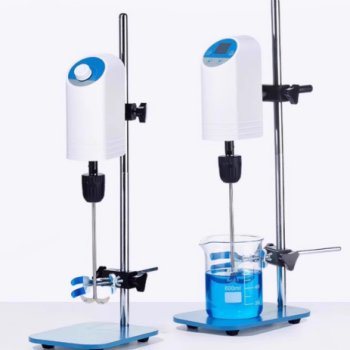
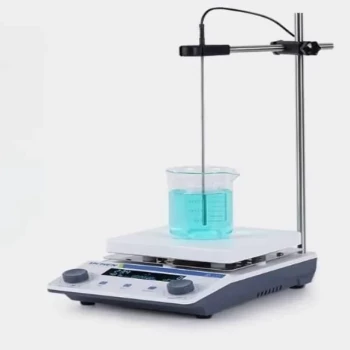
A laboratory stirred reactor guarantees effective results through the precise application of mechanical energy to create a uniform suspension. By maintaining controllable rotation speeds, typically between 500 and 700 rpm, the reactor keeps solid catalyst particles in a vigorous slurry state within the liquid phase (such as phenolic wastewater).
The reactor's primary function is to eliminate macroscopic mass transfer resistance, ensuring that the interaction between ozone, pollutants, and the catalyst is driven by chemical reactivity rather than physical mixing limitations.
Achieving the Optimal Physical State
Creating a Uniform Slurry
The foundation of a successful heterogeneous reaction is the physical distribution of the catalyst. In a static or poorly mixed system, solid particles will naturally settle. A stirred reactor uses specific rotation speeds (500-700 rpm) to counteract gravity, forcing the catalyst into a uniformly suspended slurry state.
Maximizing Active Site Availability
When the catalyst is suspended as a slurry, its entire surface area is exposed to the reactants. This ensures that the active sites on the solid particles are accessible to the surrounding liquid and gas. Without this suspension, the catalyst at the bottom of the reactor would be largely inactive, leading to erroneous experimental data.
Enhancing Reaction Kinetics
Eliminating Mass Transfer Resistance
The most critical role of vigorous stirring is the removal of macroscopic mass transfer resistance. This resistance occurs when the movement of reactants to the catalyst surface is slower than the chemical reaction itself. By maintaining a high rotation speed, the reactor ensures that the transport of molecules is not the bottleneck of the process.
The Three-Phase Contact Efficiency
Heterogeneous ozonation involves three distinct phases: ozone gas, liquid pollutants, and solid catalysts. The reactor significantly enhances the three-phase contact efficiency between these elements. Vigorous stirring forces the ozone gas and liquid pollutants into frequent, direct contact with the solid catalyst, facilitating the oxidation process.
Understanding the Trade-offs
The Risk of Insufficient Agitation
If the rotation speed falls below the recommended 500 rpm threshold, the system risks failing to maintain a true slurry. This allows macroscopic mass transfer resistance to re-emerge, meaning your results will reflect physical mixing limits rather than true chemical kinetics. You cannot accurately assess the catalyst's performance if the reaction is throttled by poor suspension.
Optimizing Your Experimental Setup
To ensure valid data in heterogeneous catalytic ozonation, align your reactor settings with your specific experimental goals.
- If your primary focus is determining true reaction kinetics: Maintain rotation speeds between 500 and 700 rpm to ensure the reaction is not limited by mass transfer.
- If your primary focus is maximizing pollutant degradation: Ensure a uniformly suspended slurry state to utilize 100% of the catalyst's active sites for three-phase contact.
Effective stirring transforms a physical mixture into a chemically active environment suitable for reliable data collection.
Summary Table:
| Parameter | Recommended Setting | Impact on Reaction Performance |
|---|---|---|
| Rotation Speed | 500 - 700 RPM | Eliminates macroscopic mass transfer resistance |
| Physical State | Uniform Slurry | Ensures 100% availability of catalyst active sites |
| Phase Interaction | Three-Phase Contact | Enhances collision frequency between gas, liquid, and solid |
| Reaction Regime | Kinetic Control | Ensures data reflects chemical reactivity, not physical mixing limits |
Elevate Your Chemical Research with KINTEK Precision
Unlock the full potential of your heterogeneous catalysis experiments with KINTEK’s advanced laboratory solutions. Whether you are optimizing phenolic wastewater treatment or developing next-generation catalysts, our high-performance high-temperature high-pressure reactors and autoclaves provide the precise agitation and thermal control necessary to eliminate mass transfer bottlenecks.
Why choose KINTEK?
- Comprehensive Range: From stirred reactors and electrolytic cells to precision crushing and milling systems, we provide the tools for every stage of material preparation.
- Engineered for Accuracy: Our equipment ensures a perfectly suspended slurry state, allowing you to capture true kinetic data without interference from physical mixing limits.
- End-to-End Support: We supply essential consumables, including PTFE products, ceramics, and crucibles, to keep your lab running at peak efficiency.
Ready to achieve superior consistency in your three-phase reactions? Contact our technical experts today to find the perfect reactor configuration for your lab.
References
- Ana S. Fajardo, Rosa M. Quinta‐Ferreira. Treatment of a simulated phenolic effluent by heterogeneous catalytic ozonation using Pt/Al<sub>2</sub>O<sub>3</sub>. DOI: 10.1080/09593330.2012.692720
This article is also based on technical information from Kintek Solution Knowledge Base .
Related Products
- High Performance Laboratory Stirrers for Diverse Applications
- Laboratory Small Constant Temperature Heated Magnetic Stirrer Heater and Stirrer
- High Pressure Laboratory Autoclave Reactor for Hydrothermal Synthesis
- Stainless High Pressure Autoclave Reactor Laboratory Pressure Reactor
- Mini SS High Pressure Autoclave Reactor for Laboratory Use
People Also Ask
- How does a laboratory stirrer influence MOF product quality? Master Precision in Non-Solvothermal Synthesis
- What critical role does a Laboratory Stirrer play during leaching? Enhance Titanium-Magnesium Waste Recovery
- What is the primary function of laboratory stirring equipment in the preparation of compost leachate? Optimize Extraction
- What is a laboratory mixer? A Guide to Achieving Perfect Sample Homogeneity
- What is a laboratory mixer used for? Choose the Right Tool for Liquids or Solids