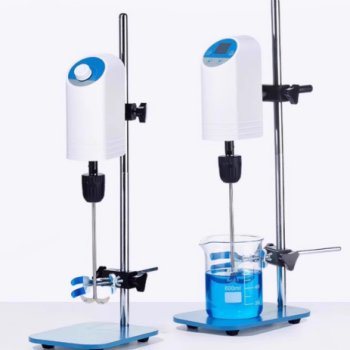
A mechanical stirring device functions by using a motor-driven rod to forcibly integrate reinforcement particles into a molten matrix. In the specific context of Titanium Carbide (TiC) reinforced composites, the device operates at controlled high speeds, such as 150 rpm, to physically mix preheated TiC particles into a molten copper alloy. This mechanical intervention is essential to disperse the particles uniformly before the material undergoes centrifugal casting.
The device’s primary value is not merely mixing, but generating sufficient force to break the gas films surrounding particles and overcome surface tension, ensuring the reinforcement phase is truly wetted by the matrix.
The Mechanics of Particle Incorporation
Motor-Driven Rotation
The core of the system is a high-speed motor connected to a stirring rod submerged within the melt.
This rod provides the kinetic energy necessary to agitate the molten copper alloy. It transforms electrical energy into mechanical shear forces within the liquid.
Controlled Velocity
The reference highlights a specific operational speed of 150 rpm.
maintaining this specific rotational speed is critical. It generates a vortex or flow pattern strong enough to pull particles into the bulk of the melt without causing excessive turbulence that might entrap oxides.
Thermal Preparation
Before the stirring begins, the TiC reinforcement particles are preheated.
While the stirring device does the mixing, this thermal step is a prerequisite. It minimizes the temperature gradient between the particle and the melt, aiding the mechanical stirring process in achieving integration.
Overcoming Physical Barriers
Disrupting the Gas Film
One of the most significant challenges in creating composites is that small particles are often surrounded by a thin layer of gas.
The mechanical stirring device acts to physically break this gas film. By forcibly colliding the melt against the particles, the rod strips away this gaseous barrier, allowing the liquid metal to touch the particle surface.
Conquering Surface Tension
Molten metals have high surface tension, which naturally resists wetting foreign particles like TiC.
The stirring action provides the mechanical force required to overcome this surface tension. It forces the liquid matrix to wet the solid particles, preventing them from simply floating on top or clustering together.
Understanding the Trade-offs
The Necessity of Force vs. Stability
The process relies heavily on the "forcible" nature of the incorporation.
If the stirring speed is too low, the device will fail to break the gas film, leading to particle rejection. However, the process is sensitive; the stirring must be balanced to ensure uniform distribution without damaging the melt quality before the subsequent centrifugal casting step.
Making the Right Choice for Your Goal
To ensure the successful production of TiC particle-reinforced composites, consider how the stirring parameters align with your objectives.
- If your primary focus is Particle Wetting: Ensure the stirring speed is sufficient (e.g., 150 rpm) to generate enough shear force to strip away gas films and overcome surface tension.
- If your primary focus is Material Homogeneity: Verify that the stirring is maintained long enough to achieve a uniform distribution of the reinforcement phase prior to casting.
Mechanical stirring is the bridge that transforms a mixture of solid particles and liquid metal into a cohesive, high-performance composite material.
Summary Table:
| Feature | Function in TiC Melting | Key Benefit |
|---|---|---|
| Motor-Driven Rod | Provides kinetic energy and mechanical shear | Converts energy into fluid motion |
| 150 RPM Velocity | Creates controlled vortex flow | Incorporates particles without oxides |
| Gas Film Disruption | Physically strips gaseous barriers from TiC | Enables direct liquid-to-particle contact |
| Surface Tension Control | Overcomes matrix-to-particle resistance | Ensures wetting and prevents clustering |
| Particle Preheating | Minimizes temperature gradients | Facilitates seamless mechanical integration |
Elevate Your Composite Fabrication with KINTEK Expertise
Successfully integrating TiC particles into molten matrices requires precision, power, and reliable thermal control. KINTEK specializes in advanced laboratory equipment designed for the most demanding material science applications.
Whether you are developing metal matrix composites or conducting high-temperature research, our portfolio offers everything you need for success:
- High-Temperature Furnaces: Induction melting and atmosphere-controlled systems for perfect melt conditions.
- Advanced Processing: High-performance stirring solutions and crushing/milling systems for particle preparation.
- Precision Lab Tools: From vacuum reactors and autoclaves to high-pressure hydraulic presses and specialized ceramics/crucibles.
Don't let poor wetting or non-uniform distribution compromise your research. Our team of experts is ready to help you select the ideal equipment to achieve superior material homogeneity.
Contact KINTEK today to optimize your melting and stirring processes!
References
- N. Radhika, S. Thirumalini. Experimental Studies on Mechanical and Wear Behaviour of TiC Reinforced Cu-Sn-Ni Functionally Graded Composite. DOI: 10.24874/ti.2019.41.04.07
This article is also based on technical information from Kintek Solution Knowledge Base .
Related Products
- Laboratory Small Constant Temperature Heated Magnetic Stirrer Heater and Stirrer
- High Performance Laboratory Stirrers for Diverse Applications
- Custom PTFE Teflon Parts Manufacturer for Magnetic Stirring Bar
- Laboratory Multifunctional Small Speed-Adjustable Horizontal Mechanical Shaker for Lab
- Laboratory Vibratory Sieve Shaker Machine Slap Vibrating Sieve
People Also Ask
- What role does a magnetic stirrer with heating play in ZnO nanoparticle synthesis? Precision Control for Quality Results
- What role does a constant temperature heating magnetic stirrer play in MFC-HAp synthesis? Achieve Material Homogeneity
- What is the function of a laboratory magnetic stirrer in Ni–Cr–P electrodeposition? Optimize Ion Transport & Coating
- Why is a laboratory magnetic stirrer required for benzoic acid esters? Boost Reaction Speed & Yield with High RPM
- What role does a laboratory magnetic stirrer play in TiO2 and TiO2-Ag sol preparation? Master Chemical Kinetics