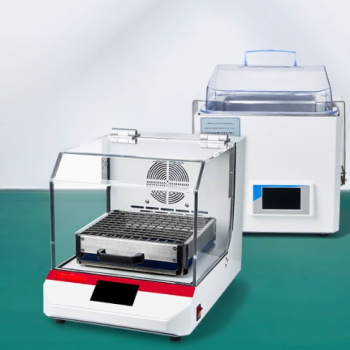
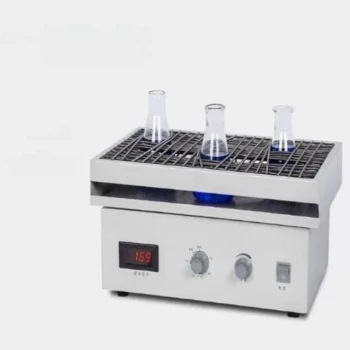
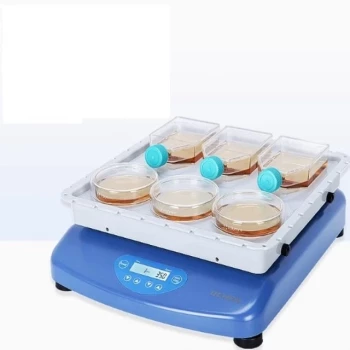
A microplate shaker is the primary safeguard against experimental error caused by particle sedimentation in nanocomposite studies. By maintaining a constant oscillation speed, typically between 50 and 100 rpm, it keeps high-density nanoparticles suspended in the solution. This continuous motion ensures that the bacterial suspension maintains uniform contact with the antimicrobial agent, preventing the agent from settling out of the reaction zone.
Without consistent mechanical mixing, high-density nanoparticles will settle at the bottom of the well, failing to interact effectively with the bacteria. The microplate shaker creates a homogenous environment that is essential for generating accurate and reproducible Minimum Inhibitory Concentration (MIC) data.
The Mechanics of Suspension Stability
Overcoming Particle Sedimentation
Nanocomposites often possess a higher density than the bacterial culture media they are suspended in. Without intervention, gravity causes these particles to sink to the bottom of the 96-well plate.
A microplate shaker counteracts this natural settling process. By applying constant mechanical oscillation, it forces the particles to remain in a dynamic, suspended state throughout the incubation period.
Maximizing Contact Efficiency
For an antimicrobial agent to be effective, it must physically encounter the target pathogen.
Continuous mixing ensures maximum surface area contact between the nanocomposite material and bacteria such as Escherichia coli and Staphylococcus aureus. This prevents "dead zones" in the well where bacteria might grow unchecked simply because the antimicrobial agent has settled elsewhere.
Impact on Data Integrity
Ensuring Accurate MIC90 Values
The validity of MIC90 values—the concentration inhibiting 90% of bacterial growth—relies on the assumption that the concentration is uniform throughout the well.
If the nanocomposite settles, the effective concentration in the bulk liquid drops, potentially leading to artificially high MIC results (false resistance). The shaker maintains the actual concentration gradient, ensuring the observed inhibition corresponds to the intended dosage.
Consistency Across Concentration Gradients
When evaluating bactericidal effects across different concentrations, variables must be isolated.
A microplate shaker ensures that mixing physics remains constant across all wells. This allows researchers to attribute differences in bacterial growth strictly to the chemical concentration of the nanocomposite, rather than variations in particle settling rates.
Understanding the Trade-offs
The Importance of Speed Regulation
While mixing is critical, the specific speed range is equally important.
The reference emphasizes a range of 50-100 rpm. This specific window provides enough energy to prevent settling but likely avoids excessive turbulence that could splash the medium or mechanically stress the bacteria independent of the nanocomposite's effect. operating outside this "sweet spot" can introduce new variables that compromise data accuracy.
Making the Right Choice for Your Goal
To ensure the reliability of your MIC experiments, apply the following principles based on your specific objectives:
- If your primary focus is preventing false negatives: Maintain a continuous shaker speed of 50-100 rpm to ensure high-density nanoparticles do not settle away from the bacteria.
- If your primary focus is comparative accuracy: Use consistent mechanical oscillation to guarantee that inhibition data reflects true chemical potency rather than physical distribution issues.
Proper mechanical mixing transforms a heterogeneous mixture into a reliable, quantifiable experimental system.
Summary Table:
| Feature | Impact on MIC Accuracy | Optimization Goal |
|---|---|---|
| Particle Suspension | Prevents sedimentation of high-density nanocomposites | Uniform distribution in 96-well plates |
| Contact Efficiency | Maximizes interaction between bacteria and antimicrobial agents | Eliminates "dead zones" for growth |
| Concentration Gradient | Ensures actual dosage matches intended concentration | Prevents false resistance (high MIC values) |
| Speed Control | Maintains 50-100 rpm to avoid medium splashing | Isolated chemical effects from mechanical stress |
Elevate Your Research Precision with KINTEK
Consistency is the backbone of groundbreaking laboratory research. At KINTEK, we understand that even the smallest variable—like particle sedimentation—can compromise your Minimum Inhibitory Concentration (MIC) data. Our advanced range of shakers and homogenizers is engineered to provide the precise oscillation speeds necessary to keep your nanocomposites in perfect suspension, ensuring every result is accurate and reproducible.
Beyond mixing solutions, KINTEK offers a comprehensive portfolio for your lab, including high-temperature furnaces, hydraulic presses, and specialized consumables like PTFE products and ceramics. Whether you are conducting antimicrobial studies or advanced material synthesis, our expert team is ready to provide the high-performance tools your project demands.
Ready to eliminate experimental error? Contact KINTEK today to discover how our laboratory equipment can optimize your experimental workflows and enhance your data integrity.
References
- Maryam Azizi‐Lalabadi, Mahmood Alizadeh Sani. Antimicrobial activity of Titanium dioxide and Zinc oxide nanoparticles supported in 4A zeolite and evaluation the morphological characteristic. DOI: 10.1038/s41598-019-54025-0
This article is also based on technical information from Kintek Solution Knowledge Base .
Related Products
- Laboratory Test Sieves and Vibratory Sieve Shaker Machine
- Laboratory Vibratory Sieve Shaker Machine for Dry and Wet Three-Dimensional Sieving
- Shaking Incubators for Diverse Laboratory Applications
- Laboratory Multifunctional Small Speed-Adjustable Horizontal Mechanical Shaker for Lab
- Laboratory Vibratory Sieve Shaker Machine Slap Vibrating Sieve
People Also Ask
- How does a laboratory vibratory sieve shaker facilitate the microstructural study of gas-atomized alloy powders?
- What role does a laboratory vibrating sieve shaker play in the LiFePO4 powder processing workflow? Ensure Batch Quality
- What is the use of vibratory sieve shaker? Achieve Precise Particle Size Analysis for Your Lab
- How is a vibratory sieve shaker used in the particle size analysis of mechanically alloyed powders? Expert Guide
- Why use a vibratory sieve shaker for PET powder? Achieve Precise Particle Size Control for Chemical Research