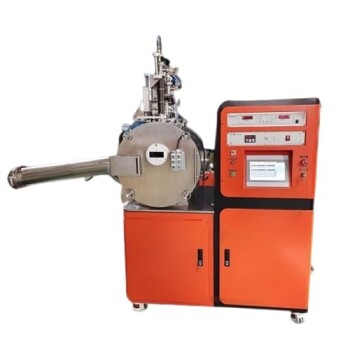
A smart pressure controller operates as the dynamic regulator of the reaction environment. It functions by actively modulating an inlet valve in coordination with a vacuum pump to hold the system pressure at a rigid set value, typically within a tight tolerance like 1 KPa ± 0.05 KPa. This automated intervention ensures that the vacuum level remains constant, regardless of the fluctuating gas volumes produced during the carbothermic reduction process.
Precise pressure control is not merely a safety measure; it is the critical variable that synchronizes magnesium vapor generation with condensation rates while preventing efficiency-killing reverse reactions.
The Mechanics of Regulation
The Feedback Loop
The controller continuously monitors the internal pressure of the reaction chamber.
It compares the real-time reading against the target set point (e.g., 1 KPa).
Coordinating Hardware
To maintain this target, the controller signals the inlet valve to open or close incrementally.
Simultaneously, it works in conjunction with the vacuum pump to evacuate excess gas or maintain the required vacuum level.
Precision Tolerance
The system is designed to handle very specific parameters, maintaining stability within a margin of ± 0.05 KPa.
This high level of precision prevents the wide pressure swings that often occur in manual or less sophisticated systems.
Optimizing the Carbothermic Reaction
Balancing Reaction Rates
The primary goal of this regulation is to balance the rate of magnesium vapor generation with the rate of condensation.
If the pressure is too high, vapor generation may be suppressed; if too low, condensation efficiency may suffer.
The smart controller finds the exact equilibrium required for maximum throughput.
Inhibiting Reverse Reactions
In vacuum carbothermic reduction, there is a risk of the reaction reversing, causing the magnesium vapor to revert to its oxidized state.
By locking the pressure at a specific constant, the controller creates an environment that inhibits these reverse reactions.
This ensures that the forward reaction dominates, preserving the yield and purity of the magnesium.
Understanding the Trade-offs
Response Time vs. Stability
A controller set for extreme sensitivity may react to minor noise, causing the valves to open and close too rapidly.
This "hunting" behavior can lead to mechanical wear on the inlet valve without improving process quality.
Reliance on Mechanical Integrity
The smart controller is entirely dependent on the physical capacity of the vacuum pump and the sealing of the system.
If the pump is undersized or a seal leaks, the controller cannot compensate via software logic alone.
Making the Right Choice for Your Goal
To maximize the effectiveness of a smart pressure controller in your system, consider your specific production priorities.
- If your primary focus is maximizing yield: Set the controller to the lowest pressure possible within the 1 KPa range to encourage vapor generation, ensuring the variance stays within the ± 0.05 KPa limit to prevent reversion.
- If your primary focus is equipment longevity: Widen the response delay slightly to prevent the inlet valve from oscillating rapidly, reducing mechanical wear while maintaining acceptable pressure averages.
Success in carbothermic reduction depends not just on achieving a vacuum, but on sustaining a stable, precise pressure environment that protects your chemical reaction.
Summary Table:
| Feature | Function in Carbothermic Reduction | Impact on Process |
|---|---|---|
| Set Point Regulation | Maintains rigid 1 KPa target | Synchronizes vapor generation & condensation |
| Feedback Loop | Real-time monitoring vs. target | Prevents efficiency-killing pressure swings |
| Valve Coordination | Modulates inlet valve & vacuum pump | Inhibits reverse oxidation reactions |
| Precision Tolerance | Tight margin (±0.05 KPa) | Ensures high purity and maximum throughput |
Precision Control for Superior Lab Results
Maximize your magnesium yield and ensure reaction stability with KINTEK’s advanced laboratory solutions. Whether you are conducting vacuum carbothermic reduction or complex CVD/PECVD processes, KINTEK provides the high-performance tools you need.
Our extensive portfolio includes:
- High-Temperature Furnaces: Muffle, tube, and vacuum systems designed for thermal precision.
- Reaction Vessels: High-temperature high-pressure reactors and autoclaves for demanding environments.
- Pressure Management: Advanced vacuum systems and smart controllers for stable reaction environments.
- Material Processing: Precision crushing, milling, and hydraulic presses (pellet, hot, isostatic) for sample preparation.
Ready to elevate your research efficiency? Contact KINTEK today to discover how our specialized equipment and consumables can optimize your laboratory workflow.
Related Products
- Split Chamber CVD Tube Furnace with Vacuum Station Chemical Vapor Deposition System Equipment Machine
- Customizable CO2 Reduction Flow Cell for NRR ORR and CO2RR Research
- Chemical Vapor Deposition CVD Equipment System Chamber Slide PECVD Tube Furnace with Liquid Gasifier PECVD Machine
- Customer Made Versatile CVD Tube Furnace Chemical Vapor Deposition Chamber System Equipment
- Vacuum Induction Melting Spinning System Arc Melting Furnace
People Also Ask
- What is the function of a tube furnace in CVD SiC synthesis? Achieving Ultra-Pure Silicon Carbide Powders
- What is a CVD tube furnace? A Complete Guide to Thin-Film Deposition
- What are the technical advantages of using a CVD tube furnace? Optimize Silicon-Carbon Battery Anodes
- What is the function of a high-temperature CVD tube furnace in 3D graphene foam prep? Master 3D Nanomaterial Growth
- How does a CVD tube furnace inhibit the sintering of silver supports? Boost Membrane Durability and Performance