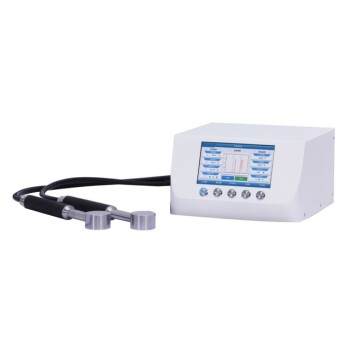
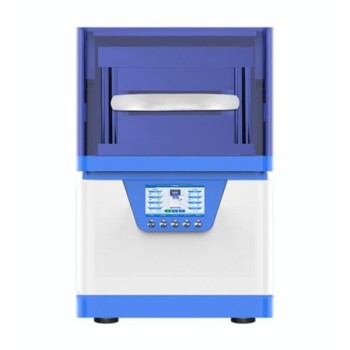
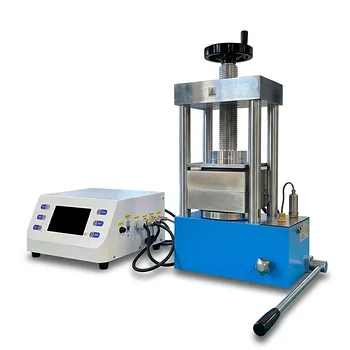
The fundamental role of a high-precision laboratory hydraulic press equipped with heating plates is to generate a dual-variable environment for testing welded copper components. It applies a constant compression load while simultaneously introducing controlled gradient contact temperatures. This specific combination allows for the accurate simulation of complex, real-world working conditions within a controlled laboratory setting.
Core Takeaway By strictly controlling both pressure and thermal cycles, this setup enables the isolation and observation of residual stress initiation and evolution specifically within the weld zone.
Simulating Complex Working Conditions
The Role of Constant Compression
The hydraulic aspect of the press ensures that the copper specimen is subjected to a steady, unyielding mechanical load. This mimics the constant physical pressure the component would endure in structural or industrial applications.
Creating Thermal Gradients
The integrated heating plates are not merely for bulk heating; they provide gradient contact temperatures. This allows researchers to study how heat flows across the weld interface while the material is under physical deformation.
Replicating Operational Stress
By combining these two factors, the equipment recreates the specific thermo-mechanical cycles a component faces in service. This moves the experiment beyond simple strength testing into realistic performance simulation.
Uncovering Material Behaviors
Tracking Residual Stresses
The primary analytical goal is to observe the lifecycle of residual stresses. The equipment facilitates the monitoring of how these internal stresses begin and grow during the specific pressure and thermal cycles.
Focusing on the Weld Zone
The study specifically targets the weld zone, which is often the most vulnerable area of the component due to metallurgical changes. The setup isolates this region to determine how it reacts to simultaneous thermal and mechanical stress.
Important Considerations and Trade-offs
Simulation Limits
While high-precision, this remains a simulation of boundary conditions. It isolates specific variables to ensure clarity, which may oversimplify the chaotic interactions found in a total operational environment.
Calibration Complexity
Achieving precise thermal gradients while maintaining constant hydraulic pressure requires rigorous equipment calibration. Any fluctuation in the heating plate uniformity can significantly skew the data regarding stress evolution.
Making the Right Choice for Your Research
- If your primary focus is Stress Evolution: Ensure your experimental setup prioritizes the stability of the constant compression load to isolate the effects of thermal changes on stress initiation.
- If your primary focus is Operational Simulation: Utilize the heating plates to rigorously replicate the specific thermal gradients found in the component's actual working environment, rather than applying uniform heat.
Precise control over both heat and pressure is the only way to accurately predict the failure points of welded copper under load.
Summary Table:
| Feature | Function in Hot Compression Experiments | Impact on Welded Copper |
|---|---|---|
| Constant Compression | Applies a steady, unyielding mechanical load | Mimics real-world structural pressure |
| Heating Plates | Provides controlled gradient contact temperatures | Replicates operational thermal environments |
| Precision Control | Maintains dual-variable stability (Heat + Pressure) | Isolates residual stress initiation points |
| Weld Zone Focus | Targets the metallurgical transition area | Identifies potential failure points under stress |
Elevate Your Material Research with KINTEK Precision
Precise control over thermo-mechanical variables is essential for predicting material failure. KINTEK specializes in advanced laboratory equipment designed for the most demanding research environments. From high-precision hydraulic presses (pellet, hot, isostatic) to high-temperature furnaces and crushing systems, we provide the tools you need for accurate, repeatable results.
Whether you are studying residual stress in welded components or developing next-generation materials, our expert team is ready to support your lab with customized solutions and high-quality consumables like PTFE products, ceramics, and crucibles.
Contact KINTEK today to optimize your experimental setup!
References
- Ayman Abu Ghazal, Khaled SHATNAWI. Study of the Contact Thermal Compression Behavior of Copper using Scanning Contact Potentiometry Method and Finite Element Analysis. DOI: 10.48048/wjst.2021.22795
This article is also based on technical information from Kintek Solution Knowledge Base .
Related Products
- Automatic High Temperature Heated Hydraulic Press Machine with Heated Plates for Lab
- Manual High Temperature Heated Hydraulic Press Machine with Heated Plates for Lab
- 24T 30T 60T Heated Hydraulic Press Machine with Heated Plates for Laboratory Hot Press
- Automatic Heated Hydraulic Press Machine with Heated Plates for Laboratory Hot Press 25T 30T 50T
- Automatic Heated Hydraulic Press Machine with Heated Plates for Laboratory Hot Press
People Also Ask
- What is a heated hydraulic press used for? Essential Tool for Curing, Molding, and Laminating
- Why is a heated hydraulic press used for warm pressing NASICON green tapes? Optimize Your Solid Electrolyte Density
- Why is a heated laboratory hydraulic press necessary for composite laminates? Achieve Void-Free Structural Integrity
- What is a hot hydraulic press? Harness Heat and Pressure for Advanced Manufacturing
- What is the core function of a laboratory heated hydraulic press in CSP? Revolutionize Low-Temp Ceramic Sintering