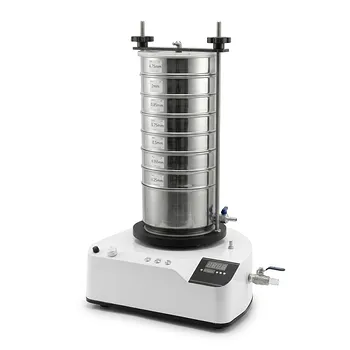
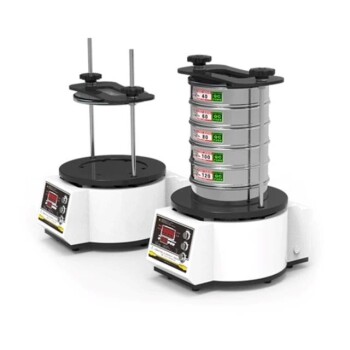
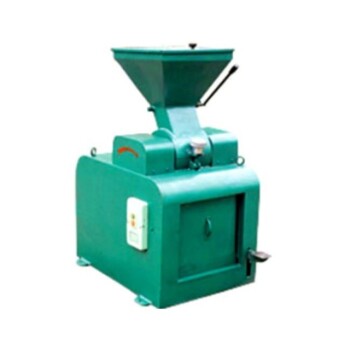
The standard laboratory test sieve is the primary tool for ensuring particle size uniformity during the preparation of biomass charcoal powder. By grading ground biomass or pre-carbonized materials through precise mesh openings, the sieve eliminates oversized particles and narrows the size distribution range. This precision is fundamental to controlling heat transfer rates, chemical reactivity, and the physical structural integrity of the final charcoal product.
A laboratory test sieve ensures a consistent particle size distribution, which is the foundational requirement for achieving uniform heat conduction during pyrolysis and maintaining a predictable pore structure in biomass-derived carbon.
Achieving Uniform Heat Transfer and Carbonization
Ensuring Even Heat Conduction
During the pyrolysis process, heat must penetrate the center of each particle. A standard sieve, such as a 100-mesh sieve, ensures that all particles are within a specific size range, preventing larger particles from under-carbonizing while smaller ones over-react.
Maintaining Consistent Residence Time
In industrial simulations or furnace testing, uniform particle size ensures that each grain experiences the same residence time and heating conditions. This eliminates variables that could skew data regarding combustion efficiency or emission results.
Promoting Structural Uniformity
Consistent particle sizes lead to a regular pore structure within the biochar substrate. This structural harmony is essential for applications requiring specific adsorption properties or consistent performance characteristics in the final carbon material.
Enhancing Physical Properties and Stability
Eliminating Stress Concentration Points
When charcoal powder is pressed into briquettes or pellets, the presence of large, outlier particles can create stress concentration points. By using a sieve to classify the powder, manufacturers ensure a smoother distribution that improves the macroscopic physical properties and fracture resistance of the final product.
Improving Molding Density and Aesthetics
A uniform powder, often graded to 60-mesh or 100-mesh, allows for tighter packing during the mixing and molding phases. This leads to a higher molding density and a more consistent aesthetic appearance, which is critical for commercial biomass products.
Stabilizing Combustion Rates
Particle size directly influences how oxygen interacts with the fuel during burning. By precisely controlling the size distribution, sieving ensures a stable combustion rate, preventing flare-ups or inconsistent energy output in biomass pellets.
Optimizing Surface Activity and Reactivity
Increasing Specific Surface Area
Finer sieving, such as using a 200-mesh sieve, increases the total specific surface area available for chemical reactions. This is particularly important for bamboo charcoal or coconut shell charcoal intended for environmental remediation or modification processes.
Ensuring Chemical Reactivity Consistency
A narrow particle size distribution, such as the 75 µm to 120 µm range, ensures that biomass materials have consistent reactivity during modification reactions. This uniformity guarantees that the final biochar quality is reproducible across different batches.
Facilitating Homogeneous Mixing
When biomass is co-fired with other fuels like coal or sorghum, sieving ensures that the different materials can be mixed uniformly. This prevents stratification and ensures that the thermal characteristics of the blend remain predictable.
Understanding the Trade-offs and Limitations
The Risk of Sieve Blinding
When processing oily or moisture-rich biomass charcoal, fine mesh screens are prone to blinding (clogging). This can lead to inaccurate grading and requires the use of specialized cleaning methods or vibrating sieves to maintain throughput.
Mechanical Degradation During Sieving
Extended sieving times can cause particle attrition, where the charcoal particles rub against each other and the mesh, breaking down into even finer dust. This can inadvertently shift the particle size distribution away from the intended specification.
Balance Between Fineness and Cost
While finer powders offer higher reactivity, the energy and time required to grind and sieve charcoal to extremely fine levels (e.g., sub-75 microns) increase exponentially. Developers must balance the functional benefits of finer particles against the increased production costs.
How to Apply This to Your Project
Making the Right Choice for Your Goal
- If your primary focus is high-quality biochar production: Use a sieve to strictly control particle size prior to pyrolysis to ensure uniform heat conduction and a regular pore structure.
- If your primary focus is manufacturing biomass briquettes: Prioritize sieving to eliminate large particles that cause structural weaknesses and inconsistent combustion rates.
- If your primary focus is laboratory research or simulation: Utilize high-precision vibrating sieves to achieve a narrow distribution range, ensuring the repeatability of your experimental data.
- If your primary focus is environmental adsorption/remediation: Focus on achieving a high mesh count (e.g., 200-mesh) to maximize the specific surface area and reaction activity of the charcoal.
Precise particle size control through standardized sieving is the bridge between raw biomass and a high-performance, predictable charcoal product.
Summary Table:
| Application Area | Benefit of Sieving | Impact on Charcoal Quality |
|---|---|---|
| Pyrolysis | Uniform heat conduction | Prevents under/over-carbonization and ensures regular pore structure. |
| Briquette Molding | Eliminates stress points | Improves molding density, structural integrity, and fracture resistance. |
| Chemical Reactivity | Increases specific surface area | Enhances adsorption properties for environmental remediation. |
| Combustion | Controls size distribution | Ensures stable burning rates and prevents inconsistent energy output. |
| Data Accuracy | Narrows distribution range | Guarantees repeatability in laboratory research and industrial simulations. |
Elevate Your Biomass Research with KINTEK Precision
Achieving high-performance biomass charcoal requires more than just raw materials—it demands rigorous particle size control and precise thermal processing. KINTEK specializes in providing the high-quality laboratory equipment needed to refine your production process.
From our precision sieving equipment and crushing and milling systems that ensure perfect particle grading, to our advanced high-temperature furnaces (muffle, tube, and vacuum) designed for uniform carbonization, we offer a comprehensive suite of solutions for carbon material researchers.
Why choose KINTEK?
- Comprehensive Range: We provide everything from sieves and hydraulic presses to high-pressure reactors and autoclaves.
- Precision & Reliability: Our tools are engineered to eliminate variables, ensuring your data is repeatable and your products are consistent.
- Expert Support: We help you balance functional benefits with production efficiency.
Ready to optimize your biomass-to-charcoal workflow? Contact our technical team today to find the perfect equipment for your laboratory.
References
- Jianhui Zhao, Shaopo Wang. Cu/CuO-Decorated Peanut-Shell-Derived Biochar for the Efficient Degradation of Tetracycline via Peroxymonosulfate Activation. DOI: 10.3390/catal13091246
This article is also based on technical information from Kintek Solution Knowledge Base .
Related Products
- Laboratory Test Sieves and Sieving Machines
- Laboratory Test Sieves and Vibratory Sieve Shaker Machine
- Laboratory Vibratory Sieve Shaker Machine Slap Vibrating Sieve
- Laboratory Vibratory Sieve Shaker Machine for Dry and Wet Three-Dimensional Sieving
- Laboratory Wet Three-Dimensional Vibratory Sieve Shaker Machine
People Also Ask
- What are laboratory test sieves used for? A Guide to Particle Size Analysis
- How do you calculate the sieve test? Master Particle Size Distribution for Quality Control
- What are the specifications for test sieves? A Guide to ASTM & ISO Standards for Accurate Particle Analysis
- What materials are required for sieving? Achieve Accurate Particle Size Analysis
- What is the difference between ASTM standards sieves and is standard sieves? Ensure Compliance for Your Lab