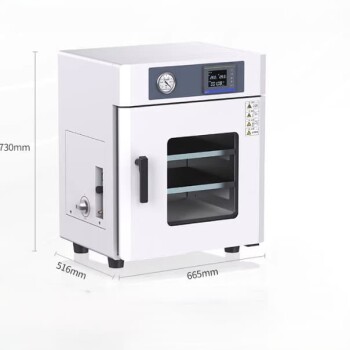
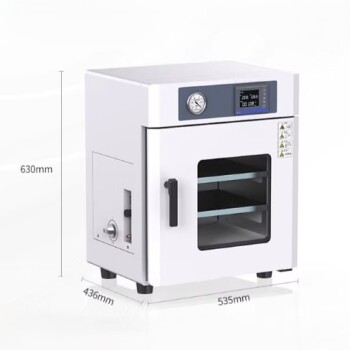
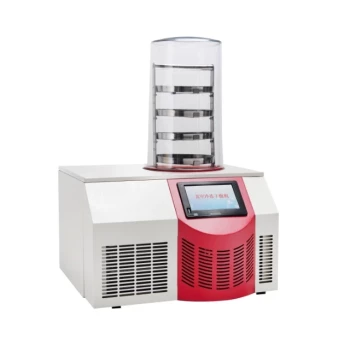
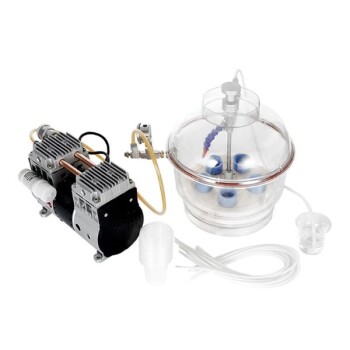
A vacuum drying oven functions by lowering the ambient pressure to facilitate solvent evaporation, allowing the SnO2/MoS2 catalyst to dry efficiently at a controlled temperature of 70 °C. In this final preparation stage, the equipment serves as a preservation tool, ensuring that the removal of residual solvents from nanopores does not compromise the material's chemical or structural stability.
Core Takeaway The vacuum drying process is essential for SnO2/MoS2 catalysts because it decouples drying from high heat and oxygen exposure. This method preserves the chemical potential of active sites by preventing oxidation and maintains the physical architecture of nanosheet arrays by mitigating damaging capillary forces.
The Critical Role of Vacuum Drying
The final drying stage is not merely about removing moisture; it is about defining the catalyst's final properties. For SnO2/MoS2 heterostructures, the vacuum oven addresses three specific challenges that standard convection drying cannot resolve.
Efficient Solvent Removal at Low Temperatures
The primary function of the oven is to remove residual solvents trapped deep within the catalyst's nanopores.
Under standard atmospheric pressure, effectively clearing these pores often requires temperatures well above 100 °C. However, by reducing the internal pressure, the vacuum oven lowers the boiling point of the solvents, allowing for rapid volatilization at a much gentler 70 °C.
Prevention of Surface Oxidation
SnO2/MoS2 catalysts rely on specific "active sites" on their surface to facilitate chemical reactions.
In a standard high-temperature air environment, oxygen can react with these sites prematurely. The vacuum environment eliminates the presence of oxygen during the heating process. This ensures that the active sites remain unoxidized and chemically potent for their intended application.
Preservation of Structural Integrity
The physical structure of this catalyst consists of delicate nanosheet arrays.
During standard drying, liquid evaporating from pores can generate significant capillary forces, which may cause these fine structures to collapse or the pores to close. Vacuum drying mitigates these forces, ensuring the nanosheets remain intact and the surface area remains maximized for future catalytic activity.
Understanding the Trade-offs
While vacuum drying offers superior protection for delicate structures, it is important to understand how it contrasts with other methods to ensure it is the correct choice for your specific needs.
Vacuum vs. Forced Air Convection
For robust materials like dolomite or simple catalyst precursors, a forced-air oven operating at 105–115 °C is often sufficient.
Forced air utilizes convection to dry materials quickly, but it introduces oxygen and higher thermal stress. For SnO2/MoS2, the speed of forced air is a liability; the vacuum method trades speed for the preservation of delicate chemical states and pore structures.
Temperature Precision vs. Phase Change
It is critical to distinguish between the drying stage and the synthesis stage.
While a high-precision oven might be used at 200 °C for the synthesis (reaction) of SnO2/MoS2 to control phase transformation, the drying stage discussed here must remain at 70 °C. Exceeding this temperature during drying could inadvertently trigger unwanted phase changes or sintering before the catalyst is ready.
Making the Right Choice for Your Goal
The choice of drying method dictates the final quality of your catalyst. When handling SnO2/MoS2, apply the following principles:
- If your primary focus is preserving active sites: Prioritize the vacuum environment to eliminate oxygen, preventing the "accidental oxidation" that degrades catalytic performance.
- If your primary focus is structural stability: Rely on the low-temperature (70 °C) vacuum setting to minimize capillary tension and prevent the collapse of nanosheet arrays.
By utilizing vacuum drying, you ensure the catalyst transitions from a wet precursor to a high-performance active material without suffering thermal or oxidative damage.
Summary Table:
| Feature | Vacuum Drying (70 °C) | Standard Convection (105-115 °C) |
|---|---|---|
| Mechanism | Pressure reduction to lower boiling point | High-temperature thermal evaporation |
| Oxygen Exposure | Minimal (Vacuum environment) | High (Forced air) |
| Structural Impact | Preserves nanosheet arrays/nanopores | Risk of pore collapse/capillary damage |
| Active Sites | Protected from premature oxidation | Potential for oxidative degradation |
| Best Use Case | Delicate SnO2/MoS2 heterostructures | Robust precursors & dolomite |
Elevate Your Material Research with KINTEK
Precision is paramount when preparing advanced SnO2/MoS2 catalysts. At KINTEK, we understand that the final drying stage defines your material's performance. Our high-performance vacuum drying ovens are designed to provide the stable thermal environments and reliable vacuum levels necessary to preserve active sites and delicate nanosheet architectures.
Beyond drying, KINTEK specializes in a comprehensive range of laboratory equipment including:
- High-Temperature Furnaces: Muffle, tube, and vacuum systems for precise synthesis.
- Processing Tools: Crushing, milling, and hydraulic presses (pellet, hot, isostatic).
- Advanced Reactors: High-temperature high-pressure reactors and autoclaves.
- Battery Research: Specialized tools, electrolytic cells, and cooling solutions.
Ready to ensure the integrity of your next-generation catalysts? Contact KINTEK today to discover how our expert-grade equipment can optimize your laboratory workflow.
References
- Kun Huang, Fangzhi Huang. Super-stable SnO<sub>2</sub>/MoS<sub>2</sub> enhanced the electrocatalytic hydrogen evolution in acidic environments. DOI: 10.1039/d2ra03627d
This article is also based on technical information from Kintek Solution Knowledge Base .
Related Products
- 56L Vertical Laboratory Vacuum Drying Oven
- 23L Laboratory Vacuum Drying Oven
- Laboratory Scientific Electric Heating Blast Drying Oven
- Benchtop Laboratory Vacuum Freeze Dryer
- Dental Porcelain Zirconia Sintering Ceramic Vacuum Press Furnace
People Also Ask
- Why is a laboratory vacuum drying oven recommended for rice straw residues? Protect Your Biomass Integrity
- What role does a laboratory vacuum drying oven play in the preparation of modified multi-walled carbon nanotubes?
- What is the importance of using a laboratory vacuum drying oven? Preserving Slow-Release Microcapsule Integrity
- Why is a Laboratory Vacuum Drying Oven recommended for PBAT microspheres? Protect Sensitive Polymer Integrity
- What role does a laboratory vacuum drying oven play in processing nanoparticle powder samples? Protect Sample Integrity