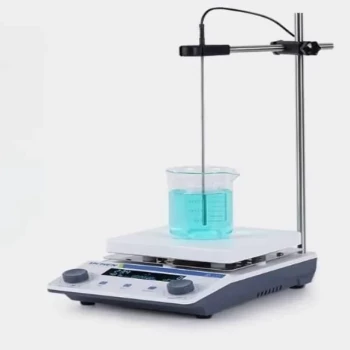
The integration of a magnetic stirring system significantly enhances experimental fidelity by enforcing continuous fluid flow throughout the high-pressure reactor. This mechanical action eliminates localized concentration gradients, ensuring consistent and thorough contact between the carbon dioxide, formation water, and carbonate rock powders.
The primary influence of magnetic stirring is the enhancement of mass transfer, which drives the multiphase system to chemical equilibrium rapidly. This capability allows researchers to observe critical mineral transformations without necessitating prohibitively long experimental durations.
Driving Chemical Efficiency
Removing Static Barriers
In static systems, chemical reactions can slow down as reactants deplete in the immediate vicinity of the rock surface.
An integrated magnetic stirrer creates continuous fluid flow, which constantly refreshes the fluid at the rock interface. This prevents the formation of stagnant layers that would otherwise inhibit reaction progress.
Maximizing Interfacial Contact
The geochemical process involves a complex interaction between three phases: gas (CO2), liquid (formation water), and solid (rock powders).
Stirring ensures these components remain in a state of thorough contact. This prevents phase separation and ensures the entire rock sample is exposed to uniform chemical conditions.
Accelerating Research Outcomes
Shortening Time to Equilibrium
The rate at which a system reaches a stable state is governed by mass transfer.
By mechanically enhancing this process, the stirring system allows the reactor to reach chemical equilibrium much faster than diffusion-dominated setups. This efficiency is critical for time-sensitive research.
Observing Trends Sooner
Mineral transformations in carbonate rocks can be geologically slow processes.
However, the enhanced kinetics provided by stirring enable the observation of significant mineral transformation trends within a feasible experimental window. This makes it possible to model long-term geochemical behaviors in a short-term laboratory setting.
Understanding the Trade-offs
Mechanical Attrition
While vigorous mixing is essential for chemical homogeneity, it introduces physical energy to the system.
Continuous stirring of rock powders may cause physical attrition, essentially grinding the particles further. This could inadvertently increase the reactive surface area during the experiment, a variable that should be accounted for when analyzing rates of dissolution or precipitation.
Making the Right Choice for Your Goal
To maximize the utility of your high-pressure reactor experiments, align the use of the stirring system with your specific research objectives:
- If your primary focus is Rapid Kinetic Assessment: Utilize the stirring system to eliminate diffusion limitations and reach equilibrium quickly, allowing you to screen for mineral changes efficiently.
- If your primary focus is Simulating High-Flow Aquifers: The stirring system effectively mimics dynamic subsurface conditions where fluid flow drives continuous chemical interaction.
By eliminating concentration gradients, the magnetic stirring system transforms a static vessel into a dynamic environment that yields faster, more uniform geochemical data.
Summary Table:
| Feature | Impact on Geochemical Outcomes | Research Benefit |
|---|---|---|
| Fluid Dynamics | Eliminates localized concentration gradients | Ensures consistent chemical environments |
| Mass Transfer | Enhances interaction between CO2, water, and rock | Rapidly drives system to chemical equilibrium |
| Phase Contact | Maximizes gas-liquid-solid interfacial contact | Prevents phase separation and stagnant layers |
| Reaction Kinetics | Overcomes diffusion-limited barriers | Enables observation of mineral trends in shorter windows |
| Physical Energy | May cause mechanical attrition of rock powders | Provides data for dynamic, high-flow aquifer simulation |
Elevate Your Geochemical Research with KINTEK Precision
Unlock the full potential of your high-pressure experiments with KINTEK’s advanced high-temperature high-pressure reactors and autoclaves. Specifically designed for demanding research environments, our integrated magnetic stirring systems ensure uniform fluid flow and accelerated mass transfer, crucial for accurate mineral transformation studies.
Whether you are focusing on carbon sequestration, battery research, or material synthesis, KINTEK provides a comprehensive range of laboratory solutions—from crushing and milling systems for sample preparation to cooling solutions and specialized consumables like PTFE and ceramics.
Ready to transform your static experiments into dynamic research breakthroughs? Contact KINTEK today to consult with our experts and find the perfect high-pressure reactor setup for your lab’s unique needs!
References
- Kaisar Ahmat, Jie Li. CO2-Water-Rock Interactions in Carbonate Formations at the Tazhong Uplift, Tarim Basin, China. DOI: 10.3390/min12050635
This article is also based on technical information from Kintek Solution Knowledge Base .
Related Products
- Laboratory Small Constant Temperature Heated Magnetic Stirrer Heater and Stirrer
- Mini SS High Pressure Autoclave Reactor for Laboratory Use
- Stainless High Pressure Autoclave Reactor Laboratory Pressure Reactor
- Customizable High Pressure Reactors for Advanced Scientific and Industrial Applications
- Customizable Laboratory High Temperature High Pressure Reactors for Diverse Scientific Applications
People Also Ask
- What role does a magnetic stirrer with heating play in ZnO nanoparticle synthesis? Precision Control for Quality Results
- What role does a constant temperature heating magnetic stirrer play in MFC-HAp synthesis? Achieve Material Homogeneity
- What is the function of a laboratory magnetic stirrer in Ni–Cr–P electrodeposition? Optimize Ion Transport & Coating
- Why is a laboratory magnetic stirrer required for benzoic acid esters? Boost Reaction Speed & Yield with High RPM
- What role does a laboratory magnetic stirrer play in TiO2 and TiO2-Ag sol preparation? Master Chemical Kinetics