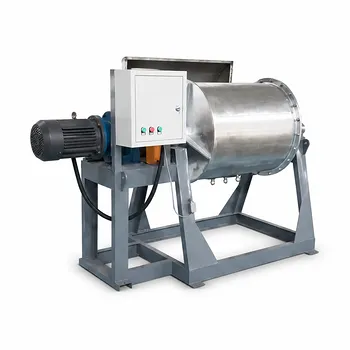
High-energy mechanical ball milling acts as a critical structural modifier that directly enhances the photocatalytic capabilities of cobalt ferrite (CoFe2O4). By subjecting the material to intense impact and shear forces, this process reduces particles to the nanometer scale while simultaneously engineering beneficial defects within the crystal lattice.
High-energy milling does more than just grind material; it fundamentally alters surface chemistry by creating oxygen vacancies. These defects serve as active sites that improve molecular adsorption, leading to higher efficiency in hydrogen production under visible light.
The Physical Mechanism of Enhancement
Application of Intense Forces
The process relies on the interaction between grinding media (balls) and the cobalt ferrite. The equipment generates intense impact and shear forces that are transferred directly to the material.
Reduction to the Nanoscale
These mechanical forces physically break down the cobalt ferrite particles. The result is a reduction in particle size down to the nanometer scale, which significantly increases the specific surface area available for reactions.
Defect Engineering and Chemical Reactivity
Creation of Oxygen Vacancies
Beyond simple size reduction, the mechanical stress induces specific structural changes. The process creates numerous vacancy defects, specifically oxygen vacancies, within the cobalt ferrite crystal lattice.
Breaking Chemical Bonds
The intense mechanical force is sufficient to break chemical bonds within the material structure. This disruption is necessary to introduce the structural defects that alter the material's electronic properties.
Enhanced Adsorption Sites
The introduced vacancies and structural defects act as active sites. These sites significantly improve the material's physical adsorption capacity for molecules, which is a prerequisite for effective surface reactions.
The Result: Photocatalytic Performance
Optimization for Visible Light
The structural modifications allow the cobalt ferrite to operate more effectively under visible light irradiation. The presence of defects modulates how the material interacts with light energy.
Hydrogen Production Efficiency
The combination of increased surface area and active oxygen vacancies directly correlates to performance. These factors work in tandem to improve hydrogen production efficiency, making the material a more potent photocatalyst.
Understanding the Process Dynamics
The Role of Aggressive Processing
It is important to recognize that this is a destructive process used for constructive ends. The enhancement relies on breaking chemical bonds and distorting the perfect crystal lattice.
Structural Integrity vs. Reactivity
The goal is not to maintain a perfect crystal structure, but to intentionally introduce disorder. The "defects" are the functional features that drive the enhanced chemical reactivity and adsorption capacity.
Making the Right Choice for Your Goal
When employing high-energy ball milling for cobalt ferrite, consider your specific performance targets:
- If your primary focus is increasing reaction rates: Prioritize milling parameters that maximize particle size reduction to the nanometer scale for the highest specific surface area.
- If your primary focus is visible light activity: Ensure the mechanical force is sufficient to induce lattice stress and generate oxygen vacancies, as these are the drivers for hydrogen production efficiency.
By leveraging mechanical force to engineer nanoscale defects, you transform cobalt ferrite from a standard oxide into a highly active photocatalyst.
Summary Table:
| Mechanism | Impact on CoFe2O4 | Functional Benefit |
|---|---|---|
| Mechanical Force | Intensive impact and shear | Particle reduction to nanometer scale |
| Surface Area | Increased specific surface area | More available sites for surface reactions |
| Defect Engineering | Creation of oxygen vacancies | Improved molecular adsorption & reactivity |
| Bond Disruption | Breaking of chemical bonds | Altered electronic properties for light capture |
| Light Response | Optimization for visible light | Enhanced efficiency in hydrogen production |
Maximize Your Material Reactivity with KINTEK
Ready to elevate your research into photocatalysis and hydrogen production? KINTEK specializes in precision-engineered laboratory equipment designed for the most demanding applications. Whether you are performing high-energy mechanical milling, material crushing, or advanced synthesis, we provide the tools to engineer the perfect defects.
Our extensive portfolio includes:
- Crushing and Milling Systems: Achieve precise nanoscale particle reduction.
- High-Temperature Furnaces: Perfect for annealing and structural modification.
- Hydraulic Presses & Isostatic Tools: For superior material density and pellet preparation.
- Specialized Reactors & Consumables: From high-pressure autoclaves to essential ceramics and crucibles.
Don't settle for standard results. Contact KINTEK today to discover how our high-performance equipment can transform your cobalt ferrite research and optimize your laboratory's efficiency!
References
- Yudith Ortega López, V. Collins Martínez. Synthesis Method Effect of CoFe<sub>2</sub>O<sub>4</sub> on Its Photocatalytic Properties for H<sub>2</sub> Production from Water and Visible Light. DOI: 10.1155/2015/985872
This article is also based on technical information from Kintek Solution Knowledge Base .
Related Products
- High Energy Planetary Ball Mill Milling Machine for Laboratory
- High Energy Planetary Ball Mill for Laboratory Horizontal Tank Type Milling Machine
- High-Energy Omnidirectional Planetary Ball Mill Milling Machine for Laboratory
- High Energy Planetary Ball Mill Milling Machine for Laboratory
- High Energy Planetary Ball Mill Machine for Laboratory Horizontal Tank Type
People Also Ask
- What role do planetary ball mills and zirconia media play in LLZT preparation? Optimize Your Solid Electrolyte Research
- What is the primary function of a planetary ball mill? Mastering SiC/Al Composite Mixing for Homogeneity
- What is the primary purpose of using a planetary ball mill for LAGP? Achieve High-Purity Solid-State Electrolytes
- What role does a planetary ball mill play in the preparation of LGVO powders? Precision Refinement for Aerosol Deposition
- What is the function of a planetary ball mill in the preparation of high-entropy rare earth silicate multi-phase ceramics?