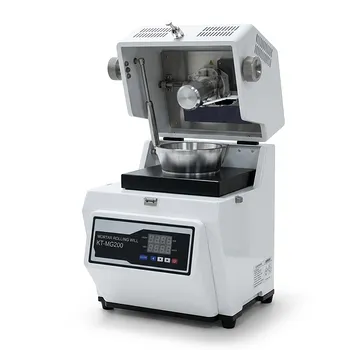
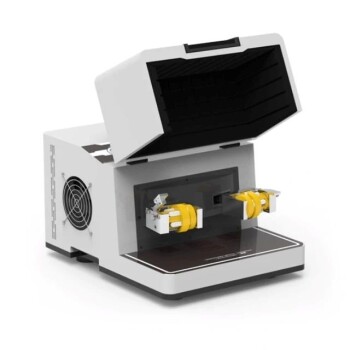
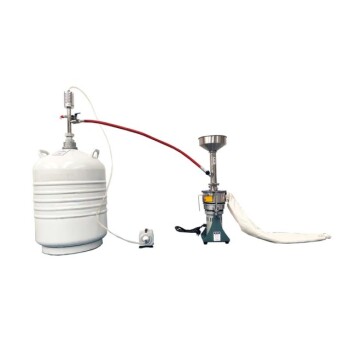
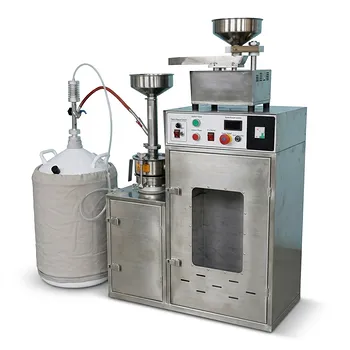
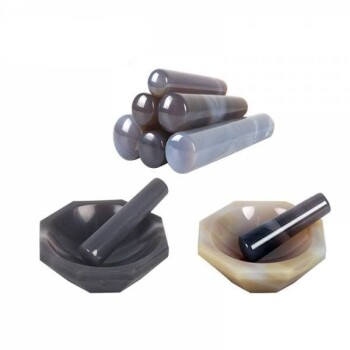
Industrial-grade grinding facilitates platinum recovery by mechanically pulverizing bulk waste materials, such as spent automotive catalyst honeycombs, into fine, micron-scale particles. This mechanical breakdown is the prerequisite step that liberates trapped metals, preparing them for subsequent chemical extraction processes.
By reducing bulk material to particle sizes around 0.3 mm, grinding equipment drastically increases specific surface area. This process breaks the physical encapsulation of the ceramic or metal matrix, ensuring that chemical leaching agents can make full contact with the platinum, palladium, and rhodium components.
The Mechanics of Liberation
To recover Platinum Group Metals (PGMs) from secondary resources, you must first solve the problem of physical accessibility.
Breaking Physical Encapsulation
In secondary resources like catalytic converters, valuable metals are often trapped inside a rigid ceramic or metallic structure.
Grinding equipment applies intense mechanical force to shatter this matrix. This destroys the physical "cage" holding the PGMs, effectively liberating the valuable material from the waste substrate.
Achieving Micron-Scale Particle Size
The efficiency of this process relies on precision.
Industrial grinders reduce the material to a specific micron-scale standard, typically around 0.3 mm. Uniform particle size is critical for ensuring consistent behavior during downstream processing.
Optimizing for Chemical Extraction
The primary goal of grinding is to prepare the material for hydrometallurgical processes (leaching).
Maximizing Specific Surface Area
The reduction in particle size leads to an exponential increase in specific surface area.
By turning a solid honeycomb into a fine powder, you expose a vastly larger amount of the material's surface. This is the single most important factor in determining the speed and completeness of chemical reactions.
Enabling Efficient Leaching
Once the material is pulverized, chemical leaching agents are introduced to dissolve the metals.
Without proper grinding, the chemicals would only strip the outer layer of the bulk material, leaving internal PGMs untouched. High-quality grinding ensures the leaching solution penetrates fully, maximizing the recovery rate of platinum, palladium, and rhodium.
Understanding the Trade-offs
While grinding is essential for chemical recovery, it is distinct from thermal recovery methods.
Mechanical Preparation vs. Thermal Phase Separation
Grinding focuses on increasing surface area for chemical interaction.
In contrast, high-temperature industrial furnaces (induction or electric) utilize extreme thermal energy (1000°C–2000°C) to melt the mixture. This thermal approach separates metals based on density and melting point—creating a platinum-rich metallic phase and a liquid slag—rather than relying on particle size and surface area.
Operational Considerations
Grinding is generally a preparatory step for hydrometallurgy (using aqueous chemistry).
Thermal treatment is typically a pyrometallurgical process (using heat). Choosing between—or combining—these methods depends on whether your recovery plant is designed for chemical leaching or high-temperature smelting.
Assessing Your Recovery Strategy
The choice of equipment dictates the efficiency of your downstream processes.
- If your primary focus is Chemical Leaching (Hydrometallurgy): You must prioritize grinding equipment capable of consistently achieving 0.3 mm particle sizes to maximize surface area contact.
- If your primary focus is Smelting (Pyrometallurgy): You should focus on thermal energy solutions like induction furnaces to separate phases, though coarse grinding may still be required for feed preparation.
Effective recovery begins with the precise physical liberation of the metal from its matrix.
Summary Table:
| Feature | Impact on PGM Recovery | Importance |
|---|---|---|
| Particle Size Reduction | Achieves ~0.3 mm for uniform processing | High |
| Surface Area Increase | Maximizes contact between leaching agents and metals | Critical |
| Physical Liberation | Breaks ceramic/metallic encapsulation of metals | Essential |
| Matrix Destruction | Frees platinum, palladium, and rhodium from substrates | Primary |
| Process Compatibility | Prepares feed for hydrometallurgical leaching | Necessary |
Maximize Your PGM Recovery with KINTEK Precision Solutions
Don't let valuable platinum group metals remain trapped in your secondary resources. KINTEK provides the high-performance crushing and milling systems, sieving equipment, and high-temperature furnaces needed to optimize both hydrometallurgical and pyrometallurgical recovery lines. From achieving the perfect 0.3 mm micron-scale powder to advanced smelting in our induction melting and vacuum furnaces, our laboratory and industrial-grade equipment ensures peak efficiency and maximum yield.
Ready to refine your extraction process? Contact our technical experts today to discover how KINTEK’s comprehensive range of grinding solutions and high-temperature reactors can transform your material recovery operations.
References
- Kifle Dejene. Utilizing Solid Phase Sorbents with Various Functional Groups Based on the HASAB Principle for Recovering Platinum Group Metals from Secondary Sources. DOI: 10.33425/2690-8077.1167
This article is also based on technical information from Kintek Solution Knowledge Base .
Related Products
- High Energy Planetary Ball Mill Milling Machine for Laboratory
- High Energy Planetary Ball Mill Milling Machine for Laboratory
- Three-dimensional electromagnetic sieving instrument
- Laboratory Grinding Mill Mortar Grinder for Sample Preparation
- Mini Planetary Ball Mill Machine for Laboratory Milling
People Also Ask
- What is the primary function of a planetary high-energy ball mill? Master Mechanical Alloying for Nickel Nanoparticles
- Why is a high-energy planetary ball mill preferred over traditional casting for nanocrystalline HEAs?
- What is the function of a high-energy planetary ball mill? Unlock Nanoscale Precision in Powder Metallurgy
- What is the function of a high-energy planetary ball mill in preparing MAB phase precursors? Optimize MBene Synthesis
- How does a high-energy planetary ball mill achieve room-temperature reactions? Master Mechanical Alloying Efficiency