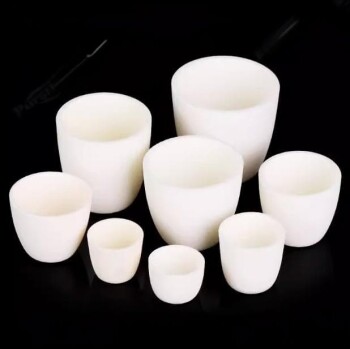
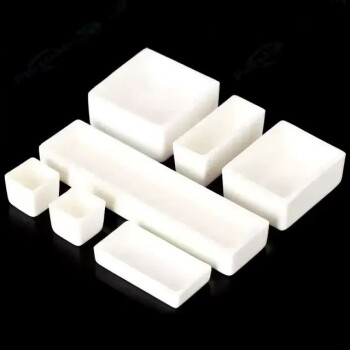
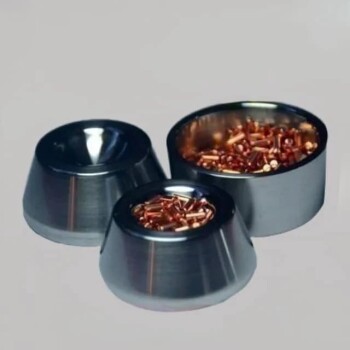
The crucible method simulates industrial conditions by transforming the test material itself into the containment vessel for corrosive agents. By fabricating a crucible from forsterite-spinel ceramic and filling it with media such as iron, slag, copper, or aluminum, researchers create a direct contact interface. When heated above the melting point of the media, this setup mimics the intense, prolonged exposure that furnace linings endure in operational settings.
The crucible method isolates the specific interaction between refractory materials and molten industrial byproducts. It provides a focused environment to measure chemical stability and resistance to penetration under controlled thermal stress.
Replicating the Furnace Environment
The Vessel as the Test Subject
In this method, the forsterite-spinel ceramic is not merely a passive sample; it serves as the structural container.
This geometry precisely mirrors the architecture of an industrial furnace. Just as a furnace lining must hold molten content, the ceramic crucible must physically contain the corrosive media during the test.
Achieving Liquid-Phase Interaction
To simulate real-world corrosion, the test subjects the crucible to constant high-temperature heat treatment.
The temperature is specifically raised above the melting point of the corrosive media (e.g., iron or slag). This ensures the ceramic faces liquid-phase attack, which is significantly more aggressive than solid-state contact and representative of active smelting conditions.
Key Evaluation Metrics
Assessing Chemical Stability
The primary goal is to evaluate how the forsterite-spinel ceramic withstands chemical attack.
By maintaining contact at high heat, the test reveals if the ceramic components react adversely with the molten media. This predicts whether the lining will degrade or dissolve when exposed to specific industrial slags or metals.
Measuring Penetration Resistance
Beyond surface reactions, this method tests the material's internal integrity.
It allows engineers to observe if the molten liquid can penetrate the pores of the ceramic wall. High resistance to penetration is critical for preventing structural failure in long-term industrial applications.
Understanding the Trade-offs
Static vs. Dynamic Simulation
While this method is excellent for testing chemical compatibility, it is primarily a static test.
Real-world industrial furnaces often involve flowing molten metal, which introduces mechanical erosion. The crucible method focuses on chemical corrosion and penetration but does not simulate the physical wear caused by fluid movement.
Thermal Gradient Limitations
The crucible is typically heated uniformly in a lab environment.
In contrast, industrial linings often face a steep thermal gradient (extremely hot on the inside, cooler on the outside). This difference can influence how deeply the corrosive media penetrates compared to the uniform heating of the test.
Applying These Insights to Your Project
To ensure the longevity of your industrial furnace linings, align your testing metrics with your operational risks.
- If your primary focus is chemical compatibility: Use the crucible method to verify that your forsterite-spinel composition is chemically inert to your specific slag or metal type.
- If your primary focus is mechanical erosion: Recognize that this test only predicts chemical stability and penetration, not the physical wear from flowing liquids.
Effective material selection relies on distinguishing between chemical failure and mechanical failure in high-heat environments.
Summary Table:
| Simulation Factor | Laboratory Crucible Method | Industrial Furnace Reality |
|---|---|---|
| Contact Interface | Ceramic acts as the containment vessel | Furnace lining holds molten load |
| Phase State | Liquid-phase (media heated above melting point) | Constant contact with molten slag/metal |
| Corrosion Type | Primarily chemical & static penetration | Chemical, static, and dynamic erosion |
| Temperature | Uniform heating in lab furnace | Steep thermal gradient across lining |
| Key Outcome | Chemical compatibility & pore resistance | Structural longevity & wear life |
Optimize Your Refractory Performance with KINTEK
Ensure your industrial furnace linings withstand the most aggressive environments. At KINTEK, we specialize in providing high-performance laboratory equipment tailored for material science and industrial testing. Whether you are analyzing forsterite-spinel ceramics or developing new refractory compositions, our extensive range of high-temperature furnaces (muffle, tube, and vacuum), high-pressure reactors, and precision crushing and milling systems provides the controlled environment you need for accurate simulation.
Why choose KINTEK?
- Comprehensive Solutions: From ceramic crucibles and PTFE products to advanced hydraulic presses for sample preparation.
- Precision Engineering: Our equipment is designed to replicate intense thermal stresses and chemical interactions.
- Expert Support: We help research labs and industrial manufacturers select the right tools for battery research, metallurgical analysis, and thermal processing.
Ready to elevate your material testing? Contact our technical experts today to find the perfect equipment for your specific industrial application.
References
- Martin Nguyen, Radomír Sokolář. Corrosion Resistance of Novel Fly Ash-Based Forsterite-Spinel Refractory Ceramics. DOI: 10.3390/ma15041363
This article is also based on technical information from Kintek Solution Knowledge Base .
Related Products
- Engineering Advanced Fine Ceramics Alumina Crucibles (Al2O3) for Thermal Analysis TGA DTA
- Engineering Advanced Fine Ceramics Alumina Al2O3 Crucible With Lid Cylindrical Laboratory Crucible
- Alumina Al2O3 Ceramic Crucible Semicircle Boat with Lid for Engineering Advanced Fine Ceramics
- Arc-Shaped Alumina Ceramic Crucible High Temperature Resistant for Engineering Advanced Fine Ceramics
- Engineering Advanced Fine Alumina Al2O3 Ceramic Crucible for Laboratory Muffle Furnace
People Also Ask
- Why Use Alumina Crucibles for TGA of Bicyclic Carbonates? Ensure Data Purity & Chemical Inertness
- Why are alumina crucibles and mother powder essential for LATP sintering? Optimize Your Solid Electrolyte Performance
- Why are high-purity alumina crucibles used for liquid lead corrosion experiments? Ensure Data Accuracy at 550°C
- What is the primary purpose of using alumina crucibles for LLTO ceramics? Optimize Your High-Temperature Sintering
- Why Use Alumina Crucibles & Powder Burial for NaSICON? Ensure Phase Purity and Prevent Elemental Volatilization