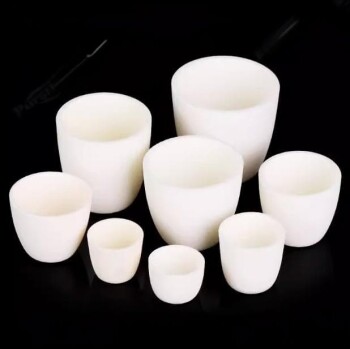
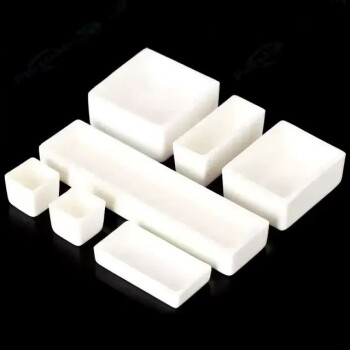
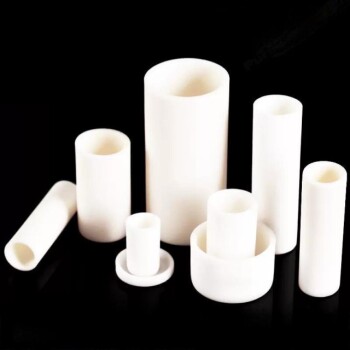
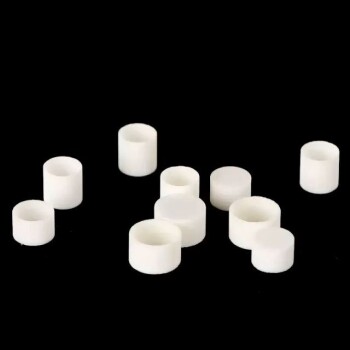
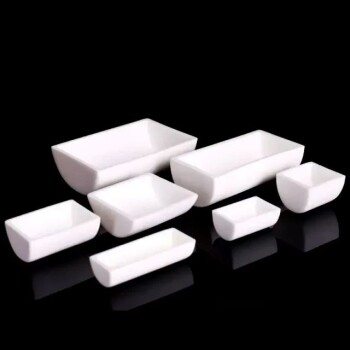
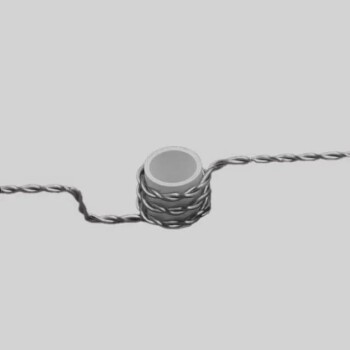
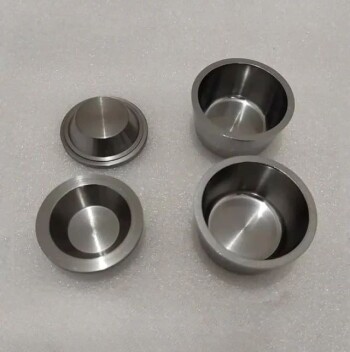
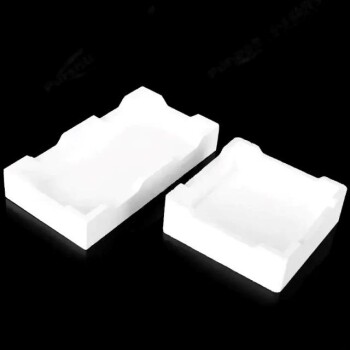
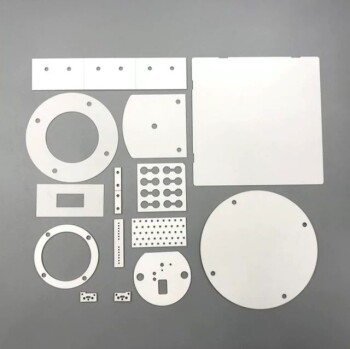
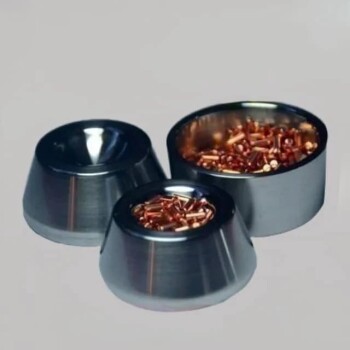
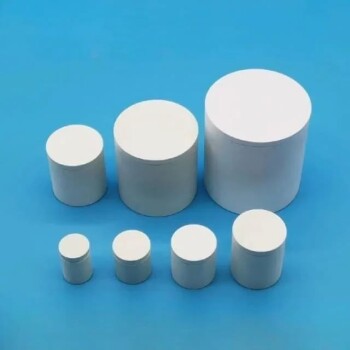
High-purity alumina crucibles function as essential, inert carriers that preserve the chemical integrity of samples during high-temperature studies. Specifically for Al2TiO5 coating crystallization kinetics, they ensure that the sample undergoes annealing without reacting with its container, guaranteeing that experimental data reflects only the coating's intrinsic behavior.
The core value of high-purity alumina lies in its exceptional thermochemical stability. By preventing solid-phase reactions and impurity introduction during calcination, it ensures that phase transition data remains uncorrupted by external environmental factors.
Preserving Chemical Integrity at High Temperatures
To accurately study how a material crystallizes, you must eliminate variables that could alter its chemical composition. High-purity alumina addresses the deep need for a "blank slate" environment.
Exceptional Thermochemical Stability
Crystallization studies for Al2TiO5 often require prolonged calcination at temperatures of 700 °C or higher. Under these intense thermal conditions, lesser materials might degrade or soften. High-purity alumina remains physically and chemically stable, providing a consistent environment throughout the duration of the experiment.
Preventing Solid-Phase Reactions
A common failure point in high-temperature materials science is the "container effect," where the crucible reacts with the sample. Alumina is chosen because it does not undergo solid-phase reactions with Al2TiO5 coatings. This isolation ensures the sample remains chemically distinct from its holder.
Eliminating Trace Impurities
The "high-purity" designation is critical; it means the crucible introduces no trace elements into the sample. Even minor impurities can act as nucleation sites or dopants, artificially altering crystallization kinetics. Using high-purity crucibles negates this risk, ensuring the observed kinetics are inherent to the coating alone.
Ensuring Accurate Analytical Data
The ultimate goal of using these crucibles is to protect the validity of downstream analysis techniques, such as X-ray Diffraction (XRD) and Raman spectroscopy.
Fidelity in Phase Transition Data
XRD and Raman spectroscopy rely on detecting specific crystal structures and vibrational modes. If the crucible reacted with the sample, the resulting spectra would show peaks from reaction byproducts. Alumina's inertness ensures that the data collected accurately maps the phase evolution of the Al2TiO5 coating.
Isolation and Containment
While primary interactions are chemical, physical containment is also vital. High-quality crucibles isolate samples, preventing cross-contamination from volatile compounds generated during the heating process. This physical isolation is necessary to maintain the purity of the specific kinetic data being measured.
Understanding the Trade-offs
While high-purity alumina is the standard for these studies, it is important to recognize potential limitations to ensure experimental success.
Thermal Shock Sensitivity
Despite their thermal stability, alumina ceramics can be susceptible to thermal shock. Rapid heating or cooling rates can cause the crucibles to crack or shatter. Experimental protocols must include controlled ramp rates to preserve the integrity of the container.
Chemical Compatibility Limits
Alumina is generally inert, but it is not universally resistant to all chemistries. It can react with certain highly basic or acidic fluxes at extreme temperatures. Researchers must always verify the specific compatibility of their sample material with alumina before proceeding.
Making the Right Choice for Your Research
Selecting the correct crucible is about matching the material properties to your specific analytical goals.
- If your primary focus is Phase Analysis (XRD/Raman): Prioritize high-purity alumina to prevent solid-phase reactions and ensure spectral peaks represent only your sample material.
- If your primary focus is Mass Gain/Corrosion Studies: Rely on the crucible's physical integrity to collect flaking oxide scales, ensuring accurate mass measurements.
- If your primary focus is Cost Efficiency: Evaluate if lower purity options are viable, but recognize the high risk of trace impurity contamination affecting crystallization data.
Success in kinetic studies depends not just on the sample, but on the invisible reliability of the vessel that holds it.
Summary Table:
| Feature | Benefit in Al2TiO5 Kinetic Studies |
|---|---|
| Thermochemical Stability | Resists degradation during prolonged calcination at 700°C+ |
| Inert Surface | Prevents solid-phase reactions between sample and container |
| High Purity Level | Eliminates trace impurities that act as false nucleation sites |
| Physical Containment | Ensures sample isolation for accurate XRD and Raman analysis |
Elevate Your Materials Research with KINTEK
Precision in crystallization kinetics requires the highest quality laboratory essentials. KINTEK specializes in providing premium high-purity alumina crucibles and ceramics designed to withstand the most demanding thermal environments without compromising your data.
Beyond our specialized crucibles, we offer a comprehensive range of high-performance tools for your lab:
- High-Temperature Furnaces: Muffle, tube, and vacuum furnaces for precise annealing.
- Milling & Pressing: Crushing systems and hydraulic presses for sample preparation.
- Advanced Reactors: High-temperature high-pressure reactors and autoclaves.
- Specialized Consumables: PTFE products and high-grade ceramic labware.
Ensure your experimental results reflect only your material's intrinsic behavior. Contact KINTEK today to discuss your laboratory requirements!
References
- Sebastian Öhman, Mats Boman. Selective kinetic growth and role of local coordination in forming Al<sub>2</sub>TiO<sub>5</sub>-based coatings at lower temperatures. DOI: 10.1039/d1ma00428j
This article is also based on technical information from Kintek Solution Knowledge Base .
Related Products
- Arc-Shaped Alumina Ceramic Crucible High Temperature Resistant for Engineering Advanced Fine Ceramics
- High Purity Alumina Granulated Powder for Engineering Advanced Fine Ceramics
- High Purity Pure Graphite Crucible for Evaporation
- Engineering Advanced Fine Alumina Al2O3 Ceramic Crucible for Laboratory Muffle Furnace
- High Purity Pure Graphite Crucible for Electron Beam Evaporation
People Also Ask
- Why Use Alumina Crucibles & Powder Burial for NaSICON? Ensure Phase Purity and Prevent Elemental Volatilization
- What is the primary purpose of using alumina crucibles for LLTO ceramics? Optimize Your High-Temperature Sintering
- Why are alumina crucibles and mother powder essential for LATP sintering? Optimize Your Solid Electrolyte Performance
- Why are high-purity alumina crucibles used for liquid lead corrosion experiments? Ensure Data Accuracy at 550°C
- Primary considerations for choosing alumina crucibles and quartz tubes in indium intercalation: Ensure Material Purity