The stirring speed in a polyol reaction is a critical variable that directly alters both the dimensions and the purity of silver nanowires. Specifically, moderate stirring promotes the growth of thinner, longer nanowires by homogenizing silver ion concentration, while vigorous stirring introduces oxygen to etch away unwanted byproducts.
The mechanical energy input from stirring does more than mix chemicals; it dictates the competition between crystal growth and oxidative dissolution. Balancing this speed allows you to minimize non-uniform deposition while actively removing defective nuclei.
Optimizing Growth Through Homogenization
The Role of Silver Ion Distribution
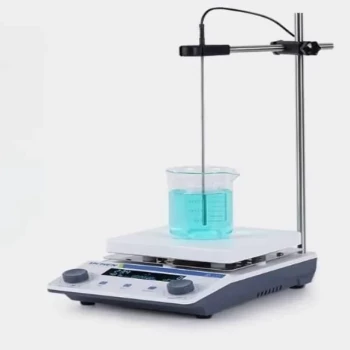
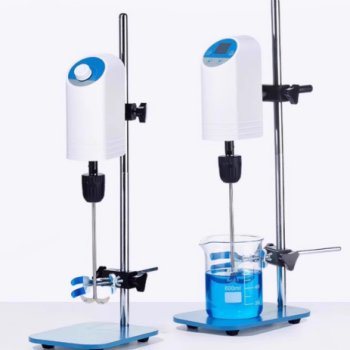
A laboratory or magnetic stirrer is essential for homogenizing the concentration of silver ions within the reaction solution.
Without adequate mixing, localized concentration gradients can occur. These gradients lead to unpredictable growth rates across the solution volume.
Achieving Thinner, Longer Nanowires
Moderate stirring speeds are generally preferred for maximizing the aspect ratio of the nanowires.
By maintaining a uniform chemical environment, you reduce the non-uniformity of silver atom deposition onto the five-fold twinned particles (MTPs).
This controlled, even deposition is the mechanism that allows the wires to grow thinner and longer rather than thickening prematurely.
Purity Control Through Oxidative Etching
Increasing Oxygen Contact
When you increase the agitation to vigorous stirring speeds, you physically alter the gas-liquid interface.
This aggressive mixing significantly increases the contact between the reaction liquid and atmospheric oxygen.
Eliminating Unwanted Nuclei
The introduced oxygen triggers a process known as oxidative etching.
This chemical attack specifically targets and removes unwanted nuclei and unstable particles.
Consequently, vigorous stirring regulates the final purity of the batch by dissolving the byproducts that would otherwise contaminate the nanowire sample.
Understanding the Trade-offs
The Balance of Agitation
There is a distinct trade-off between morphological control and chemical etching.
If the stirring is too slow, the lack of homogenization leads to uneven deposition, resulting in wires that are thick or short.
However, if stirring is excessive, the enhanced oxidative etching might become too aggressive, potentially destabilizing the desired MTPs along with the unwanted nuclei.
Making the Right Choice for Your Goal
To select the appropriate stirring speed, you must define the primary objective of your synthesis batch.
- If your primary focus is High Aspect Ratio (Length): Utilize moderate stirring speeds to ensure uniform deposition on MTPs, resulting in thinner, longer nanowires.
- If your primary focus is Sample Purity: Employ vigorous stirring to maximize oxygen contact and etch away unwanted nuclei, reducing the presence of particles other than nanowires.
Mastering the agitation rate provides a powerful, non-chemical lever for fine-tuning the geometry and quality of your silver nanowires.
Summary Table:
| Stirring Speed | Primary Mechanism | Effect on Morphology | Impact on Sample Purity |
|---|---|---|---|
| Moderate | Ion Homogenization | Thinner, longer nanowires (high aspect ratio) | Standard purity |
| Vigorous | Oxidative Etching | Controlled growth via byproduct removal | High purity (removes unwanted nuclei) |
| Low/None | Localized Gradients | Thick, short, or non-uniform wires | Low purity (increased contaminants) |
Elevate Your Nanomaterial Synthesis with KINTEK Precision
Precision in stirring is non-negotiable for high-quality silver nanowire production. At KINTEK, we specialize in high-performance laboratory equipment designed to give you total control over your chemical reactions.
Whether you require precise magnetic stirrers for uniform ion distribution or advanced high-temperature high-pressure reactors and autoclaves for complex polyol synthesis, our comprehensive range supports every stage of your research. From milling systems and hydraulic presses to specialized PTFE products and ceramics, KINTEK provides the reliability your lab demands.
Ready to optimize your synthesis results? Contact our technical experts today to find the perfect equipment solution for your laboratory!
References
- Longxia Yang, Haicheng Wang. Silver Nanowires: From Synthesis, Growth Mechanism, Device Fabrications to Prospective Engineered Applications. DOI: 10.30919/es8d808
This article is also based on technical information from Kintek Solution Knowledge Base .
Related Products
- Laboratory Small Constant Temperature Heated Magnetic Stirrer Heater and Stirrer
- Custom PTFE Teflon Parts Manufacturer for Magnetic Stirring Bar
- High Performance Laboratory Stirrers for Diverse Applications
- Three-dimensional electromagnetic sieving instrument
- Custom PTFE Teflon Parts Manufacturer for PTFE Stirring Bar Recovery Rod
People Also Ask
- What role does a magnetic stirrer with heating play in ZnO nanoparticle synthesis? Precision Control for Quality Results
- What role does a constant temperature heating magnetic stirrer play in MFC-HAp synthesis? Achieve Material Homogeneity
- What is the function of a laboratory magnetic stirrer in Ni–Cr–P electrodeposition? Optimize Ion Transport & Coating
- Why is a laboratory magnetic stirrer required for benzoic acid esters? Boost Reaction Speed & Yield with High RPM
- What role does a laboratory magnetic stirrer play in TiO2 and TiO2-Ag sol preparation? Master Chemical Kinetics