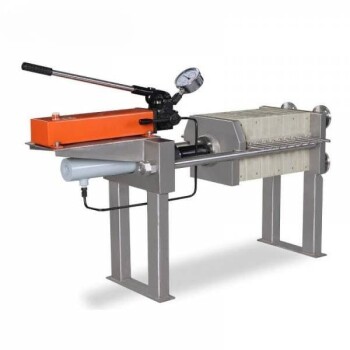
Precision hydraulic presses are the fundamental drivers of ceramic green body integrity. They apply high, controlled uniaxial pressure—typically ranging from 100 to 400 MPa—to rearrange loose powder particles and induce plastic deformation within a precision mold. This process eliminates internal voids and establishes a uniform density distribution, which is the primary defense against warping, cracking, or uneven shrinkage during the subsequent high-temperature sintering phase.
The precision of a hydraulic press dictates the internal microstructure and dimensional stability of a ceramic green body. By minimizing density gradients through accurate pressure control, the press ensures the material achieves the consistent initial density required for high-performance mechanical and electromagnetic properties.
The Mechanics of Powder Consolidation
Particle Rearrangement and Void Elimination
A precision hydraulic press forces granulated ceramic powders to displace and fill the empty spaces between particles. This consolidation reduces the physical distance between particles, creating the necessary environment for solid-state chemical reactions.
By eliminating internal voids and macro defects, the press ensures the green body has sufficient bulk density. This initial densification is critical for the material to survive the transition from a loose powder to a solid ceramic block.
Plastic Deformation and Interlocking
High axial pressure, often exceeding 1 ton/cm², induces plastic deformation in the powder particles. This causes them to interlock physically, providing the green body with its initial mechanical strength.
This strength is essential for handling and further processing before the material is fired. Without this structural consolidation, the green body would be too fragile to be moved from the mold to the furnace.
Impact on Sintering and Final Microstructure
Minimizing Density Gradients
The most critical role of a precision press is the reduction of density gradients within the part. Inaccurate pressure distribution leads to some areas being more compacted than others, which causes uneven shrinkage during sintering.
Precise control prevents the green body from warping or micro-cracking when exposed to temperatures as high as 1600 degrees Celsius. Maintaining a uniform density ensures the final component retains its intended geometric shape.
Controlling Grain Growth and Diffusion
The initial packing density determined by the press directly influences grain growth during the firing process. A consistent initial density allows for predictable diffusion-controlled reactions in the tube furnace.
When the green body is uniform, the resulting ceramic achieves higher physical density and optimized microstructures. This is particularly vital for specialized materials like SiOC/ZrB2 composites or electromagnetic wave-absorbing ceramics.
Understanding the Trade-offs
The Risk of Over-Pressing
While high pressure increases density, exceeding the material's limits can lead to lamination or capping. This occurs when air trapped in the powder is compressed and then expands rapidly when the pressure is released, causing the green body to split.
Geometric Limitations
Uniaxial pressing in a hydraulic press often results in non-uniform pressure in parts with high aspect ratios (deep molds). The friction between the powder and the mold walls can cause the bottom of the part to be less dense than the top.
Tooling and Wear
The use of high-strength alloy steel molds is necessary to withstand the intense pressures of a precision press. However, these molds are subject to significant wear over time, which can eventually degrade the dimensional accuracy of the green bodies.
How to Apply This to Your Project
Making the Right Choice for Your Goal
Achieving the best quality ceramic green body requires balancing pressure settings with your specific material requirements.
- If your primary focus is Dimensional Integrity: Utilize closed-loop pressure control to minimize density gradients and prevent warping during the 1600°C sintering stage.
- If your primary focus is High Mechanical Strength: Opt for higher pressures (up to 400 MPa) to maximize particle interlocking and eliminate macro-voids within the mold.
- If your primary focus is Handling and Pre-forming: Focus on consistent axial pressure to ensure the green body has sufficient "green strength" for transport to subsequent high-pressure processing steps.
The precision of your hydraulic press is the single most important factor in bridging the gap between a loose powder mixture and a high-performance ceramic component.
Summary Table:
| Feature | Impact on Ceramic Green Body | Key Benefit |
|---|---|---|
| High Uniaxial Pressure | Rearranges particles and eliminates internal voids | Increases bulk density and structural integrity |
| Precise Pressure Control | Minimizes density gradients and internal stresses | Prevents warping and cracking during sintering |
| Particle Interlocking | Induces plastic deformation at the micro-level | Enhances "green strength" for easier handling |
| Uniform Consolidation | Controls grain growth and diffusion reactions | Optimizes mechanical and electromagnetic properties |
Elevate Your Ceramic Research with KINTEK Precision
Achieving the perfect ceramic green body requires more than just raw power—it requires the exact precision found in KINTEK laboratory solutions. We specialize in high-performance hydraulic presses (pellet, hot, and isostatic) engineered to eliminate density gradients and ensure the structural integrity of your materials.
To support your entire workflow, KINTEK offers a comprehensive range of equipment, including:
- High-Temperature Furnaces: Muffle, tube, and vacuum furnaces for flawless sintering.
- Material Preparation: Advanced crushing, milling, and sieving systems.
- Precision Consumables: High-strength ceramics, crucibles, and PTFE products.
Whether you are developing advanced composites or specialized electromagnetic ceramics, our experts are ready to help you optimize your process. Contact KINTEK today to find your solution and bridge the gap between powder and high-performance components!
References
- K. D. Bopanna, Ginni Nijhawan. RETRACTED: Enhanced Sintering Performance of Ceramic Composites Fabricated by Powder Metallurgy. DOI: 10.1051/e3sconf/202343001126
This article is also based on technical information from Kintek Solution Knowledge Base .
Related Products
- Laboratory Hydraulic Press Lab Pellet Press Machine for Glove Box
- 24T 30T 60T Heated Hydraulic Press Machine with Heated Plates for Laboratory Hot Press
- Heated Hydraulic Press Machine with Heated Plates for Vacuum Box Laboratory Hot Press
- Laboratory Hydraulic Press Split Electric Lab Pellet Press
- Laboratory Hydraulic Pellet Press for XRF KBR FTIR Lab Applications
People Also Ask
- What is the function of a laboratory hydraulic press in W-Cu composites? Control Porosity and Material Ratio
- What is the role of a laboratory hydraulic press in the initial stages of Li6PS5Cl preparation? Key to Green Pellets
- What role does a laboratory hydraulic press play in triboelectric testing? Achieve Precision Alloy Sample Prep
- How can a laboratory hydraulic press be applied to chitosan for wastewater treatment? Optimize Pores & Strength
- How do a precision laboratory hydraulic press and specialized molds contribute to the fabrication of spherical ceramic samples? Achieving High-Density Material Precision