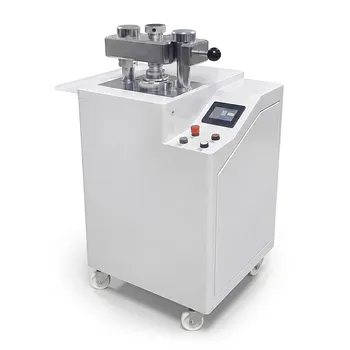
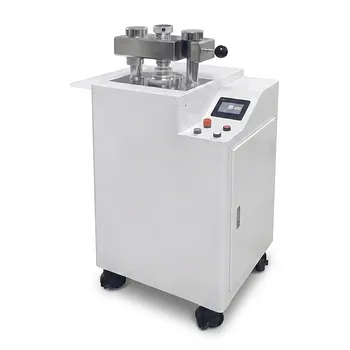
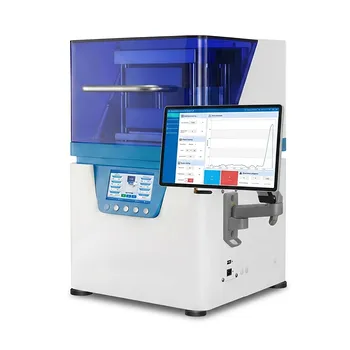
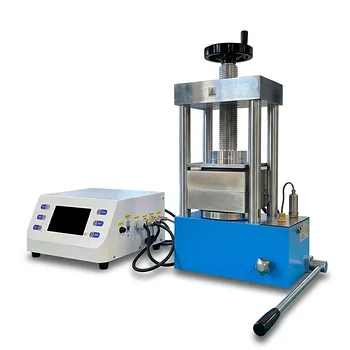
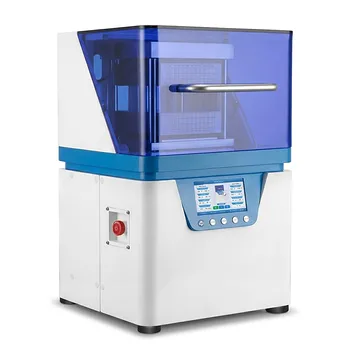
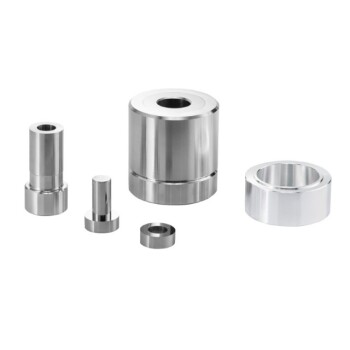
The laboratory hydraulic press transforms pulverized Refuse Derived Fuel (RDF) by applying intense, controlled static pressure to loose waste powder within a specialized mold. This mechanical compaction forces the particles to undergo physical rearrangement and plastic deformation, resulting in dense pellets or briquettes with high mechanical strength. This process significantly increases the fuel's volumetric energy density while providing a standardized shape for both efficient transport and scientific analysis.
By converting loose RDF powder into dense, uniform shapes, a hydraulic press optimizes the fuel's energy density and combustion characteristics, making it a viable alternative to traditional lump coal.
The Mechanics of Waste Densification
High-Pressure Consolidation
The press acts as the core power source, providing the force necessary to overcome intermolecular repulsion between waste particles. By maintaining constant high pressures—sometimes reaching up to 288 MPa—the machine ensures the powder reaches the necessary "green body" density.
Physical Rearrangement and Plastic Deformation
Under pressure, pulverized waste undergoes a physical transformation where particles are forced into a tight packing arrangement. This process induces plastic deformation, where the particles permanently change shape to fill voids, leading to a stable, solid structure.
Mechanical Interlocking and Binders
The densification process relies on mechanical interlocking and intermolecular forces to hold the pellet together. In many laboratory settings, specific binders are mixed with the Municipal Solid Waste (MSW) powder to ensure the resulting pellets maintain their integrity after being removed from the mold.
Enhancing Fuel Performance and Logistics
Improving Volumetric Energy Density
One of the primary goals of using a hydraulic press is to reduce the bulkiness of the raw waste. By compressing the powder into dense pellets, the energy density per unit volume is significantly increased, which drastically reduces storage and transportation costs.
Optimizing Combustion Characteristics
The press allows researchers to control the porosity of the formed RDF. Proper porosity ensures uniform air distribution during combustion, allowing the RDF to burn with characteristics similar to traditional coal rather than unpredictable loose waste.
Mechanical Strength for Thermal Processing
Densified pellets possess the mechanical strength required to survive subsequent thermal processing, such as sintering or recrystallization. This ensures the fuel does not crumble or turn back into dust during the high-temperature phases of energy recovery.
The Role in Laboratory Analysis
Standardizing Samples for Accuracy
In analytical chemistry, the press is used to create pellets with standardized geometric dimensions. This uniformity is critical for techniques like infrared spectroscopy or X-ray fluorescence, as it improves the signal-to-noise ratio and ensures repeatable data.
Improving Heat Transfer in TGA
When preparing samples for Thermogravimetric Analysis (TGA), pelletization ensures the material fits compactly into the crucible. This reduces internal voids and improves heat transfer efficiency, allowing the resulting curves to more accurately reflect the material's true thermal degradation.
Understanding the Trade-offs
The Impact of Elastic Recovery
A common challenge in the pelletization process is elastic recovery, where the material "springs back" after the pressure is released. If the pressure is not maintained for a specific duration, or if the material is too elastic, the pellets may lose their density or crack over time.
Energy Consumption vs. Pellet Quality
While higher pressures (like 288 MPa) result in superior density, they also require significant energy input. Finding the optimal pressure that ensures sufficient mechanical strength without excessive energy waste is a constant balancing act in RDF production.
Binder Dependency and Chemical Purity
Adding binders can improve pellet stability, but it also alters the chemical composition of the fuel. Researchers must carefully account for how these additives might influence the emission profiles or the ash content during final combustion.
Applying This Process to Your Project
Making the Right Choice for Your Goal
- If your primary focus is improving transport efficiency: Focus on maximizing the compression pressure to achieve the highest possible volumetric energy density.
- If your primary focus is scientific repeatability: Prioritize standardized mold dimensions and constant static pressure to ensure every sample has identical morphology for analytical testing.
- If your primary focus is combustion optimization: Carefully control the pressure and particle size to achieve a specific porosity that mimics the burning behavior of coal.
- If your primary focus is thermal stability research: Use the press to create high-density samples that can withstand the mechanical stresses of sintering and high-temperature degradation.
By mastering the precise application of pressure and mold design, you can transform inconsistent waste streams into a high-performance, standardized energy source.
Summary Table:
| Feature | Mechanical Process | Benefit to RDF Production |
|---|---|---|
| High Pressure | Overcomes intermolecular repulsion | Achieves high "green body" density (up to 288 MPa) |
| Deformation | Plastic rearrangement of particles | Creates stable, solid structures without voids |
| Standardization | Precision mold shaping | Ensures repeatable data for TGA and spectroscopy |
| Densification | Volumetric compression | Increases energy density and reduces logistics costs |
Elevate Your Waste-to-Energy Research with KINTEK
Maximize the potential of your RDF samples with KINTEK’s high-precision laboratory hydraulic presses. Whether you need manual, electric, or hot isostatic pressing, our equipment is designed to provide the consistent, high-pressure environment necessary for superior pellet density and mechanical strength.
From pellet presses and specialized dies to TGA-ready crucibles and high-temperature furnaces, KINTEK specializes in providing the comprehensive toolsets required for advanced material science and fuel analysis. Our solutions ensure your lab achieves standardized, high-performance results every time.
Ready to optimize your densification process? Contact our experts today to find the perfect equipment for your research goals!
References
- Marcelina Bury, Piotr Burmistrz. Influence of RDF Composition on Mercury Release during Thermal Pretreatment. DOI: 10.3390/en16020772
This article is also based on technical information from Kintek Solution Knowledge Base .
Related Products
- Automatic Laboratory Hydraulic Pellet Press Machine for Lab Use
- Laboratory Manual Hydraulic Pellet Press for Lab Use
- Laboratory Manual Hydraulic Pellet Press for Lab Use
- Laboratory Hydraulic Press Lab Pellet Press Machine for Glove Box
- Automatic XRF Pellet Press 40 Ton Hydraulic Sample Preparation Press for Fluorescent Spectroscopy Analysis
People Also Ask
- What is the role of a laboratory hydraulic pellet press and stainless steel molds in the fabrication of RuO2/NbC anodes?
- What role does a laboratory pellet press play in the enhancement of biomass energy products? Optimize Fuel Efficiency
- What is the purpose of using a laboratory pellet press when evaluating the electronic conductivity of carbon powders? Guide
- How does a laboratory hydraulic pellet press contribute to SiCw/2024 aluminum composite preforms? Optimize Densification
- What is the significance of applying 200 MPa of pressure with a laboratory hydraulic pellet press for composite ceramics?