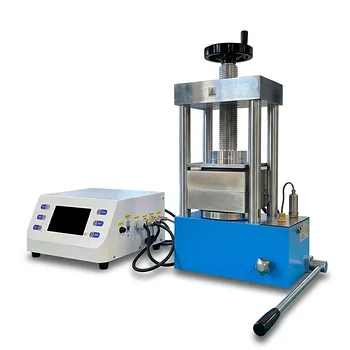
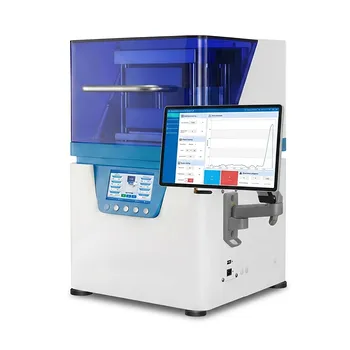
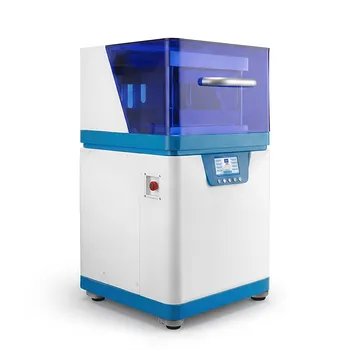
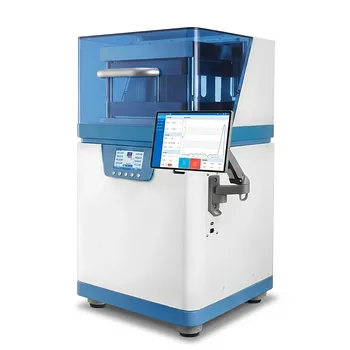
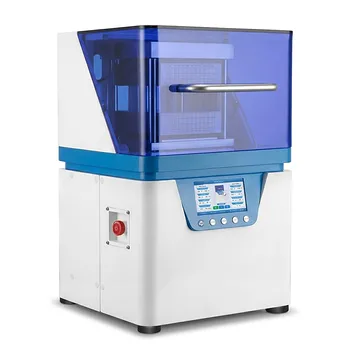
The laboratory hydraulic press transforms loose Niobium-doped Strontium Titanate powders into a structured "green body" by applying precise uniaxial pressure within a specialized mold. This mechanical compaction forces individual particles into close contact, establishing the initial geometric shape and providing the mechanical integrity required for subsequent high-temperature processing.
Core Takeaway: The hydraulic press is the critical bridge between raw powder and a viable ceramic component, as it establishes the uniform density and particle contact necessary for successful solid-state sintering and chemical diffusion.
The Mechanics of Uniaxial Compaction
Transforming Powder to Green Body
The process begins by placing homogenized Niobium-doped Strontium Titanate powder into a high-precision steel mold. The hydraulic press applies a specific axial load—typically around 50 MPa for this material—to consolidate the loose particles into a solid pellet or "green body."
This stage is vital because it establishes the basic geometric profile of the ceramic tool. Without this initial compaction, the material would lack the structural strength needed to be handled or placed into a sintering furnace.
Enhancing Particle Contact and Density
High-pressure compaction serves to eliminate air pockets and inter-particle voids within the powder mass. By forcing the particles closer together, the press increases the contact tightness, which is essential for the material's structural integrity.
Reducing the physical distance between particles creates the ideal environment for diffusion-controlled solid-state reactions. This proximity is what allows the ceramic to transition from a pressed powder into a dense, functional material during the firing stage.
Engineering the Internal Microstructure
The Role of Pressure Control
Precise control over the applied pressure is non-negotiable for producing high-quality ceramics. The hydraulic press must deliver consistent force to ensure a uniform internal density across the entire sample.
If the pressure is inconsistent, it creates density gradients where some areas are more compacted than others. These gradients are the primary cause of internal stresses that lead to failure in later stages of production.
Preparing for the Sintering Stage
A well-pressed green body acts as a physical prototype for the final densification treatment. The initial packing density achieved in the press directly determines how the material will behave when exposed to high heat in a tube furnace.
Proper compaction helps control grain growth and ensures that the sample reaches its maximum theoretical density. This foundational step is what prevents the ceramic from undergoing excessive shrinkage or losing its shape during the transition to a finished product.
Understanding the Trade-offs and Pitfalls
The Risk of Non-Uniform Density
One of the most significant challenges in hydraulic pressing is the potential for pressure friction against the mold walls. This can result in a green body that is denser at the top than at the bottom, leading to "warping" or uneven dimensions after firing.
Over-Compaction and Lamination
While high pressure is necessary for density, exceeding the material's limits can cause lamination or "capping." This occurs when internal air is trapped or when the elastic recovery of the powder causes the green body to crack horizontally upon release from the mold.
Mold Wear and Contamination
Using steel molds requires meticulous maintenance to prevent surface contamination of the Niobium-doped Strontium Titanate. Any wear or scratches on the mold surface will be mirrored in the green body, potentially creating stress concentrators that lead to structural failure.
Applying This Process to Your Research
Making the Right Choice for Your Goal
- If your primary focus is maximizing final density: Utilize higher pressing pressures (tailored to the specific powder) to minimize inter-particle voids and reduce the sintering time required for full densification.
- If your primary focus is preventing structural cracks: Ensure the powder is properly granulated and use a controlled decompression rate to allow the green body to stabilize before removal from the die.
- If your primary focus is chemical purity: Use high-grade steel or tungsten carbide molds and ensure the powder is thoroughly homogenized and dried to prevent chemical reactions during the pressing phase.
By mastering the precise application of uniaxial pressure, you ensure that the Niobium-doped Strontium Titanate green body possesses the structural and microstructural foundation necessary for advanced electronic or structural applications.
Summary Table:
| Process Stage | Core Objective | Key Benefit for Ceramics |
|---|---|---|
| Uniaxial Compaction | Transform loose powder into a "green body" | Provides mechanical integrity for handling |
| Void Reduction | Eliminate air pockets and increase contact | Creates the ideal environment for diffusion |
| Pressure Control | Maintain uniform internal density | Prevents warping and stress failure during firing |
| Decompression | Controlled release of axial load | Avoids lamination and "capping" cracks |
Precision is the foundation of advanced ceramic research. At KINTEK, we specialize in providing high-performance laboratory hydraulic presses—including manual, electric, and isostatic models—to ensure your Niobium-doped Strontium Titanate samples achieve maximum uniform density.
Beyond compaction, our comprehensive portfolio supports your entire workflow with high-temperature tube and muffle furnaces for sintering, precision crushing and milling systems, and high-purity ceramic crucibles. Empower your material synthesis and achieve superior structural results today. Contact KINTEK to find your laboratory's perfect equipment solution!
References
- Yibing Zhu, Robert Freer. Precursor-Led Grain Boundary Engineering for Superior Thermoelectric Performance in Niobium Strontium Titanate. DOI: 10.1021/acsami.2c22712
This article is also based on technical information from Kintek Solution Knowledge Base .
Related Products
- Manual Lab Heat Press
- Fully Automatic Heated Hydraulic Lab Press for Materials Sintering and Sample Preparation
- Heated Hydraulic Press Machine with Integrated Manual Heated Plates for Lab Use
- Laboratory Hydraulic Pellet Press for XRF KBR FTIR Lab Applications
- Laboratory Manual Hydraulic Pellet Press for Lab Use
People Also Ask
- Why use laboratory manual hydraulic presses for semiconductor pellets? Optimize Annealing & Crystalline Quality
- How is a laboratory manual hydraulic press used in solid-state battery testing? Optimize Electrode Performance
- What is manual hydraulic press? A Guide to Simple, High-Force Compression
- What role does a laboratory manual hydraulic press play in the preparation of salt pellets? Ensure Research Precision
- What is a manual press? Amplify Your Force for Precision Assembly and Stamping