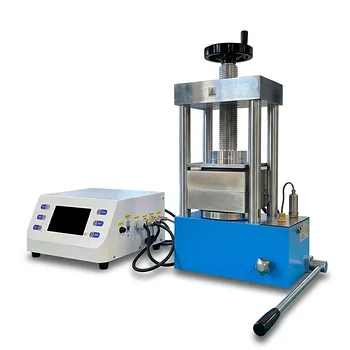
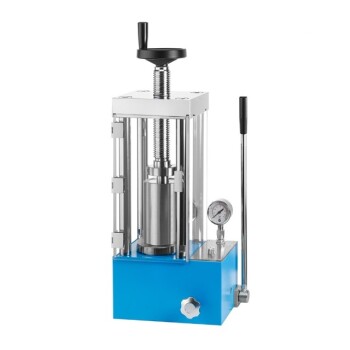
A laboratory manual hydraulic press acts as the critical preparatory tool for transforming loose composite powders into dense, geometric pellet samples. By applying controlled high pressure, it simulates the actual formation of electrode layers within all-solid-state batteries, enabling researchers to accurately measure compression density, evaluate particle-to-particle contact, and verify electrical conductivity.
The hydraulic press bridges the gap between raw material synthesis and functional performance. It creates the high-density environment necessary to reveal how well solid electrode particles interact and conduct charge, which is the defining factor in battery efficiency.
Simulating Real-World Battery Architecture
Creating the Test Sample
To evaluate a material, you cannot simply test loose powder. The hydraulic press is used to compress prepared composite powders into a solid state.
This results in dense pellet samples with specific, measurable geometric dimensions.
Mimicking Electrode Layer Formation
All-solid-state batteries rely on tightly packed layers for ion transport. The pressing process replicates the mechanical conditions of actual electrode layer formation.
This allows you to observe how the material behaves when it is formed into a functional component rather than just a raw substance.
Improving Interfacial Contact
The primary challenge in solid-state batteries is the resistance between particles. The press forces particles together to maximize surface area contact.
This enables the evaluation of interfacial contact, determining if the material can maintain the necessary connectivity for electron and ion flow.
The Mechanics of Performance Evaluation
Measuring Compression Density
Performance is directly linked to how dense the material can get without degrading. The press allows for the precise calculation of compression density.
By knowing the applied pressure and the resulting pellet dimensions, you can determine the material's compaction efficiency.
Verifying Electrical Conductivity
Resistivity testing requires a stable, conductive path. The press facilitates the verification of the electrode layer's electrical conductivity under high-pressure conditions.
This ensures that the resistance measurements reflect the material's intrinsic properties, not just the looseness of the powder.
Critical Considerations for Accurate Testing
Ensuring Uniform Distribution
High-precision pressing is required to ensure powder particles are distributed uniformly throughout the sample.
If the green density (density before sintering or further processing) is inconsistent, the resistivity data will be unreliable.
Preventing Signal Instability
During the testing phase, physical stability is paramount. The use of precision fixtures—similar to specialized racks with spacers—allows for the exact control of distance between test electrodes.
This rigid positioning prevents physical displacement, eliminating unstable electrical signals that lead to noisy or false data.
Optimizing Your Evaluation Strategy
To get the most out of your hydraulic press for battery research, tailor your approach to your specific testing goals:
- If your primary focus is Material Synthesis: Prioritize achieving a specific and repeatable compression density to ensure your pellets simulate a realistic electrode layer.
- If your primary focus is Resistivity Testing: Focus on the use of precision spacers and fixtures to ensure electrode stability, preventing movement that causes signal noise.
Ultimately, the hydraulic press is not just about force; it is about creating the consistent, high-density structure required to reveal the true potential of your electrode materials.
Summary Table:
| Evaluation Metric | Role of Hydraulic Press | Impact on Battery Research |
|---|---|---|
| Compression Density | Compresses loose powder into geometric pellets | Determines compaction efficiency and energy density potential |
| Interfacial Contact | Maximizes particle-to-particle surface contact | Reduces internal resistance for better ion/electron transport |
| Electrical Conductivity | Creates a stable, dense path for resistivity testing | Ensures conductivity data reflects intrinsic material properties |
| Sample Consistency | Ensures uniform distribution and green density | Prevents signal instability and ensures repeatable test results |
Elevate Your Battery Research with KINTEK Precision Solutions
Unlock the full potential of your all-solid-state battery materials with KINTEK’s industry-leading laboratory equipment. Whether you are synthesizing next-generation electrode layers or conducting high-precision resistivity testing, our manual and isostatic hydraulic presses provide the controlled pressure necessary for accurate performance evaluation.
Beyond sample preparation, KINTEK offers a comprehensive suite of tools for energy research, including:
- High-Pressure Reactors & Autoclaves for advanced material synthesis.
- Crushing & Milling Systems for uniform powder preparation.
- Electrolytic Cells, Electrodes, and Battery Consumables for full-scale testing.
- High-Temperature Furnaces (Muffle, Vacuum, CVD) for sintering and processing.
Ready to achieve superior pellet density and reliable data? Contact KINTEK today to discuss your laboratory needs and find the perfect equipment to accelerate your battery innovation.
Related Products
- Manual Heated Hydraulic Press Machine with Heated Plates for Laboratory Hot Press
- Laboratory Manual Hydraulic Pellet Press for Lab Use
- Manual High Temperature Heated Hydraulic Press Machine with Heated Plates for Lab
- Laboratory Manual Hydraulic Pellet Press for Lab Use
- Manual Lab Heat Press
People Also Ask
- Why use laboratory manual hydraulic presses for semiconductor pellets? Optimize Annealing & Crystalline Quality
- What is manual hydraulic press? A Guide to Simple, High-Force Compression
- Why is a laboratory hydraulic hot press essential for high-density, additive-free Silicon Carbide? Unlock Pure SiC.
- How does a laboratory hydraulic hot press ensure the quality of PHBV/natural fiber composites? Expert Guide
- What is the function of a laboratory hydraulic hot press in the assembly of solid-state photoelectrochemical cells?