Knowledge universal laboratory press Why use laboratory manual hydraulic presses for semiconductor pellets? Optimize Annealing & Crystalline Quality
Author avatar

Tech Team · Kintek Solution

Updated 1 month ago

Why use laboratory manual hydraulic presses for semiconductor pellets? Optimize Annealing & Crystalline Quality


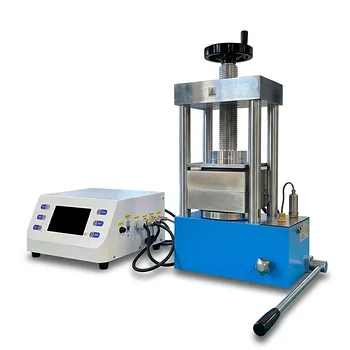
The use of a laboratory manual hydraulic press is essential for maximizing physical contact between reactant particles. By applying several tons of pressure to milled phosphide powders, the press creates a dense "green body" that minimizes inter-particle voids. This tight compaction is the critical precursor to annealing, as it facilitates the efficient movement of atoms across particle boundaries required for high-quality semiconductor synthesis.

Core Takeaway: Compressing powders into pellets transforms a loose mixture into a high-density medium that optimizes solid-state diffusion. This process is the primary driver for achieving high phase purity, uniform dopant distribution, and superior crystalline quality during subsequent heat treatment.

The Physics of Compaction

Eliminating Inter-particle Voids

Loose powder contains significant air gaps and spatial separations that act as barriers to atomic movement. Hydraulic pressure reduces these inter-particle voids, simulating the high-pressure environments often required for material stability.

Creating the "Green Body"

The resulting pellet, often referred to as a green body, provides a stable geometry (typically 13 mm in diameter) for handling. This format ensures that the powder maintains its structural integrity and density throughout the various stages of the annealing process.

Enhancing Solid-State Reaction Kinetics

Shortening Atomic Diffusion Paths

Solid-state reactions rely on the migration of atoms from one particle to another. By increasing the contact area, you significantly shorten the diffusion distance that ions must travel to react, which speeds up the chemical transformation.

Accelerating Phase Formation

Dense pellets allow for the rapid formation of the target phase, such as the specific phosphide lattice structure. Without this close contact, the reaction would be sluggish, potentially requiring much longer annealing times to reach completion.

Impacts on Material Quality

Improving Crystalline Uniformity

Compaction ensures that components, including dopant ions, are uniformly embedded into the crystal lattice. This homogeneity is vital for semiconductors, where even minor structural inconsistencies can degrade electronic performance.

Reducing Required Reaction Temperatures

Pelletized materials can often achieve a complete reaction at lower temperatures than loose powders. This efficiency reduces the presence of residual intermediate products and prevents the loss of volatile components during high-temperature calcination.

Understanding the Trade-offs

Pressure-Induced Defects

While high pressure is beneficial, excessive force can introduce structural strain or micro-cracks in the green body. These physical defects may persist through the annealing stage, negatively impacting the final material's mechanical strength.

Contamination and Die Friction

The process of pressing involves direct contact between the powder and the steel die. Without proper lubrication or liners, iron contamination can occur, or the pellet may crack upon ejection due to friction against the die walls.

Applying This to Your Research Goal

How to Optimize Your Pelletizing Process

To ensure the best results for your phosphide semiconductor synthesis, consider your specific experimental objectives:

  • If your primary focus is Phase Purity: Maximize the pressure within the safe limits of your die to ensure no unreacted precursors remain in the voids.
  • If your primary focus is Grain Size Control: Use moderate pressure to maintain a refined grain structure, preventing the excessive grain growth that can occur in over-compacted samples.
  • If your primary focus is Electronic Performance: Ensure the die is thoroughly cleaned or use a protective foil to prevent metallic impurities from entering the semiconductor powder.

Properly calibrated hydraulic pressing turns a simple powder mixture into a reactive system capable of forming high-performance crystalline materials.

Summary Table:

Process Feature Benefit for Semiconductors Impact on Material Quality
Void Elimination Maximizes inter-particle contact Ensures consistent atomic diffusion and high density.
Green Body Creation Provides stable sample geometry Maintains structural integrity and uniform heat distribution.
Kinetic Acceleration Shortens atomic diffusion paths Enables faster phase formation at lower reaction temperatures.
Dopant Embedding Uniformly distributes ions Enhances electronic performance and crystalline homogeneity.

Elevate Your Semiconductor Synthesis with KINTEK Precision

Achieving high phase purity and uniform dopant distribution starts with the perfect pellet. KINTEK specializes in high-performance laboratory equipment designed for rigorous material research. Our robust manual and automatic hydraulic presses (including pellet, hot, and isostatic models) provide the precise pressure needed to create high-density green bodies, while our advanced muffle, vacuum, and CVD furnaces ensure optimal annealing conditions.

From crushing and milling systems for powder preparation to high-purity ceramic crucibles and consumables, KINTEK offers a complete workflow solution for semiconductor innovation.

Ready to optimize your solid-state reaction kinetics? Contact KINTEK today to discuss your specific research requirements and discover how our laboratory solutions can enhance your material quality.

References

  1. Tassilo M. F. Restle, Thomas F. Fässler. Direct Band Gap Semiconductors with Two‐ and Three‐Dimensional Triel‐Phosphide Frameworks (Triel=Al, Ga, In). DOI: 10.1002/chem.202304097

This article is also based on technical information from Kintek Solution Knowledge Base .

Related Products

People Also Ask

Related Products

Laboratory Manual Hydraulic Pellet Press for Lab Use

Laboratory Manual Hydraulic Pellet Press for Lab Use

Efficient sample preparation with small footprint Manual Lab Hydraulic Press. Ideal for material researching labs, pharmacy, catalytic reaction, and ceramics.

Laboratory Manual Hydraulic Pellet Press for Lab Use

Laboratory Manual Hydraulic Pellet Press for Lab Use

Efficient Manure Lab Hydraulic Press with Safety Cover for sample preparation in material research, pharmacy, and electronic industries. Available in 15T to 60T.

Manual Heated Hydraulic Press Machine with Heated Plates for Laboratory Hot Press

Manual Heated Hydraulic Press Machine with Heated Plates for Laboratory Hot Press

The Manual Heat Press is a versatile piece of equipment suitable for a variety of applications, operated by a manual hydraulic system that applies controlled pressure and heat to the material placed on the piston.

Manual Lab Heat Press

Manual Lab Heat Press

Manual hydraulic presses are mainly used in laboratories for various applications such as forging, molding, stamping, riveting and other operations. It allows the creation of complex shapes while saving material.

Heated Hydraulic Press Machine with Integrated Manual Heated Plates for Lab Use

Heated Hydraulic Press Machine with Integrated Manual Heated Plates for Lab Use

Efficiently process heat-pressing samples with our Integrated Manual Heated Lab Press. With a heating range up to 500°C, it's perfect for various industries.

Manual High Temperature Heated Hydraulic Press Machine with Heated Plates for Lab

Manual High Temperature Heated Hydraulic Press Machine with Heated Plates for Lab

The High Temperature Hot Press is a machine specifically designed for pressing, sintering and processing materials in a high temperature environment. It is capable of operating in the range of hundreds of degrees Celsius to thousands of degrees Celsius for a variety of high temperature process requirements.

Heated Hydraulic Press Machine with Heated Plates Split Manual Laboratory Hot Press

Heated Hydraulic Press Machine with Heated Plates Split Manual Laboratory Hot Press

Efficiently prepare your samples with our Split Manual Heated Lab Press. With a pressure range up to 40T and heating plates up to 300°C, it's perfect for various industries.

Automatic Laboratory Hydraulic Press for XRF & KBR Pellet Press

Automatic Laboratory Hydraulic Press for XRF & KBR Pellet Press

Fast and easy xrf sample pellet preparation with KinTek Automatic Lab Pellet Press. Versatile and accurate results for X-ray fluorescence analysis.

Automatic Laboratory Hydraulic Pellet Press Machine for Lab Use

Automatic Laboratory Hydraulic Pellet Press Machine for Lab Use

Experience efficient sample preparation with our Automatic Lab Press Machine. Ideal for material research, pharmacy, ceramics, and more. Features a compact size and hydraulic press functionality with heating plates. Available in various sizes.

Automatic Laboratory Hot Press 400x400 mm with Programmable High Temperature and Hydraulic Force Control

Automatic Laboratory Hot Press 400x400 mm with Programmable High Temperature and Hydraulic Force Control

This advanced automatic laboratory hot press features 400x400mm heated platens, 50-ton hydraulic force, and 500C programmable heating, engineered for precise powder metallurgy, advanced materials research, and demanding industrial quality control testing applications, delivering unparalleled reliability and process repeatability.

Automatic Heated Hydraulic Press Machine with Heated Plates for Laboratory Hot Press

Automatic Heated Hydraulic Press Machine with Heated Plates for Laboratory Hot Press

The Automatic High Temperature Heat Press is a sophisticated hydraulic hot press designed for efficient temperature control and product quality processing.

30T 40T Split Automatic Heated Hydraulic Press Machine with Heated Plates for Laboratory Hot Press

30T 40T Split Automatic Heated Hydraulic Press Machine with Heated Plates for Laboratory Hot Press

Discover our split automatic heated lab press 30T/40T for precise sample preparation in material research, pharmacy, ceramics, and electronics industries. With a small footprint and heating up to 300°C, it's perfect for processing under vacuum environment.

Laboratory Hydraulic Press Split Electric Lab Pellet Press

Laboratory Hydraulic Press Split Electric Lab Pellet Press

Efficiently prepare samples with a split electric lab press - available in various sizes and ideal for material research, pharmacy, and ceramics. Enjoy greater versatility and higher pressure with this portable and programmable option.

Laboratory Hydraulic Press Lab Pellet Press Machine for Glove Box

Laboratory Hydraulic Press Lab Pellet Press Machine for Glove Box

Controlled environment lab press machine for glove box. Specialized equipment for material pressing and shaping with high precision digital pressure gauge.

Fully Automatic Heated Hydraulic Lab Press for Materials Sintering and Sample Preparation

Fully Automatic Heated Hydraulic Lab Press for Materials Sintering and Sample Preparation

This fully automatic heated hydraulic lab press provides precise temperature and pressure control up to 25 tons. Engineered for material science, sintering, and sample preparation, it features programmable multi-stage profiles, advanced dual-layer safety guards, and rapid water-cooling systems.

Automatic Heated Hydraulic Press Machine with Heated Plates for Laboratory Hot Press 25T 30T 50T

Automatic Heated Hydraulic Press Machine with Heated Plates for Laboratory Hot Press 25T 30T 50T

Efficiently prepare your samples with our Automatic Heated Lab Press. With a pressure range up to 50T and precise control, it's perfect for various industries.

Laboratory Hydraulic Pellet Press for XRF KBR FTIR Lab Applications

Laboratory Hydraulic Pellet Press for XRF KBR FTIR Lab Applications

Efficiently prepare samples with the Electric Hydraulic Press. Compact and portable, it's perfect for labs and can work in a vacuum environment.

Laboratory Hydraulic Press Lab Pellet Press for Button Battery

Laboratory Hydraulic Press Lab Pellet Press for Button Battery

Efficiently prepare samples with our 2T Button Battery Press. Ideal for material research labs and small-scale production. Small footprint, lightweight, and vacuum-compatible.

Heated Hydraulic Press Machine with Heated Plates for Vacuum Box Laboratory Hot Press

Heated Hydraulic Press Machine with Heated Plates for Vacuum Box Laboratory Hot Press

Enhance your lab's precision with our lab press for vacuum box. Press pills and powders with ease and precision in a vacuum environment, reducing oxidation and improving consistency. Compact and easy to use with a digital pressure gauge.

Automatic High Temperature Heated Hydraulic Press Machine with Heated Plates for Lab

Automatic High Temperature Heated Hydraulic Press Machine with Heated Plates for Lab

The High Temperature Hot Press is a machine specifically designed for pressing, sintering and processing materials in a high temperature environment. It is capable of operating in the range of hundreds of degrees Celsius to thousands of degrees Celsius for a variety of high temperature process requirements.


Leave Your Message