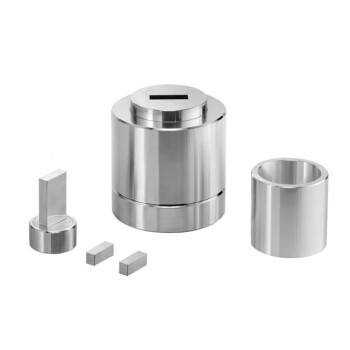
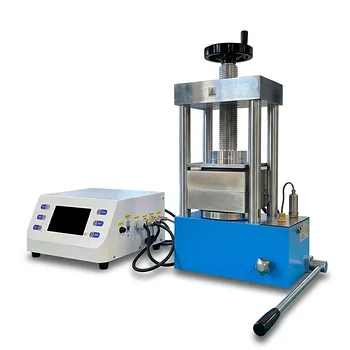
A laboratory hydraulic press serves as the critical mechanism for transforming loose, recycled polyamide powder into testable solid forms. After polyamides are recovered via solvent precipitation or supercritical CO2 processes, the press applies precise, high-tonnage force to compact the powder. This creates dense "green bodies" or standardized thin sheets necessary for accurate downstream analysis.
The primary function of the press in this context is densification: it mechanically forces air out of the loose powder to eliminate internal micropores, ensuring that subsequent analytical data reflects the material's properties rather than its packing defects.
The Mechanics of Sample Preparation
Consolidating Precipitated Powder
Solvent precipitation results in a loose, often low-density powder. A hydraulic press uses a die or mold to compress this disparate material into a cohesive solid.
This compaction is essential to convert the "fluff" of recovered material into a handleable green body (a compacted part before sintering or melting) or a flat sheet.
Eliminating Microstructural Defects
The specific value of the hydraulic press lies in its ability to remove internal micropores.
By applying controlled pressure, the press collapses voids between powder particles. This results in a sample with uniform density, which is a prerequisite for reliable physical testing.
Why Densification is Critical for Analysis
Enhancing Infrared Spectroscopy Accuracy
For techniques like infrared spectroscopy (IR), the sample surface must be consistent and dense.
If a sample retains significant porosity, it can scatter light or produce inconsistent absorption readings. The hydraulic press creates the smooth, void-free surface required to obtain high-quality spectral data.
Standardizing for Thermodynamic Testing
Thermodynamic performance testing requires samples to have a uniform mass distribution and thermal conductivity.
A press ensures that the sample—whether a pellet or a sheet—has a standardized geometry and density. This allows researchers to attribute thermal behaviors to the polyamide itself, rather than to air pockets trapped within the sample.
Preparation for Melt Reprocessing
Before the material is re-melted or extruded, it often needs to be in a compacted form to ensure even feeding and melting.
The "green bodies" created by the press provide a stable, pre-densified starting point. This facilitates smoother transitions during melt reprocessing studies.
Understanding the Trade-offs
Pressure Uniformity vs. Density Gradients
While hydraulic presses are powerful, applying pressure too quickly can trap air pockets rather than eliminating them.
If the pressure is not held for an adequate "dwell time," the sample may exhibit density gradients (hard on the outside, soft in the center). This inconsistency can lead to skewed results in mechanical or thermal testing.
The Limits of Cold Compaction
The primary reference focuses on pressure forming, often done at ambient temperatures for "green bodies."
However, without the addition of heat (hot pressing), the particles are mechanically interlocked but not fused. These samples are excellent for analysis but may lack the ultimate mechanical strength of a fully melted part.
Making the Right Choice for Your Goal
To get the most out of your hydraulic press during polyamide recovery, align your parameters with your specific testing needs:
- If your primary focus is Infrared Spectroscopy (IR): Prioritize high pressure and smooth mold surfaces to minimize surface scattering and maximize signal clarity.
- If your primary focus is Melt Reprocessing: Aim for a moderate density that creates a stable "green body" capable of being handled without crumbling, rather than maximum optical clarity.
- If your primary focus is Thermodynamic Testing: Ensure consistent dwell times during pressing to guarantee uniform density throughout the entire thickness of the sample.
The hydraulic press is not just a crushing tool; it is a standardization device that ensures your recycled polyamide data is reproducible and valid.
Summary Table:
| Process Stage | Function of Hydraulic Press | Impact on Analysis |
|---|---|---|
| Powder Consolidation | Converts loose precipitate into cohesive "green bodies" | Facilitates handling and standardized geometry |
| Defect Elimination | Removes internal micropores and voids | Ensures data reflects material properties, not packing defects |
| Surface Preparation | Creates smooth, void-free sample surfaces | Enhances Infrared Spectroscopy (IR) signal clarity and accuracy |
| Thermal Standardization | Ensures uniform mass distribution and conductivity | Improves reproducibility in thermodynamic performance testing |
| Melt Pre-processing | Produces stable, pre-densified starting material | Guarantees even feeding and melting during reprocessing studies |
Elevate Your Polymer Research with KINTEK Precision
Ensure your recycled polyamide data is reproducible and valid with KINTEK’s high-performance laboratory hydraulic presses. Whether you need manual, automatic, or heated pellet, hot, or isostatic presses, our equipment is engineered to eliminate microstructural defects and deliver the uniform density required for critical IR spectroscopy and thermodynamic testing.
Beyond sample preparation, KINTEK specializes in a comprehensive range of laboratory solutions, including:
- High-Temperature Furnaces: Muffle, vacuum, and CVD systems for advanced material processing.
- Sample Preparation: Crushing, milling, and sieving equipment for consistent feedstock.
- Advanced Reactors: High-temperature high-pressure reactors and autoclaves for polymer synthesis.
- Specialized Consumables: PTFE products, ceramics, and crucibles for contamination-free results.
Ready to transform your loose precipitates into high-quality test samples? Contact KINTEK today to find the perfect press for your lab!
References
- Lin Zheng, Chonggang Wu. Recycling and Degradation of Polyamides. DOI: 10.3390/molecules29081742
This article is also based on technical information from Kintek Solution Knowledge Base .
Related Products
- Automatic Laboratory Hydraulic Pellet Press Machine for Lab Use
- Laboratory Hydraulic Press Split Electric Lab Pellet Press
- Laboratory Manual Hydraulic Pellet Press for Lab Use
- Assemble Square Lab Press Mold for Laboratory Applications
- Laboratory Hydraulic Press Lab Pellet Press for Button Battery
People Also Ask
- What is the role of a laboratory hydraulic pellet press and stainless steel molds in the fabrication of RuO2/NbC anodes?
- What role does a laboratory pellet press play in the enhancement of biomass energy products? Optimize Fuel Efficiency
- What is the purpose of using a laboratory pellet press when evaluating the electronic conductivity of carbon powders? Guide
- How does a laboratory hydraulic pellet press contribute to SiCw/2024 aluminum composite preforms? Optimize Densification
- What is the significance of applying 200 MPa of pressure with a laboratory hydraulic pellet press for composite ceramics?