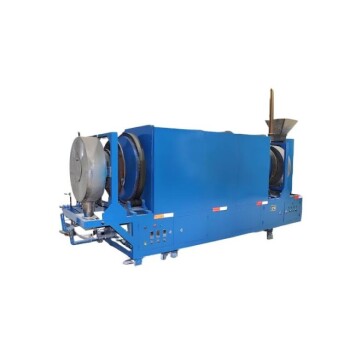
A laboratory tube heating furnace achieves specific reaction environments through precise multi-zone temperature control and strategic reactor positioning. By maintaining the reactor center within a high-temperature zone capable of reaching 1140°C while keeping the ends external to the heating source, researchers can isolate thermal variables effectively. This physical configuration is paired with vacuum or slight positive pressure systems to strictly regulate atmospheric composition during failure analysis.
By decoupling the high-temperature heating zone from the cooler reactor ends, this setup allows for the precise regulation of magnesium vapor partial pressure, enabling the accurate simulation of complex industrial degradation cycles.
Achieving Precision Through Zonal Control
The Role of Multi-Zone Heating
To study high-temperature failure mechanics, uniformity is critical. The furnace utilizes multi-zone temperature control to establish a stable, high-heat environment in the center of the reactor.
Strategic Physical Positioning
The configuration explicitly keeps the ends of the reactor outside the furnace. This creates a deliberate temperature differential between the sample in the center and the seals or controls at the ends.
Temperature Capabilities
This setup is designed for rigorous thermal testing, supporting temperatures up to 1140°C. This range is sufficient to induce thermal stress and phase changes in many industrial alloys.
Controlling the Reaction Environment
Managing Vapor Pressure
The primary utility of this configuration is the ability to control magnesium vapor partial pressure. By manipulating the furnace temperature and the temperature gradient along the tube, researchers can dictate how much magnesium vapor interacts with the sample.
Atmospheric Regulation
The system operates under strict atmospheric controls to prevent unwanted contamination. Experiments are conducted under either a vacuum or a slight positive pressure argon environment to isolate the specific chemical reactions being studied.
Simulating Real-World Failure Scenarios
Replicating Industrial Cycles
Real-world materials often fail because of fluctuating conditions, not static ones. This furnace configuration allows for the simulation of complex industrial cycles.
Dual-Environment Exposure
Researchers can expose alloys to alternating conditions within a single experiment. This includes simulating environments that are both oxidizing and contain magnesium vapor, which is essential for characterizing the true thermal stability of a material.
Operational Considerations and Trade-offs
Gradient Management
While keeping the ends outside the furnace protects seals, it introduces a thermal gradient. Researchers must account for heat loss at the boundaries to ensure the central reaction zone remains at the target temperature of 1140°C.
Specificity of Application
This configuration is highly specialized for vapor pressure studies, particularly magnesium. It may require recalibration or reconfiguration if the goal is to study failure modes unrelated to vapor interactions or atmospheric pressure changes.
Making the Right Choice for Your Experiment
To maximize the utility of a laboratory tube furnace for failure analysis, align the configuration with your specific data requirements.
- If your primary focus is Material Stability: Prioritize the multi-zone control features to ensure the central heating zone maintains a consistent 1140°C without fluctuation.
- If your primary focus is Environmental Interaction: Focus on the pressure control systems, ensuring the vacuum or argon flow can precisely maintain the required magnesium vapor partial pressure.
Success in high-temperature failure studies relies on the precise intersection of thermal consistency and atmospheric control.
Summary Table:
| Feature | Configuration Detail | Benefit for Failure Studies |
|---|---|---|
| Temperature Range | Up to 1140°C | Enables induction of thermal stress and phase changes in alloys. |
| Heating Zones | Multi-zone temperature control | Ensures a stable and uniform high-heat environment in the reactor center. |
| Physical Setup | External reactor ends | Protects seals and creates controlled temperature gradients. |
| Atmospheric Control | Vacuum or positive Argon pressure | Regulates magnesium vapor partial pressure and prevents contamination. |
| Study Application | Complex industrial cycling | Replicates real-world oxidizing and magnesium vapor environments. |
Elevate Your Material Research with KINTEK Precision
Don't let inconsistent thermal gradients compromise your high-temperature failure analysis. KINTEK specializes in advanced laboratory equipment designed for the most demanding research environments. Our comprehensive range of tube furnaces, vacuum systems, and CVD/PECVD solutions provides the precise multi-zone control and atmospheric regulation needed to simulate complex industrial cycles accurately.
Whether you are performing magnesium vapor studies or testing the thermal stability of new alloys, our high-performance crushing and milling systems, hydraulic presses, and ceramic consumables ensure your workflow is seamless from sample preparation to final analysis.
Ready to achieve superior accuracy in your lab? Contact KINTEK today to discuss your specific configuration needs and discover how our specialized equipment can drive your next breakthrough.
References
- Namurata Sathirachinda Pålsson, Sinthu Chanthapan. Effect of liquid magnesium on high temperature failure of heat resistant alloy. DOI: 10.1016/j.engfailanal.2017.03.021
This article is also based on technical information from Kintek Solution Knowledge Base .
Related Products
- 1400℃ Laboratory High Temperature Tube Furnace with Alumina Tube
- 1700℃ Laboratory High Temperature Tube Furnace with Alumina Tube
- Laboratory Rapid Thermal Processing (RTP) Quartz Tube Furnace
- Multi-zone Laboratory Tube Furnace
- 1200℃ Split Tube Furnace with Quartz Tube Laboratory Tubular Furnace
People Also Ask
- What roles does a high-temperature tube furnace play in the synthesis of N/O co-doped carbon? Master Precise Doping
- What functions does a laboratory high-temperature tube furnace perform? Master Catalyst Synthesis & Carbonization
- How does a laboratory tube furnace facilitate methane catalyst evaluation & regeneration? Optimize Thermal Performance
- Why is a high-temperature tube furnace core to carbon black recovery? Master Precision Pyrolysis & Material Regeneration
- What function does a high-temperature tube furnace serve in alkali fusion hydroxide recovery? Precision Thermal Control