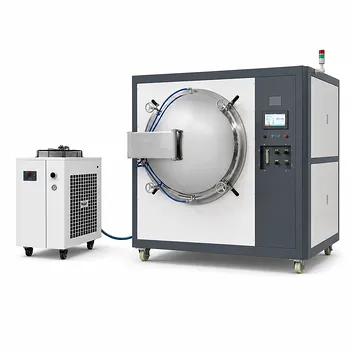
Rapid-heating induction furnaces provide a distinct advantage over traditional resistance furnaces by utilizing electromagnetic induction to achieve significantly higher heating rates. This method heats the metal sample directly from within, rather than relying on external thermal transfer. This speed is crucial for isolating specific metallurgical events, as it minimizes the window of time in which unwanted atomic diffusion can occur during the ramp-up to temperature.
By significantly shortening the heating cycle, rapid-heating induction minimizes excessive diffusion. This allows you to observe transient, non-equilibrium interface reactions and dislocation nucleation that would be obscured by the slower thermal accumulation of a resistance furnace.
The Critical Role of Heating Rate in Phase Analysis
Eliminating Thermal Lag
Traditional resistance furnaces operate by heating a heating element, which then transfers heat to the sample via radiation and convection.
This process is inherently slow.
Rapid-heating induction furnaces generate heat directly inside the metal via electromagnetic fields. This eliminates thermal lag, allowing the sample to reach target temperatures almost instantly.
Minimizing Excessive Diffusion
Time is a critical variable in phase transition studies.
During the slow ramp-up of a resistance furnace, atoms have time to diffuse across interfaces before the target temperature is reached.
Rapid induction heating effectively "freezes" the material structure until the precise moment of transformation. This prevents diffusion artifacts from distorting your data regarding the starting state of the phase transition.
Capturing Non-Equilibrium States
Many critical structural transformations are transient—they happen quickly and often outside of stable equilibrium.
Slow heating tends to drive materials toward equilibrium, effectively erasing these transient states.
The speed of induction heating allows researchers to catch and study non-equilibrium phase transitions and specific reaction kinetics that are impossible to replicate with slower heating methods.
Precision in Microstructural Observation
Observing Grain Boundary Events
The primary reference highlights the importance of this technology for studying grain boundaries.
Specifically, the suppression of diffusion allows for the precise capture of dislocation nucleation at these boundaries.
This level of detail allows researchers to correlate specific temperature points with exact structural shifts without the "noise" of pre-transformation thermal effects.
Ensuring Sample Homogeneity
Beyond speed, induction furnaces utilize electromagnetic stirring.
This natural byproduct of the induction field continuously mixes the liquid metal.
For interface studies, this ensures that the sample is chemically and thermally homogeneous, meaning a single observation point accurately represents the behavior of the entire batch.
Understanding the Trade-offs
Equipment Complexity and Cost
While induction offers superior control for kinetics, the equipment is generally more complex than resistance furnaces.
High-speed heating requires high-speed data acquisition systems to capture the rapid changes in temperature and phase.
Material Restrictions
Induction heating relies on the material's ability to conduct electricity and respond to magnetic fields.
While perfect for metals, this method is less versatile than resistance heating if your research involves non-conductive composites or ceramics alongside metals.
Making the Right Choice for Your Research
If your goal is to push the boundaries of materials science, the choice of furnace dictates the fidelity of your data.
- If your primary focus is transient kinetics: Choose rapid-heating induction to minimize diffusion and capture non-equilibrium states.
- If your primary focus is sample purity: Rely on induction to eliminate combustion byproducts and minimize the loss of volatile alloying elements.
- If your primary focus is grain boundary mechanics: Use induction to isolate specific dislocation events without the interference of prolonged thermal exposure.
For precise, time-resolved analysis of metal interfaces, speed is not just a convenience—it is a variable that determines the validity of your results.
Summary Table:
| Feature | Rapid-Heating Induction Furnace | Traditional Resistance Furnace |
|---|---|---|
| Heating Mechanism | Internal electromagnetic induction | External radiation & convection |
| Heating Rate | Ultra-fast (nearly instant) | Slow (limited by thermal lag) |
| Diffusion Control | Minimizes unwanted atomic diffusion | High risk of diffusion artifacts |
| Phase Observation | Captures transient & non-equilibrium states | Limited to equilibrium states |
| Homogeneity | High (electromagnetic stirring) | Moderate (static heat) |
| Best Application | Kinetics & interface phase transitions | General heat treatment |
Elevate Your Materials Research with KINTEK Precision
Don't let thermal lag and diffusion artifacts compromise your metallurgical data. KINTEK specializes in advanced laboratory solutions, providing high-performance induction melting and high-temperature furnaces designed to capture transient phase transitions with unmatched accuracy.
Whether you are studying grain boundary mechanics or dislocation nucleation, our comprehensive portfolio—from crushing and milling systems to high-pressure reactors and battery research tools—ensures your lab is equipped for the future of materials science.
Ready to achieve high-fidelity results? Contact us today to find the perfect heating solution for your lab!
References
- Saryu Fensin, Jian Luo. Deformation and Transitions at Interfaces and Grain Boundaries. DOI: 10.1007/s11837-019-03390-2
This article is also based on technical information from Kintek Solution Knowledge Base .
Related Products
- Laboratory Rapid Thermal Processing (RTP) Quartz Tube Furnace
- 600T Vacuum Induction Hot Press Furnace for Heat Treat and Sintering
- Vacuum Arc Induction Melting Furnace
- Lab-Scale Vacuum Induction Melting Furnace
- Non Consumable Vacuum Arc Induction Melting Furnace
People Also Ask
- What technical advantages does an RTP tube furnace offer for photoelectrodes? Achieve Precision & High Phase Purity
- How does a quartz tube furnace facilitate the synthesis of rGO? Optimize Your Cathode Matrix with Precise Pyrolysis
- What is the temperature of a quartz tube furnace? Master the Limits for Safe, High-Temp Operation
- What are the advantages of using an electric heating furnace with a quartz tube for liquid bismuth corrosion control?
- What is the maximum temperature for a quartz tube furnace? Key Limits for Safe & Efficient Operation