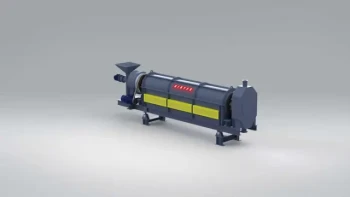
The primary advantage of integrating carbonization and activation furnaces is the creation of a self-sustaining, vertical system that combines dehydration, drying, preheating, and high-temperature activation into a single continuous process. This unified design leverages energy cascade utilization to recycle heat and steam between stages, significantly reducing energy loss and the need for external fuel sources.
Core Takeaway The true power of this integration lies in process synergy: combustible gases from activation fuel the carbonization step, while steam from carbonization drives the activation step. This closed-loop approach transforms waste byproducts into essential operational resources.
Streamlining the Production Workflow
Unifying Processing Stages
Traditional processing often requires separate units for different stages of treatment. An integrated vertical system consolidates dehydration, drying, preheating, and activation into one machine.
Simplifying Material Handling
By moving organic residues like Chinese medicine waste through a single vertical path, the complexity of material transport is reduced. This direct flow minimizes the thermal loss that typically occurs when transferring materials between separate distinct processing units.
Maximizing Energy Efficiency through Cascade Utilization
Recycling Combustible Gases
In a standalone setup, gases generated during high-temperature activation might be wasted. In this integrated system, the combustible gases from the activation phase are harvested.
Fueling the Carbonization Phase
These captured gases are redirected to provide the necessary heat for the earlier carbonization phase. This effectively turns the system's output into its own fuel input, drastically minimizing the requirement for external fuel.
Optimizing Resource Usage with Thermal Steam
Repurposing Carbonization Byproducts
The carbonization process naturally generates thermal steam as moisture is driven out of the organic residue. In many systems, this steam is simply vented as exhaust.
Driving the Activation Process
In the integrated design, this thermal steam is reintroduced into the activation furnace. Here, it functions as the "activator" required to develop the pore structure of the carbon, eliminating the need to generate fresh steam from a separate boiler.
Understanding the Operational Trade-offs
The Necessity of Balance
While the energy cascade offers high efficiency, it creates a dependency between stages. The system relies on the activation phase producing enough gas to heat the carbonization phase, and the carbonization phase producing enough steam to activate the material.
Process Stability
If the feedstock varies significantly—such as inconsistent moisture content in the medicine waste—it may disrupt this thermal balance. Operators must ensure a consistent input to maintain the synergy of the feedback loops.
Making the Right Choice for Your Goal
To determine if this integrated system aligns with your processing requirements, consider your primary operational targets:
- If your primary focus is Operational Cost Reduction: The energy cascade capability is your deciding factor, as it drastically lowers fuel bills by using internal gas and steam generation.
- If your primary focus is System Footprint and Flow: The vertical integration is key, as it eliminates the need for multiple, disconnected processing units for drying and activation.
This system is best suited for scenarios where long-term efficiency and reduced external resource consumption outweigh the need for modular, independent process control.
Summary Table:
| Feature | Integrated Vertical System | Traditional Split System |
|---|---|---|
| Energy Source | Internal combustible gases & steam recycling | External fuel and separate steam boilers |
| Process Flow | Single vertical path (Drying to Activation) | Multiple disconnected transport stages |
| Operational Cost | Significantly lower due to energy cascade | Higher due to heat loss and fuel requirements |
| Waste Handling | Optimized for consistent organic residues | Better for highly variable feedstock |
| Thermal Efficiency | High (Closed-loop heat utilization) | Lower (Heat loss during material transfer) |
Maximize Your Resource Recovery with KINTEK
Transform organic residues like Chinese medicine waste into high-value activated carbon with KINTEK’s advanced integrated furnace solutions. By leveraging our expertise in high-temperature furnaces, crushing systems, and rotary processing technology, we help laboratories and industrial facilities achieve a self-sustaining, energy-efficient production cycle.
Why choose KINTEK?
- Energy Cascade Optimization: Reduce external fuel costs by recycling process gases.
- Comprehensive Lab Portfolio: From high-temperature furnaces to precision hydraulic presses, we provide the full suite of tools for material research.
- Expert Support: Tailored solutions for drying, preheating, and activation workflows.
Ready to streamline your waste processing and lower operational costs? Contact our experts today to find the perfect system for your application!
References
- Shuo Shao, Simiao Wang. An activated carbon preparation device using traditional Chinese medicine waste residue as raw material. DOI: 10.25236/ijfet.2023.051115
This article is also based on technical information from Kintek Solution Knowledge Base .
Related Products
- Electric Rotary Kiln Small Rotary Furnace for Activated Carbon Regeneration
- Chemical Vapor Deposition CVD Equipment System Chamber Slide PECVD Tube Furnace with Liquid Gasifier PECVD Machine
- Customizable CO2 Reduction Flow Cell for NRR ORR and CO2RR Research
- Graphite Vacuum Furnace IGBT Experimental Graphitization Furnace
People Also Ask
- What is a rotary kiln electric furnace? Achieve Superior Uniform Heating for Your Materials
- What is the temperature of activated carbon regeneration? Unlock the 1000°F Process for Reuse
- What is the regeneration temperature of activated carbon? Optimize Your Process with the Right Method
- What are the characteristics of the slipping, slumping, and rolling modes of bed motion? Optimize Your Rotary Process
- What are the parts of a carbon regeneration kiln? A Guide to Its Core Components and Function