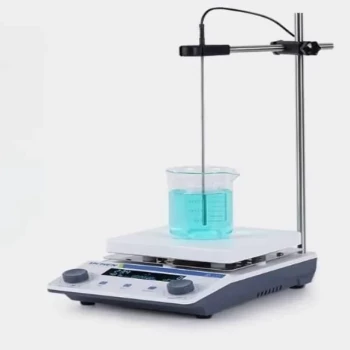
The primary advantage of a high-pressure reactor with magnetic stirring is the assurance of homogeneity. This system facilitates full contact between CO2, deionized water, and mineral samples, ensuring accurate phase equilibrium is reached under specific pressure conditions. By continuously mixing the fluid, the reactor eliminates concentration gradients, significantly accelerating the time required to reach saturation.
Core Takeaway Continuous magnetic stirring drives the system to thermodynamic equilibrium faster by removing concentration hotspots within the fluid. This results in the rapid and precise determination of ion concentrations, which is critical for establishing reliable dissolution rate baselines.
Achieving Thermodynamic Equilibrium
Ensuring Full Phase Contact
To obtain valid solubility data, the reactants—specifically CO2, deionized water, and mineral samples—must interact completely.
A high-pressure reactor designed with magnetic stirring forces these distinct phases into full contact. This mechanical integration is necessary to establish a true phase equilibrium that reflects the specific pressure conditions of your test environment.
Eliminating Concentration Gradients
In static or poorly mixed systems, dissolved ions can accumulate near the mineral surface, creating localized zones of high concentration.
Continuous magnetic stirring actively circulates the fluid, preventing these concentration gradients from forming. This ensures that the fluid composition remains uniform throughout the reactor, providing a representative sample for analysis.
Operational Efficiency and Accuracy
Accelerating Saturation Time
Time is often a constraint in solubility testing. Passive diffusion is a slow process that delays the point at which the solution becomes saturated.
By using magnetic stirring to eliminate gradients, you significantly accelerate the time required to reach saturation. This allows you to gather necessary data points much faster than with static methods.
Establishing Accurate Baselines
The ultimate goal of these tests is to determine equilibrium ion concentrations.
The combination of full phase contact and homogeneity results in the fast and accurate determination of these concentrations. Precise data here is non-negotiable, as it serves as the foundation for your dissolution rate baselines.
Common Pitfalls to Avoid
The Risk of Static Testing
While high-pressure reactors are powerful, failing to utilize the stirring mechanism effectively undermines the data.
Without continuous agitation, you risk measuring a false equilibrium. The presence of concentration gradients means your sampling may not reflect the true saturation state of the entire volume, leading to skewed baselines and unreliable dissolution rates.
Making the Right Choice for Your Experiment
To maximize the utility of your solubility tests, align your operational parameters with your specific data requirements:
- If your primary focus is Speed: Utilize continuous stirring to minimize the duration required to reach full saturation.
- If your primary focus is Accuracy: Rely on magnetic mixing to ensure homogeneity and eliminate spatial variations in ion concentration.
Consistency in stirring is the key to transforming raw experimental conditions into precise, repeatable dissolution baselines.
Summary Table:
| Feature | Benefit for Mineral Solubility Tests |
|---|---|
| Magnetic Stirring | Eliminates concentration gradients and ensures fluid homogeneity. |
| Phase Integration | Facilitates full contact between CO2, water, and mineral samples. |
| Fast Equilibrium | Significantly reduces the time required to reach saturation. |
| Data Reliability | Provides accurate ion concentration baselines for dissolution rates. |
| High-Pressure Capability | Enables testing under realistic geological or industrial conditions. |
Elevate Your Geochemical Research with KINTEK
Precision in mineral solubility testing starts with the right equipment. KINTEK specializes in advanced laboratory solutions, including high-performance high-temperature high-pressure reactors and autoclaves designed for rigorous phase equilibrium studies.
Our magnetic stirring systems ensure your experiments achieve thermodynamic equilibrium faster and more accurately, providing the reliable baselines your research demands. Beyond reactors, we offer a comprehensive range of crushing and milling systems, PTFE consumables, and cooling solutions to support your entire laboratory workflow.
Ready to optimize your testing efficiency? Contact KINTEK today to consult with our experts on the perfect reactor configuration for your target applications.
References
- Jingxia Wang, Qingchun Yu. Experimental Investigations of the Process of Carbonate Fracture Dissolution Enlargement under Reservoir Temperature and Pressure Conditions. DOI: 10.1155/2018/5971421
This article is also based on technical information from Kintek Solution Knowledge Base .
Related Products
- Laboratory Small Constant Temperature Heated Magnetic Stirrer Heater and Stirrer
- Mini SS High Pressure Autoclave Reactor for Laboratory Use
- Stainless High Pressure Autoclave Reactor Laboratory Pressure Reactor
- Customizable High Pressure Reactors for Advanced Scientific and Industrial Applications
- Customizable Laboratory High Temperature High Pressure Reactors for Diverse Scientific Applications
People Also Ask
- What role does a magnetic stirrer with heating play in ZnO nanoparticle synthesis? Precision Control for Quality Results
- What role does a constant temperature heating magnetic stirrer play in MFC-HAp synthesis? Achieve Material Homogeneity
- What is the function of a laboratory magnetic stirrer in Ni–Cr–P electrodeposition? Optimize Ion Transport & Coating
- Why is a laboratory magnetic stirrer required for benzoic acid esters? Boost Reaction Speed & Yield with High RPM
- What role does a laboratory magnetic stirrer play in TiO2 and TiO2-Ag sol preparation? Master Chemical Kinetics