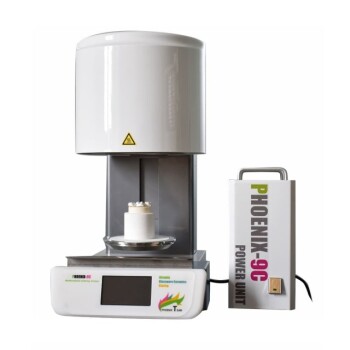
A hydrogen atmosphere sintering furnace outperforms argon systems for 316L stainless steel because it acts as both a superior thermal conductor and a powerful chemical reducing agent. While argon merely protects the metal from further oxidation, hydrogen actively removes existing surface oxides and residual carbon. This active chemistry promotes faster atomic diffusion and more effective pore closure, allowing 316L components to reach relative densities exceeding 98%.
Core Takeaway: Choosing hydrogen over argon shifts the sintering process from a passive "protective" state to an active "refining" state. This transition is essential for achieving the ultra-high density and purity required for high-performance 316L stainless steel components.
Superior Thermal Dynamics and Uniformity
Enhanced Thermal Conductivity
Hydrogen possesses a thermal conductivity approximately 10 times higher than that of argon. This property allows the furnace to transfer heat to the 316L parts with much greater efficiency and speed.
Reduction of Temperature Gradients
High conductivity effectively minimizes temperature gradients within both the furnace chamber and the individual parts. This uniformity ensures that the entire component reaches the sintering temperature simultaneously, preventing warping and internal stresses.
Rapid Cycle Times
The thermal properties of hydrogen support faster temperature rise and fall rates. This responsiveness increases overall production throughput and allows for more precise control over the sintering cycle's cooling phase.
Active Chemical Refining and Purity
Reduction of Metal Oxides
Unlike inert argon, hydrogen is a strong reducing agent that chemically reacts with surface impurities. It eliminates chromium oxide and ferrous oxide, ensuring that metal powders bond directly without a "skin" of contamination.
Residual Carbon Control
Hydrogen is critical for removing residual carbon left behind by binders during the burnout stage. By reacting with this carbon, the atmosphere prevents the formation of brittle phases and maintains the desired chemistry of the 316L alloy.
Elimination of Impurity Phases
The chemical cleaning action of a hydrogen atmosphere ensures a clean furnace environment. By stripping away oxygen and carbon, it prevents the formation of unwanted secondary phases that can compromise the part's integrity.
Achieving High Density and Performance
Accelerated Atomic Diffusion
By providing a surface free of oxides, hydrogen facilitates faster atomic diffusion between metal particles. This metallurgical bonding is the primary driver for shrinking the pore structure remaining after the debinding process.
Superior Densification Results
The combined effects of high thermal uniformity and chemical purity allow 316L stainless steel to reach relative densities greater than 98%. This level of density is difficult to achieve in an argon environment where oxides may persist.
Improved Mechanical and Corrosion Properties
High-density parts produced in hydrogen exhibit enhanced corrosion resistance and mechanical strength. The removal of oxides and carbon ensures that the 316L retains its characteristic "stainless" properties throughout its cross-section.
Understanding the Trade-offs
Safety and Infrastructure Requirements
Hydrogen is highly flammable and explosive, requiring sophisticated leak detection and safety interlocks that are not necessary for argon systems. This complexity often results in higher initial capital expenditures for equipment and facility safety.
Operational Costs and Complexity
High-purity hydrogen is often more expensive than argon and requires precise atmosphere control to prevent "hydrogen embrittlement" in certain alloys. While 316L is generally resistant to this, the process demands rigorous monitoring of gas purity and dew point.
Inert vs. Active Protection
Argon is purely inert and does not react with the powder, which makes it safer but incapable of "fixing" existing contamination. If your 316L powder has high initial oxygen content, an argon atmosphere will be unable to remove it, leading to lower final densities.
Making the Right Choice for Your Goal
To maximize the quality of your 316L stainless steel parts, consider your specific production priorities:
- If your primary focus is Maximum Density: Use a hydrogen atmosphere to eliminate oxides and promote the atomic diffusion necessary for densities over 98%.
- If your primary focus is Corrosion Resistance: Use hydrogen to ensure the complete removal of chromium oxides and carbon impurities that can lead to intergranular corrosion.
- If your primary focus is Safety and Ease of Operation: An argon atmosphere offers a simpler, lower-risk environment, though you may sacrifice final part density and purity.
- If your primary focus is High-Volume Throughput: Choose hydrogen for its superior thermal conductivity, which allows for faster heating and cooling cycles.
Selecting a hydrogen atmosphere furnace is the definitive choice for manufacturers who prioritize metallurgical purity and the highest possible density for their 316L stainless steel components.
Summary Table:
| Feature | Hydrogen Atmosphere | Argon Atmosphere |
|---|---|---|
| Primary Role | Active Reducing Agent & Refiner | Passive Protective Shield |
| Thermal Conductivity | ~10x Higher (Rapid heat transfer) | Lower (Slower thermal response) |
| Oxide Removal | Chemically removes Cr/Fe oxides | No oxide reduction capability |
| Final Density | Superior (>98% relative density) | Lower (Oxide 'skin' persists) |
| Carbon Control | Active removal of binder residues | Limited to passive protection |
| Safety/Complexity | High (Requires leak detection) | Low (Inert and simple) |
Optimize Your Sintering Process with KINTEK
Achieve unmatched metallurgical purity and maximum density in your 316L stainless steel components. KINTEK specializes in high-performance laboratory equipment, offering a precision-engineered range of atmosphere furnaces, vacuum furnaces, and CVD/PECVD systems tailored for advanced material research and production.
Whether you need to reach >98% density through hydrogen reduction or require robust crushing, milling, and hydraulic press solutions for sample preparation, our experts are here to help you select the right configuration for your laboratory.
Ready to elevate your material properties? Contact us today to find your ideal furnace solution!
References
- Pengfei Zhu, Xuanhui Qu. Investigation on the Attainment of High-Density 316L Stainless Steel with Selective Laser Sintering. DOI: 10.3390/ma17010110
This article is also based on technical information from Kintek Solution Knowledge Base .
Related Products
- Controlled Nitrogen Inert Hydrogen Atmosphere Furnace
- Mesh belt controlled atmosphere furnace
- 1200℃ Controlled Atmosphere Furnace Nitrogen Inert Atmosphere Furnace
- 1700℃ Controlled Atmosphere Furnace Nitrogen Inert Atmosphere Furnace
- 1400℃ Controlled Atmosphere Furnace with Nitrogen and Inert Atmosphere
People Also Ask
- What is the role of a hydrogen atmosphere furnace in diamond/copper composites? Enhance Your Material Purity
- Why is hydrogen used in furnaces? Achieve Superior Purity and Bright Finishes
- What are the characteristics and risks of a hydrogen atmosphere in a furnace? Master the Balance of Power and Control
- Why is a hydrogen atmosphere furnace necessary for W-Cu composite? Unlock Superior Infiltration and Density
- What is the use of hydrogen in furnace? A Key to Oxygen-Free High-Temperature Processing