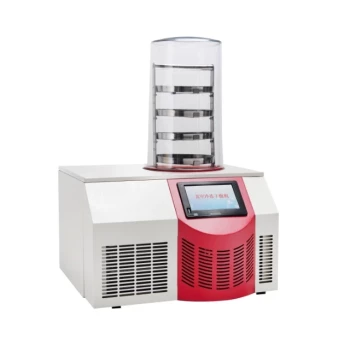
The decisive advantage of using a vacuum drying oven lies in its ability to lower solvent boiling points, enabling rapid evaporation without the destructive high heat associated with atmospheric drying. By reducing the internal pressure, you preserve the delicate Metal-Organic Framework (MOF) structure and prevent the premature oxidation of organic ligands, which is essential for successfully anchoring single iridium atoms.
Core Takeaway Atmospheric drying relies on high heat that often collapses the porous architecture of catalyst precursors. Vacuum drying mitigates this by utilizing low pressure to remove solvents at reduced temperatures, maintaining the structural integrity and ligand stability required for high-performance single-atom catalysts.
Preserving the Precursor Architecture
Preventing MOF Structure Collapse
For single-atom catalysts, the precursor often involves a Metal-Organic Framework (MOF). This framework acts as a cage to trap and disperse metal atoms.
Atmospheric drying requires high temperatures to evaporate solvents, which can cause this lattice to collapse. Vacuum drying operates at lower temperatures, ensuring the MOF structure remains intact during the critical transition from wet precursor to dry powder.
Maintaining Porous Integrity
The effectiveness of a single-atom catalyst relies heavily on its surface area and pore volume.
Vacuum drying prevents the structural shrinkage that often occurs under atmospheric conditions. By gently removing the solvent, you preserve the original porous structure of the material, providing an ideal, high-surface-area scaffold for the subsequent calcination process.
Ensuring Chemical Stability
Protecting Organic Ligands
The organic ligands within the precursor play a vital role in coordinating the iridium atoms and preventing them from aggregating.
High heat in an atmospheric oven can lead to the premature oxidation or degradation of these ligands. Vacuum drying avoids this thermal stress, keeping the ligands stable until the controlled calcination step can convert them effectively.
Preventing Thermal Sintering
Atmospheric drying exposes the material to heat that can induce particle growth before the catalyst is even formed.
Vacuum drying minimizes thermal energy, which prevents sintering and agglomeration. This ensures that the metal species remain highly dispersed rather than clumping into larger nanoparticles, which is the antithesis of a single-atom catalyst.
Common Pitfalls of Atmospheric Drying
The Risk of Oxidation
While vacuum drying creates an inert, low-oxygen environment, atmospheric drying exposes the sample to continuous oxygen flow at high temperatures.
This can degrade surface active sites and alter the oxidation state of the metal centers unpredictably. If the precursor oxidizes prematurely, the final catalytic activity is often significantly compromised.
Incomplete Solvent Removal at Safe Temperatures
To avoid thermal damage in an atmospheric oven, one might attempt to dry at lower temperatures.
However, without the assistance of vacuum pressure, this often leads to residual solvent retention. These residues can interfere with the calcination process, leading to impure final products or unpredictable structural defects.
Making the Right Choice for Your Goal
When preparing sophisticated materials like single-atom iridium-modified spinel cobalt oxides, the drying method is a structural engineering choice, not just a solvent removal step.
- If your primary focus is Atom Dispersion: Prioritize vacuum drying to preserve the ligand coordination environment that anchors single atoms.
- If your primary focus is Structural Porosity: Use vacuum drying to prevent pore collapse and maximize the surface area available for catalysis.
Vacuum drying is not merely a faster alternative; it is a requisite step for preserving the nanostructural fidelity of MOF-based single-atom catalysts.
Summary Table:
| Feature | Atmospheric Drying | Vacuum Drying |
|---|---|---|
| Temperature Required | High (Potential thermal damage) | Low (Boiling point reduction) |
| Structural Integrity | Risk of MOF/pore collapse | Preserves delicate lattice architecture |
| Chemical Stability | Risk of premature oxidation | Inert, low-oxygen environment |
| Particle Control | Higher risk of sintering/agglomeration | Minimal thermal energy, prevents clumping |
| Solvent Removal | Slower or incomplete at low temps | Rapid and thorough at low temperatures |
Elevate Your Nanotechnology Research with KINTEK
Precision is paramount when engineering high-performance catalysts like single-atom iridium-modified cobalt oxides. KINTEK specializes in advanced laboratory equipment designed to protect your most sensitive precursors.
Our high-performance vacuum drying ovens provide the precise pressure and temperature control necessary to prevent structural collapse and oxidation, ensuring the integrity of your Metal-Organic Frameworks (MOFs). Beyond drying solutions, KINTEK offers a comprehensive range of high-temperature furnaces (muffle, tube, vacuum, CVD), crushing and milling systems, and high-pressure reactors tailored for catalysis and battery research.
Maximize your catalyst's surface area and atomic dispersion today. Contact our specialists at KINTEK to find the perfect drying and thermal processing solution for your laboratory.
References
- Zhirong Zhang, Jie Zeng. Distance effect of single atoms on stability of cobalt oxide catalysts for acidic oxygen evolution. DOI: 10.1038/s41467-024-46176-0
This article is also based on technical information from Kintek Solution Knowledge Base .
Related Products
- 56L Vertical Laboratory Vacuum Drying Oven
- 23L Laboratory Vacuum Drying Oven
- Laboratory Scientific Electric Heating Blast Drying Oven
- Benchtop Laboratory Vacuum Freeze Dryer
- Dental Porcelain Zirconia Sintering Ceramic Vacuum Press Furnace
People Also Ask
- Why is a laboratory vacuum drying oven recommended for rice straw residues? Protect Your Biomass Integrity
- What role does a laboratory vacuum drying oven play in the preparation of modified multi-walled carbon nanotubes?
- What is the importance of using a laboratory vacuum drying oven? Preserving Slow-Release Microcapsule Integrity
- Why is a Laboratory Vacuum Drying Oven recommended for PBAT microspheres? Protect Sensitive Polymer Integrity
- What role does a laboratory vacuum drying oven play in processing nanoparticle powder samples? Protect Sample Integrity