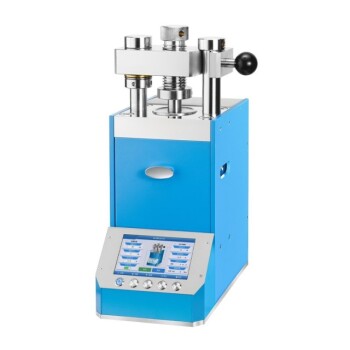
Hot isostatic pressing (HIP) fundamentally enhances the quality of high-entropy alloys by subjecting them to a simultaneous high-temperature and high-pressure environment. This process utilizes an argon atmosphere to apply omnidirectional force, effectively healing internal defects and significantly increasing material density compared to standard methods.
HIP treatment transcends simple heat treatment by forcing the closure of internal micropores and micro-cracks through extreme pressure. This leads to superior residual stress relief and the elimination of structural weaknesses that cause hydrogen embrittlement.
The Mechanics of Material Densification
Utilizing Extreme Environmental Parameters
To achieve structural improvements, HIP equipment creates an environment of 1150 °C combined with 150 MPa of pressure. This pressure is typically applied using an inert argon gas atmosphere.
Omnidirectional Defect Closure
The defining mechanism of this process is the application of omnidirectional pressure. Because the pressure is applied equally from all directions, it forces the physical closure of internal anomalies within the printed alloy.
Eliminating Microscopic Voids
Specifically, this process targets and resolves micropores and micro-cracks that occur during fabrication. By closing these voids, HIP significantly increases the overall density of the material, resulting in a more solid and uniform component.
Superior Stress Relief and Durability
Outperforming Standard Annealing
While standard annealing in a furnace provides some stress relief, HIP treatment is significantly more thorough. The combination of heat and pressure reduces residual stress down to approximately 44 MPa.
Preventing Critical Failure Modes
Beyond density, the removal of structural defects serves a vital safety function. Eliminating these defects removes the initiation points for hydrogen embrittlement, a common cause of catastrophic material failure.
Understanding the Trade-offs
The Limitations of Standard Annealing
It is critical to understand that standard furnace annealing is often insufficient for high-performance applications. While annealing treats the material thermally, it lacks the pressure mechanism required to physically close internal voids.
Structural Integrity Risks
By skipping HIP and relying on standard methods, you leave micropores and cracks intact within the alloy. These remaining defects act as stress concentrators and potential sites for embrittlement, compromising the long-term reliability of the part.
Making the Right Choice for Your Goal
When deciding on a post-treatment strategy for high-entropy alloys, consider your specific performance requirements:
- If your primary focus is maximizing material density: Utilize HIP to leverage omnidirectional pressure, which physically forces the closure of internal micropores and cracks.
- If your primary focus is critical durability and safety: Choose HIP to lower residual stress to ~44 MPa and eliminate the structural defects that lead to hydrogen embrittlement.
HIP equipment provides the definitive solution for converting printed alloys into fully dense, high-integrity components.
Summary Table:
| Feature | Standard Annealing | Hot Isostatic Pressing (HIP) |
|---|---|---|
| Mechanism | Thermal Treatment | Heat + Omnidirectional Pressure |
| Internal Defects | Remains Intact (Micropores/Cracks) | Physically Closed/Healed |
| Material Density | Lower / Inconsistent | Maximized / Near-Theoretical |
| Residual Stress | Partially Reduced | Significantly Lowered (~44 MPa) |
| Failure Resistance | Risk of Hydrogen Embrittlement | High Resistance to Fatigue & Failure |
Elevate Your Alloy Performance with KINTEK
Don't let internal micropores and residual stress compromise your high-performance materials. KINTEK specializes in advanced laboratory solutions, including high-precision isostatic presses designed to transform your high-entropy alloys into fully dense, high-integrity components. Whether you need reliable crushing and milling systems or specialized high-temperature furnaces, our comprehensive portfolio is engineered to meet the rigorous demands of material science.
Ready to eliminate structural weaknesses and ensure long-term reliability? Contact KINTEK today to find the perfect HIP solution for your lab!
References
- Shulu Feng, Lei Han. Effect of Annealing and Hot Isostatic Pressing on the Structure and Hydrogen Embrittlement Resistance of Powder-Bed Fusion-Printed CoCrFeNiMn High-Entropy Alloys. DOI: 10.3390/met13030630
This article is also based on technical information from Kintek Solution Knowledge Base .
Related Products
- Warm Isostatic Press for Solid State Battery Research
- Electric Split Lab Cold Isostatic Press CIP Machine for Cold Isostatic Pressing
- Manual Cold Isostatic Pressing Machine CIP Pellet Press
- Electric Lab Cold Isostatic Press CIP Machine for Cold Isostatic Pressing
- Automatic Lab Cold Isostatic Press CIP Machine Cold Isostatic Pressing
People Also Ask
- What is the temperature of a warm isostatic press? Achieve Optimal Densification for Your Materials
- What is the function of a Warm Isostatic Press (WIP) in all-solid-state pouch cells? Optimize Battery Density
- Why are Warm Isostatic Presses (WIP) necessary for solid-state batteries? Achieve Atomic-Level Contact
- What advantages does a warm isostatic press offer over a traditional uniaxial press for Li6PS5Cl electrolyte sheets?
- How do warm isostatic presses improve dry electrode performance? Enhance ASSB Conductivity with Heat & Pressure