Knowledge Resources What are the ceramic materials applicable to sintering? A Guide to Choosing the Right Material
Author avatar

Tech Team · Kintek Solution

Updated 2 months ago

What are the ceramic materials applicable to sintering? A Guide to Choosing the Right Material


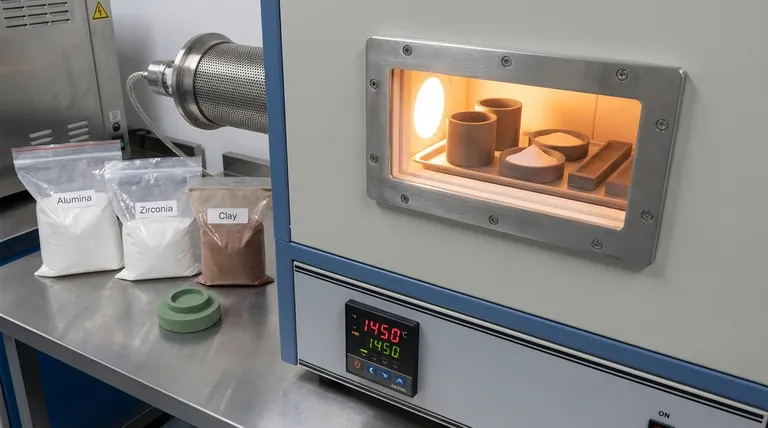
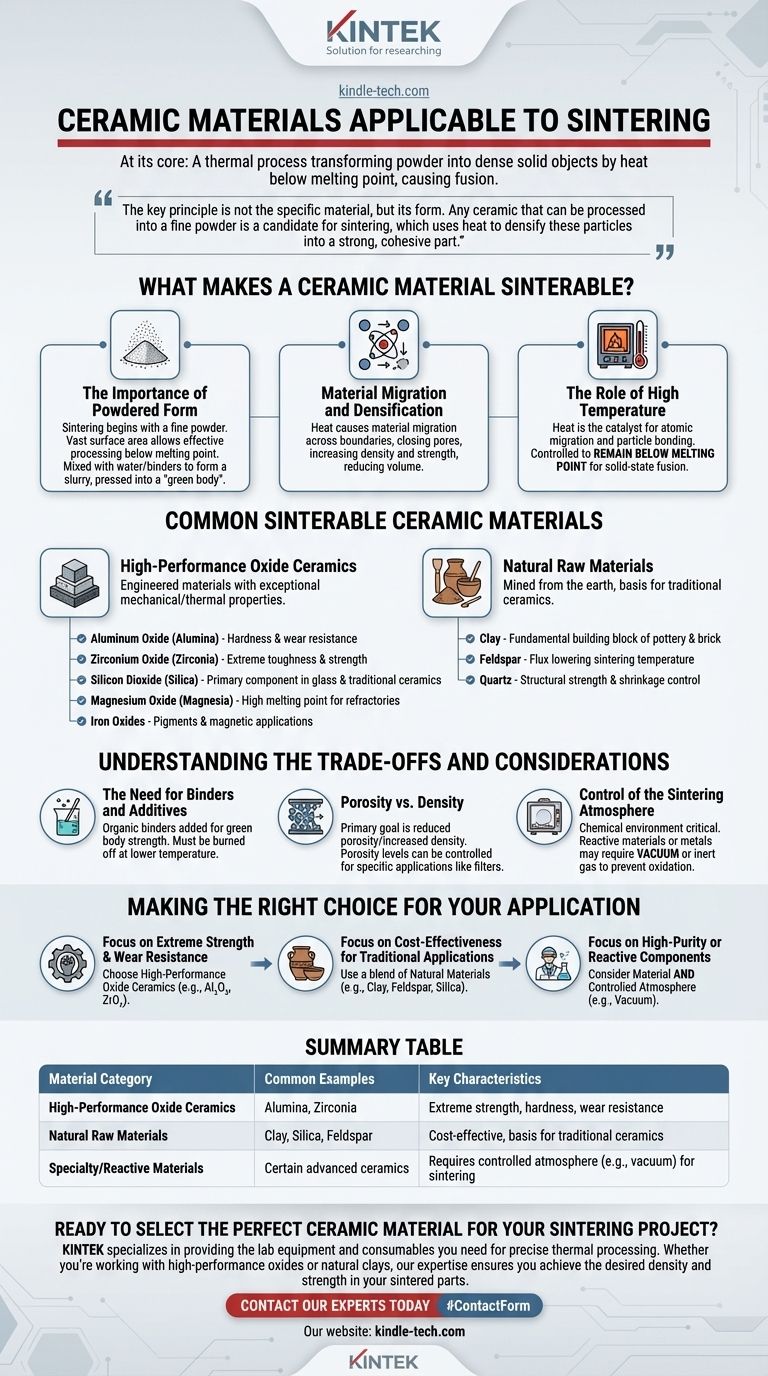
At its core, sintering is a thermal process applicable to a wide range of ceramic materials, most notably oxides like alumina and zirconia, as well as natural materials such as clay and silica. The process transforms these materials from a powdered state into a solid, dense object by applying high heat below their melting point, causing the individual particles to fuse together.

The key principle is not the specific material, but its form. Any ceramic that can be processed into a fine powder is a candidate for sintering, which uses heat to densify these particles into a strong, cohesive part.
What are the ceramic materials applicable to sintering? A Guide to Choosing the Right Material

What Makes a Ceramic Material Sinterable?

The ability to sinter a material is less about its chemical name and more about its physical form and how it behaves under heat. The entire process is built on a few fundamental principles.

The Importance of Powdered Form

Sintering begins with a fine powder. The vast surface area of these tiny particles is what allows the process to work effectively at temperatures below the material's melting point.

The process often involves mixing this powder with water and binders to form a slurry, which is then dried and pressed into the desired shape, known as a "green body."

Material Migration and Densification

When the green body is heated in a furnace, atoms move across the boundaries of the particles in a process called material migration.

This atomic movement closes the gaps (or pores) between particles. The result is a significant increase in the material's density and strength, and a reduction in its overall volume.

The Role of High Temperature

Heat is the catalyst for sintering. It provides the energy needed for atoms to migrate and for the particles to bond.

However, this temperature is carefully controlled to remain below the material's melting point. The goal is to fuse the particles together in a solid state, not to melt the material into a liquid.

Common Sinterable Ceramic Materials

While many ceramics can be sintered, they generally fall into a few key categories based on their composition and origin.

High-Performance Oxide Ceramics

These are engineered materials known for their exceptional mechanical and thermal properties. Common examples include:

  • Aluminum Oxide (Alumina): Valued for its hardness and wear resistance.
  • Zirconium Oxide (Zirconia): Known for its extreme toughness and strength.
  • Silicon Dioxide (Silica): A primary component in many glasses and traditional ceramics.
  • Magnesium Oxide (Magnesia): Used in refractory applications due to its high melting point.
  • Iron Oxides: Often used as pigments or in magnetic applications.

Natural Raw Materials

These materials are mined from the earth and form the basis of traditional ceramics like porcelain and earthenware.

  • Clay: The fundamental building block of most traditional pottery and brick.
  • Feldspar: Acts as a flux, lowering the sintering temperature of clay bodies.
  • Quartz: Provides structural strength and controls shrinkage during firing.

Understanding the Trade-offs and Considerations

Successfully sintering a ceramic part requires more than just heat. Several factors must be managed to achieve the desired outcome.

The Need for Binders and Additives

Some ceramic powders do not mix well with water or hold their shape after being pressed. In these cases, organic binders are added to the initial mix.

These binders give the green body strength but must be completely burned off at a lower temperature before the final high-temperature sintering begins.

Porosity vs. Density

The primary goal of sintering is to reduce porosity and increase density. A fully densified part is stronger and less permeable to fluids.

However, some applications, like filters, require a specific level of controlled porosity. The sintering time and temperature can be adjusted to achieve this balance.

Control of the Sintering Atmosphere

The chemical environment inside the furnace is critical. Most ceramics are sintered in air, but reactive materials require a specific atmosphere.

For example, certain advanced ceramics or metals are sintered in a vacuum or an inert gas to prevent oxidation or other unwanted chemical reactions that could compromise the final part's integrity.

Making the Right Choice for Your Application

Your choice of ceramic material depends entirely on the performance requirements of the final product.

  • If your primary focus is extreme strength and wear resistance: Choose high-performance oxide ceramics like Alumina (Al₂O₃) or Zirconia (ZrO₂).
  • If your primary focus is cost-effectiveness for traditional applications: Use a blend of natural materials like clay, feldspar, and silica.
  • If your primary focus is high-purity or reactive components: You must consider not only the material but also the necessity of a controlled sintering atmosphere, such as a vacuum.

Ultimately, mastering sintering comes from understanding that the final properties of a ceramic part are directly controlled by the starting powder and the precise application of heat.

Summary Table:

Material Category Common Examples Key Characteristics
High-Performance Oxide Ceramics Alumina (Al₂O₃), Zirconia (ZrO₂) Extreme strength, hardness, wear resistance
Natural Raw Materials Clay, Silica, Feldspar Cost-effective, basis for traditional ceramics
Specialty/Reactive Materials Certain advanced ceramics Requires controlled atmosphere (e.g., vacuum) for sintering

Ready to select the perfect ceramic material for your sintering project?

KINTEK specializes in providing the lab equipment and consumables you need for precise thermal processing. Whether you're working with high-performance oxides or natural clays, our expertise ensures you achieve the desired density and strength in your sintered parts.

Contact our experts today to discuss your specific application and discover how KINTEK can support your laboratory's success.

Visual Guide
What are the ceramic materials applicable to sintering? A Guide to Choosing the Right Material Visual Guide

Related Products

People Also Ask

Related Products

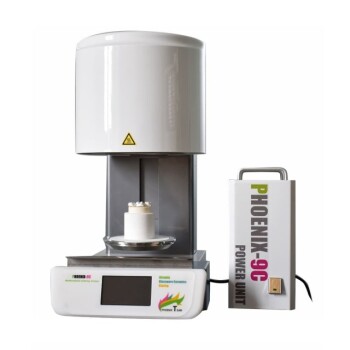
Dental Porcelain Zirconia Sintering Ceramic Furnace Chairside with Transformer

Dental Porcelain Zirconia Sintering Ceramic Furnace Chairside with Transformer

Experience top-notch sintering with Chairside Sintering Furnace with Transformer. Easy to operate, noise-free pallet, and automatic temperature calibration. Order now!

Dental Porcelain Zirconia Sintering Ceramic Vacuum Press Furnace

Dental Porcelain Zirconia Sintering Ceramic Vacuum Press Furnace

Get precise dental results with Dental Vacuum Press Furnace. Automatic temperature calibration, low noise tray, and touch screen operation. Order now!

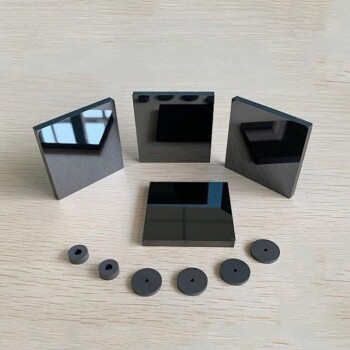
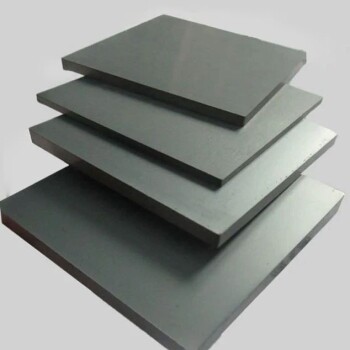
Silicon Carbide (SIC) Ceramic Sheet Wear-Resistant Engineering Advanced Fine Ceramics

Silicon Carbide (SIC) Ceramic Sheet Wear-Resistant Engineering Advanced Fine Ceramics

Silicon carbide (sic) ceramic sheet is composed of high-purity silicon carbide and ultra-fine powder, which is formed by vibration molding and high-temperature sintering.

Boron Nitride (BN) Crucible for Phosphorous Powder Sintered

Boron Nitride (BN) Crucible for Phosphorous Powder Sintered

Phosphorus powder sintered boron nitride (BN) crucible has a smooth surface, dense, pollution-free and long service life.

Vacuum Dental Porcelain Sintering Furnace

Vacuum Dental Porcelain Sintering Furnace

Get precise and reliable results with KinTek's Vacuum Porcelain Furnace. Suitable for all porcelain powders, it features hyperbolic ceramic furnace function, voice prompt, and automatic temperature calibration.

Precision Machined Silicon Nitride (SiN) Ceramic Sheet for Engineering Advanced Fine Ceramics

Precision Machined Silicon Nitride (SiN) Ceramic Sheet for Engineering Advanced Fine Ceramics

Silicon nitride plate is a commonly used ceramic material in the metallurgical industry due to its uniform performance at high temperatures.

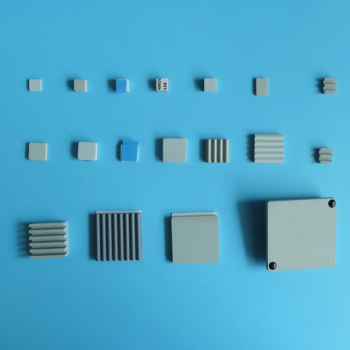
Silicon Carbide (SIC) Ceramic Sheet Flat Corrugated Heat Sink for Engineering Advanced Fine Ceramics

Silicon Carbide (SIC) Ceramic Sheet Flat Corrugated Heat Sink for Engineering Advanced Fine Ceramics

Silicon carbide (sic) ceramic heat sink not only does not generate electromagnetic waves, but also can isolate electromagnetic waves and absorb part of electromagnetic waves.

Silicon Carbide (SIC) Ceramic Plate for Engineering Advanced Fine Ceramics

Silicon Carbide (SIC) Ceramic Plate for Engineering Advanced Fine Ceramics

Silicon nitride (sic) ceramic is an inorganic material ceramic that does not shrink during sintering. It is a high-strength, low-density, high-temperature-resistant covalent bond compound.

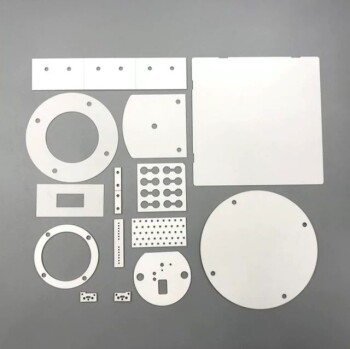
Custom-Made Alumina Zirconia Special-Shaped Ceramic Plates for Engineering Advanced Fine Ceramics Processing

Custom-Made Alumina Zirconia Special-Shaped Ceramic Plates for Engineering Advanced Fine Ceramics Processing

Alumina ceramics have good electrical conductivity, mechanical strength and high temperature resistance, while zirconia ceramics are known for their high strength and high toughness and are widely used.

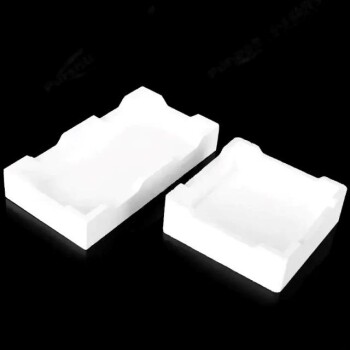
Advanced Engineering Fine Ceramics Alumina Ceramic Saggar for Fine Corundum

Advanced Engineering Fine Ceramics Alumina Ceramic Saggar for Fine Corundum

Alumina sagger products have the characteristics of high temperature resistance, good thermal shock stability, small expansion coefficient, anti-stripping, and good anti-powdering performance.

High Purity Alumina Granulated Powder for Engineering Advanced Fine Ceramics

High Purity Alumina Granulated Powder for Engineering Advanced Fine Ceramics

Ordinary alumina granulated powder is alumina particles prepared by traditional processes, with a wide range of applications and good market adaptability. This material is known for its high purity, excellent thermal stability and chemical stability, and is suitable for a variety of high-temperature and conventional applications.

High Quality Alumina Ceramic Screw for Engineering Advanced Fine Ceramics with High Temperature Resistance and Insulation

High Quality Alumina Ceramic Screw for Engineering Advanced Fine Ceramics with High Temperature Resistance and Insulation

Alumina ceramic screws are fastening components made of 99.5% alumina, ideal for extreme applications requiring excellent thermal resistance, electrical insulation and chemical resistance.

Engineering Advanced Fine Ceramics Alumina Al2O3 Crucible With Lid Cylindrical Laboratory Crucible

Engineering Advanced Fine Ceramics Alumina Al2O3 Crucible With Lid Cylindrical Laboratory Crucible

Cylindrical Crucibles Cylindrical crucibles are one of the most common crucible shapes, suitable for melting and processing a wide variety of materials, and are easy to handle and clean.

Precision Machined Yttrium Stabilized Zirconia Ceramic Rod for Engineering Advanced Fine Ceramics

Precision Machined Yttrium Stabilized Zirconia Ceramic Rod for Engineering Advanced Fine Ceramics

Zirconia ceramic rods are prepared by isostatic pressing, and a uniform, dense and smooth ceramic layer and transition layer are formed at high temperature and high speed.

Hexagonal Boron Nitride HBN Ceramic Ring

Hexagonal Boron Nitride HBN Ceramic Ring

Boron nitride ceramic (BN) rings are commonly used in high temperature applications such as furnace fixtures, heat exchangers and semiconductor processing.

Engineering Advanced Fine Alumina Al2O3 Ceramic Crucible for Laboratory Muffle Furnace

Engineering Advanced Fine Alumina Al2O3 Ceramic Crucible for Laboratory Muffle Furnace

Alumina ceramic crucibles are used in some materials and metal melting tools, and flat-bottomed crucibles are suitable for melting and processing larger batches of materials with better stability and uniformity.

Alumina Al2O3 Ceramic Crucible Semicircle Boat with Lid for Engineering Advanced Fine Ceramics

Alumina Al2O3 Ceramic Crucible Semicircle Boat with Lid for Engineering Advanced Fine Ceramics

Crucibles are containers widely used for melting and processing various materials, and semicircular boat-shaped crucibles are suitable for special smelting and processing requirements. Their types and uses vary by material and shape.

Boron Nitride (BN) Ceramic Plate

Boron Nitride (BN) Ceramic Plate

Boron nitride (BN) ceramic plates do not use aluminum water to wet, and can provide comprehensive protection for the surface of materials that directly contact molten aluminum, magnesium, zinc alloys and their slag.

Engineering Advanced Fine Ceramics Alumina Crucibles (Al2O3) for Thermal Analysis TGA DTA

Engineering Advanced Fine Ceramics Alumina Crucibles (Al2O3) for Thermal Analysis TGA DTA

TGA/DTA thermal analysis vessels are made of aluminum oxide (corundum or aluminum oxide). It can withstand high temperature and is suitable for analyzing materials that require high temperature testing.

Vacuum Heat Treat and Molybdenum Wire Sintering Furnace for Vacuum Sintering

Vacuum Heat Treat and Molybdenum Wire Sintering Furnace for Vacuum Sintering

A vacuum molybdenum wire sintering furnace is a vertical or bedroom structure, which is suitable for withdrawal, brazing, sintering and degassing of metal materials under high vacuum and high temperature conditions. It is also suitable for dehydroxylation treatment of quartz materials.


Leave Your Message