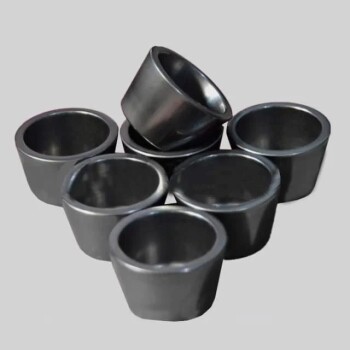
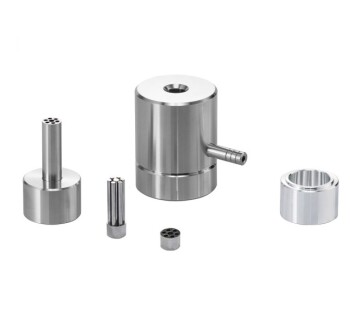
High-purity graphite molds are the central active components in the Spark Plasma Sintering (SPS) process, serving three simultaneous functions that drive the sintering mechanism. They act as the forming container to define the sample's shape, the resistive heating element that converts electrical current into thermal energy, and the pressure transmission medium that forces the powder to densify.
Core Takeaway In SPS, the graphite mold is not merely a passive vessel; it is an active participant in the process physics. Its unique ability to conduct electricity while withstanding high mechanical loads allows heat and pressure to be generated directly around the sample, facilitating rapid sintering and diffusion.
1. The Shaping Function
Defining Geometry and Size
The most fundamental role of the graphite mold is to serve as the forming container.
It holds the loose powder material, strictly defining the final shape and dimensions of the sintered component.
Dimensional Stability
To ensure the geometric accuracy of the final product, the mold must maintain its structural integrity.
It must do this without deforming, even when subjected to the extreme thermal environments characteristic of the sintering process.
2. The Thermal Function
Acting as a Heating Element
Unlike conventional sintering where heat is applied externally, the graphite mold in SPS functions as an electrical conductor.
It facilitates the passage of high-amperage pulsed direct current (DC) through the mold assembly.
Conversion to Thermal Energy
Because graphite acts as a resistor, it efficiently converts this pulsed current into Joule heat.
This allows the mold to generate thermal energy internally, which is then rapidly transferred to the sample to raise its temperature.
3. The Mechanical Function
Pressure Transmission Medium
The mold serves as the bridge between the hydraulic system and the powder sample.
It acts as a pressure transmission medium, conveying external mechanical force (typically tens of megapascals) uniformly onto the powder.
Facilitating Densification
This applied pressure is critical for the sintering physics.
It forces the powder particles together, promoting plastic flow and diffusion, which are necessary to achieve high density in the final material.
High-Temperature Strength
Graphite is unique because it retains significant mechanical strength at ultra-high temperatures.
It can withstand pressures often ranging from 10 to 50 MPa (depending on the specific setup) without failing, ensuring stable processing conditions.
Understanding the Trade-offs
Pressure Limitations
While graphite is strong, it has a finite mechanical limit compared to metallic dies.
Exceeding the specific pressure threshold (often around 50–100 MPa for high-strength graphite) can lead to mold fracture, limiting the maximum pressure available for densification.
Consumable Nature
Graphite molds are often treated as consumables rather than permanent fixtures.
Due to chemical reactivity with certain powders or wear from mechanical stress, they may degrade over time and require replacement to maintain process purity and precision.
Making the Right Choice for Your Goal
The effectiveness of your SPS process relies on balancing these three functions.
- If your primary focus is Geometric Precision: Ensure your mold design accounts for thermal expansion to maintain accurate tolerances during the heating phase.
- If your primary focus is Rapid Heating: Select a graphite grade with optimized electrical resistivity to maximize the conversion of current into Joule heat.
- If your primary focus is Maximum Density: Verify the graphite’s compressive strength rating to ensure it can safely transmit the highest possible pressure required for your material.
High-purity graphite molds are the engine of the SPS process, unifying thermal, electrical, and mechanical forces to transform loose powder into a solid, high-performance material.
Summary Table:
| Function | Role in SPS Process | Benefit to Material |
|---|---|---|
| Shaping | Forming container | Defines precise geometry and dimensional stability |
| Thermal | Resistive heating element | Rapid Joule heating for efficient thermal transfer |
| Mechanical | Pressure transmission medium | Promotes plastic flow and diffusion for high density |
| Durability | High-temperature strength | Withstands 10-50 MPa at extreme temperatures |
Maximize Your Material Density with KINTEK Precision
Are you looking to optimize your Spark Plasma Sintering results? KINTEK specializes in high-performance laboratory equipment and consumables, providing the high-purity graphite molds and advanced sintering solutions your research demands.
Beyond graphite tooling, we offer a comprehensive range of high-temperature furnaces (vacuum, CVD, dental, induction melting), hydraulic pellet presses, and high-pressure reactors designed for the most challenging applications. Whether you are working on battery research, ceramics, or advanced metallurgy, our team provides the high-quality tools and consumables like PTFE products, crucibles, and cooling solutions you need to succeed.
Take the first step toward superior sintering performance—Contact KINTEK today for expert guidance and a custom quote!
References
- Z.H. Al-Ashwan, Nouari Saheb. Corrosion Behavior of Spark Plasma Sintered Alumina and Al2O3-SiC-CNT Hybrid Nanocomposite. DOI: 10.1590/1980-5373-mr-2019-0496
This article is also based on technical information from Kintek Solution Knowledge Base .
Related Products
- High Purity Pure Graphite Crucible for Evaporation
- High Purity Pure Graphite Crucible for Electron Beam Evaporation
- Spark Plasma Sintering Furnace SPS Furnace
- Ultra-High Temperature Graphite Vacuum Graphitization Furnace
- 2200 ℃ Graphite Vacuum Heat Treat Furnace
People Also Ask
- Why are high-purity graphite crucibles preferred for sulfide solid electrolytes? Achieve Superior Material Purity
- Why is a high-purity graphite crucible required for Chromel-TaC composites? Ensure Peak Purity at 1400°C
- What role do high-purity graphite crucibles play in molten salt corrosion research? Ensure Reactor-Grade Precision
- Why are high-purity graphite crucibles used for magnesium distillation? Ensure 3N8 Purity & Thermal Stability
- Why is a high-purity graphite crucible ideal for nitrogen-doped graphene at 1500 °C? Maximize Purity and Stability