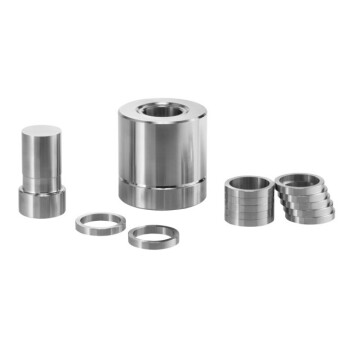
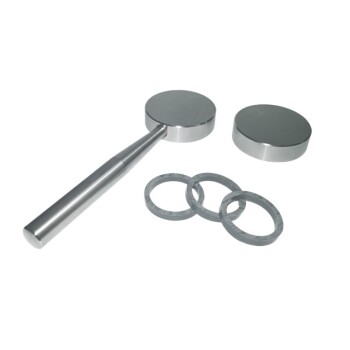
The primary functions of a graphite mold during the vacuum hot pressing of Cu-Zn composites are to provide a high-temperature resistant containment vessel, ensure uniform heat distribution, and effectively transmit mechanical pressure to the powder. Specifically, the mold must define the shape of the composite while maintaining structural integrity under operating conditions of 900°C and 25 MPa of pressure.
Core Takeaway: The graphite mold serves as the critical interface between the processing equipment and the material, simultaneously managing thermal, mechanical, and chemical factors. Its ability to conduct heat evenly while withstanding high pressure ensures the final composite achieves the necessary density and structural homogeneity without chemical contamination.
The Mechanics of Containment and Shaping
Structural Integrity Under Load
The most immediate function of the graphite mold is to act as a robust container for the metallic powder.
During the consolidation of Cu-Zn composites, the mold must withstand significant mechanical stress. It supports the powder against a mechanical pressure of 25 MPa without deforming or failing.
Defining Geometry at High Temperatures
Unlike standard metal molds which may soften or warp at sintering temperatures, graphite retains its strength at 900°C.
This allows the mold to precisely define the final geometry of the sample. By restricting the powder within a fixed volume, the mold forces the particles into close contact, facilitating the densification process.
Thermal Management and Homogeneity
Ensuring Uniform Heat Transfer
A critical challenge in sintering is maintaining a consistent temperature throughout the sample.
Graphite possesses excellent thermal conductivity. This property allows the mold to transfer heat efficiently from the furnace elements to the Cu-Zn powder.
Eliminating Thermal Gradients
By ensuring the heat is distributed evenly, the mold prevents the formation of thermal gradients (hot or cold spots).
This uniformity is essential for achieving structural homogeneity in the final product. It ensures that the entire composite sinters at the same rate, preventing internal stresses or uneven microstructures.
Chemical Stability and Surface Quality
Preventing Adverse Reactions
At 900°C, many materials become chemically reactive. The graphite mold acts as a chemically stable barrier.
It prevents adverse reactions between the mold walls and the metallic Cu-Zn sample. This inertness is vital for maintaining the chemical purity of the composite and ensuring the surface composition remains unaltered.
Facilitating Pressure Transmission
The mold is not just a passive container; it is an active transmission medium.
It transfers the axial pressure from the hydraulic system directly to the powder. Because of graphite's low friction coefficient and stability, it ensures this pressure is distributed uniformly, which is critical for achieving high density.
Understanding the Trade-offs
Mechanical Limitations and Wear
While graphite is excellent for high-temperature compression, it generally has lower tensile strength and impact resistance compared to metals.
Molds must be handled carefully to avoid chipping or cracking. Furthermore, graphite acts as a consumable; the surfaces can degrade over repeated cycles, eventually affecting dimensional precision.
Oxidation Sensitivity
Graphite is highly stable in a vacuum or inert gas, but it oxidizes rapidly in the presence of oxygen at high temperatures.
Strict vacuum integrity must be maintained. If the vacuum fails during the 900°C heating cycle, the mold can erode, potentially compromising the sample or the furnace environment.
Making the Right Choice for Your Goal
To ensure the highest quality Cu-Zn composites, you must align the mold's capabilities with your specific processing targets.
- If your primary focus is Densification: Ensure your mold design allows for the full transmission of the 25 MPa load without binding, as this pressure is the primary driver for eliminating porosity.
- If your primary focus is Microstructural Uniformity: Prioritize high-purity graphite with consistent grain structure to maximize thermal conductivity and eliminate temperature gradients during the soak time.
- If your primary focus is Dimensional Precision: Monitor the mold wear closely; even minor erosion after multiple cycles can lead to geometric inaccuracies in the final sintered part.
Success in vacuum hot pressing relies on viewing the graphite mold not just as a container, but as an active tool that governs the thermal and mechanical environment of your composite.
Summary Table:
| Function | Key Mechanism | Operational Impact |
|---|---|---|
| Containment | High-temp structural integrity | Maintains sample geometry at 900°C and 25 MPa |
| Heat Transfer | Superior thermal conductivity | Eliminates thermal gradients for structural homogeneity |
| Pressure Transmission | Low friction & high stability | Ensures uniform densification and porosity elimination |
| Chemical Stability | Inert barrier | Prevents sample contamination and adverse reactions |
Elevate Your Materials Synthesis with KINTEK Precision
Achieving perfect densification and microstructural uniformity requires high-performance equipment. KINTEK specializes in advanced laboratory solutions, including high-temperature vacuum hot pressing systems, hydraulic presses (pellet, hot, isostatic), and premium graphite and ceramic consumables.
Whether you are developing Cu-Zn composites or advanced battery materials, our comprehensive range of furnaces (vacuum, atmosphere, induction melting) and crushing systems ensures your research meets the highest standards of precision.
Ready to optimize your sintering process? Contact KINTEK today to discover how our high-temperature high-pressure solutions can drive your lab's success!
Related Products
- Ball Press Mold for Lab
- Double Plate Heating Press Mold for Lab
- Anti-Cracking Press Mold for Lab Use
- Lab Infrared Press Mold
- Special Shape Press Mold for Lab
People Also Ask
- What are the advantages of using a laboratory hydraulic press for hot pressing? Achieve Peak Nano-Composite Density
- How to use a press mold? Master the Art of Creating Consistent Ceramic Forms
- What is the press mould method? A Guide to Consistent, Detailed Ceramic Forms
- What is the purpose of specialized pressure devices in sulfide solid-state batteries? Ensure Chemo-Mechanical Stability
- Why are pressure molds with non-conductive resin inner walls required for battery testing? Ensure Data Accuracy