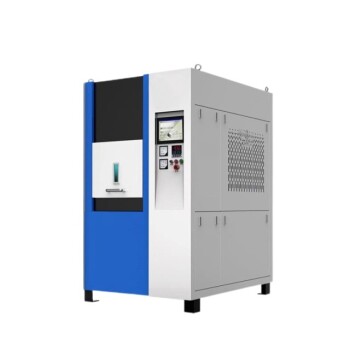
In the manufacturing of binary alloy targets, a high-temperature sintering furnace serves as the critical engine for solid-state transformation, turning loose powder compacts into dense, high-performance solids. By applying precise thermal energy below the material's melting point, the furnace facilitates atomic diffusion and the creation of metallurgical bonds. This process is essential for ensuring the resulting target can withstand the extreme stresses of high-frequency laser impact without fragmenting.
The primary function of a high-temperature sintering furnace is to drive the densification and structural stabilization of alloy powders through controlled atomic migration. It transforms a fragile "green body" into a mechanically robust, uniform target by precisely managing temperature, time, and atmospheric conditions.
Driving Densification and Structural Integrity
Facilitating Atomic Diffusion and Bonding
The furnace provides the thermal energy required to trigger atomic diffusion at the contact points of metal particles. As atoms migrate, "sintering necks" form between individual grains, evolving into stable metallurgical bonds that fuse the powder into a single crystallized mass.
Achieving High Material Density
Through the application of heat—often regulated at approximately two-thirds of the material's melting point—the furnace eliminates internal pores. This densification is vital for binary alloys, as it ensures the target material reaches the required density and translucency for industrial applications.
Enhancing Mechanical Strength
By converting compact powders into a thermally resistant solid, the furnace significantly increases the mechanical strength of the alloy. This structural integrity prevents the target from cracking or fragmenting when subjected to the intense energy of a high-frequency laser.
Precise Microstructure and Composition Control
Ensuring Uniform Alloy Distribution
A critical function of the furnace is maintaining a uniform internal distribution of the two alloy components. Precise regulation of sintering time and temperature ensures that the binary elements are perfectly integrated, preventing localized weak spots or composition gradients.
Managing Phase Purity and Grain Growth
The furnace's ability to provide stable heating and cooling rates is essential for managing microstructure and phase purity. Controlled grain growth within the furnace allows manufacturers to dictate the final physical properties of the target, such as its electrical conductivity and thermal resistance.
Solid-State Transformation
Unlike a melting furnace, the sintering furnace operates strictly below the melting point of the powder. This allows the material to retain its intended shape and form while gaining strength, effectively "molding" the alloy without liquefying it.
Environmental and Atmospheric Protection
Atmosphere Switching and Oxidation Prevention
High-temperature furnaces, particularly tube-style models, allow for a controlled atmosphere using gases like argon. This environment is crucial for metal alloys to prevent oxidation, which would otherwise contaminate the binary target and degrade its performance.
Handling Refractory Materials
For alloys with extremely high melting points, such as those involving Zirconium Diboride, industrial-grade furnaces provide the extreme thermal energy (up to 2000°C) necessary to overcome strong covalent bonds. Standard laboratory equipment often cannot reach the thresholds required to trigger the necessary surface diffusion.
Understanding the Trade-offs
Temperature Precision vs. Material Liquefaction
The most significant risk in sintering is exceeding the material's melting point. If the furnace temperature is too high, the compact will liquefy rather than sinter, destroying the target's shape and internal grain structure.
Sintering Speed vs. Structural Stress
While faster heating cycles increase throughput, they can introduce thermal gradients that lead to cracking or uneven density. Conversely, excessively long sintering times can lead to over-bonding or undesirable grain growth, which can reduce the target's effectiveness.
Atmosphere Reliability vs. Contamination
Failure to maintain a pure vacuum or inert gas environment can lead to the inclusion of interstitial impurities. These impurities can alter the binary alloy's chemical properties, making the target brittle or chemically unstable during end-use.
How to Apply This to Your Manufacturing Process
Making the Right Choice for Your Goal
To achieve the best results with a high-temperature sintering furnace, you must align your furnace parameters with the specific metallurgical requirements of your binary alloy.
- If your primary focus is Maximum Durability: Prioritize precise temperature regulation at two-thirds of the melting point to ensure deep atomic diffusion and high mechanical strength.
- If your primary focus is Material Purity: Utilize a furnace with advanced atmosphere switching capabilities, such as argon flow, to strictly prevent oxidation during the heating cycle.
- If your primary focus is Precision Microstructure: Implement a furnace with programmable cooling rates to carefully control grain growth and phase transformation.
By mastering the thermal and atmospheric variables of the sintering furnace, you ensure the production of binary alloy targets that are both chemically uniform and structurally resilient.
Summary Table:
| Function | Process Mechanism | Key Benefit |
|---|---|---|
| Densification | Atomic diffusion & metallurgical bonding | High mechanical strength & durability |
| Microstructure Control | Stable heating & programmable cooling | Uniform phase purity & grain growth |
| Atmospheric Protection | Argon gas flow or vacuum environment | Prevention of oxidation & contamination |
| Refractory Processing | High thermal energy (up to 2000°C) | Successful sintering of high-melting-point alloys |
Elevate Your Alloy Production with KINTEK Precision
Achieving the perfect solid-state transformation requires more than just heat—it requires absolute control. KINTEK specializes in advanced laboratory equipment designed for the most demanding material science applications. Whether you are manufacturing binary alloy targets or researching refractory materials, our comprehensive range of high-temperature furnaces (muffle, tube, vacuum, and atmosphere) provides the stability and atmosphere reliability you need.
Beyond sintering, we support your entire workflow with high-pressure reactors, hydraulic pellet presses, and precision crushing systems. Ensure your targets achieve maximum density and purity every time.
Ready to optimize your manufacturing process? Contact KINTEK today for expert equipment solutions
References
- Simon Siebeneicher, Stephan Barcikowski. Activity and Durability Patterns of 45 Binary Noble Metal Alloy Nanoparticle Variants for Commercial Diesel Exhaust Aftertreatment. DOI: 10.1002/cctc.202300563
This article is also based on technical information from Kintek Solution Knowledge Base .
Related Products
- Vacuum Heat Treat and Pressure Sintering Furnace for High Temperature Applications
- 2200 ℃ Tungsten Vacuum Heat Treat and Sintering Furnace
- High Temperature Muffle Oven Furnace for Laboratory Debinding and Pre Sintering
- 2200 ℃ Graphite Vacuum Heat Treat Furnace
- Ultra-High Temperature Graphite Vacuum Graphitization Furnace
People Also Ask
- What is the purpose of the heat treatment (sintering) step? Engineering Robust Electroactive Membranes
- What is a vacuum sintering furnace? Unlock Purity and Performance in Advanced Materials
- Why must green bodies produced via binder jetting undergo treatment in a vacuum sintering furnace?
- How does the vacuum environment impact sintering of diamond-copper composites? Protect Against Thermal Damage
- What are some alternative atmospheres to pure hydrogen for powder metallurgy sintering processes? Top Sintering Solutions