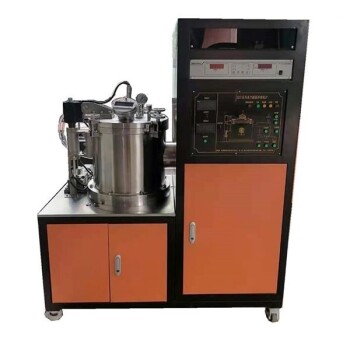
Vacuum sintering is the critical step that transforms a binder jetting print from a fragile shape into a functional metal part. Because the "green body" produced by the printer is held together solely by a temporary adhesive, it possesses low strength and high porosity. Treatment in a vacuum sintering furnace is required to burn off this binder, bond the metal atoms together, and protect the alloy from oxidation during the high-heat process.
The green body is merely a precursor; the vacuum furnace is where the actual metallurgy occurs. By removing the organic binder and facilitating atomic diffusion in an oxygen-free environment, the sintering process achieves the necessary densification and structural integrity.
The Fragility of the Green State
The Composition of a Green Body
Binder jetting (BJT) builds parts by selectively depositing a liquid binder onto layers of metal powder. The resulting object, known as a "green body," is essentially metal dust held together by dried glue.
Limitations in Strength
Because there is no metal-to-metal bonding at this stage, the part has very low mechanical strength. It can support its own weight but cannot withstand functional stress.
The Issue of Porosity
The green body is highly porous because the binder occupies the space between metal particles. To create a solid part, this space must be closed, and the binder must be removed.
The Transformation Process
Phase 1: Binder Decomposition
The first function of the furnace is to remove the temporary scaffolding. As the temperature rises, the organic binder decomposes and evaporates out of the part. This leaves behind clean metal powder ready for bonding.
Phase 2: Atomic Diffusion
Once the binder is removed, the heat is increased to initiate sintering. This triggers solid-phase or liquid-phase diffusion, where metal atoms migrate across particle boundaries.
Phase 3: Densification
This atomic movement bonds the particles together. As the particles fuse, the voids left by the binder shrink, leading to the initial densification of the component.
Why a Vacuum Environment is Non-Negotiable
Protection from Oxidation
Sintering requires temperatures close to the metal's melting point. In a standard atmosphere, these temperatures would cause rapid, destructive oxidation of the metal.
Preserving Alloy Chemistry
A vacuum environment eliminates oxygen, ensuring the chemical purity of the material. This is particularly vital for alloys containing active elements, such as Inconel 718, which are highly susceptible to oxidation at high temperatures.
Understanding the Trade-offs
Dimensional Shrinkage
As the furnace drives densification, the part volume decreases significantly. You must account for this shrinkage during the CAD design phase to ensure the final part meets tolerance specifications.
Residual Porosity
While the vacuum furnace achieves initial densification, binder jetting parts may not reach 100% theoretical density in a single run. For fatigue-critical applications, further post-processing (like Hot Isostatic Pressing) may be required to close remaining internal voids.
Making the Right Choice for Your Goal
To ensure success with binder jetting, you must view the printing and sintering as a single, coupled process.
- If your primary focus is Dimensional Accuracy: Rigorously characterize the shrinkage rate of your specific alloy in the vacuum furnace to apply accurate compensation factors to your CAD model.
- If your primary focus is Material Integrity: Ensure your vacuum furnace is capable of maintaining a high-quality vacuum to prevent the depletion or oxidation of reactive elements in complex superalloys.
The vacuum sintering furnace is the bridge between a delicate powder pre-form and a robust, industrial-grade metal component.
Summary Table:
| Process Phase | Purpose | Key Outcome |
|---|---|---|
| Binder Decomposition | Remove organic adhesives | Clean metal powder ready for bonding |
| Atomic Diffusion | Facilitate metal atom migration | Initial particle fusion and bonding |
| Densification | Close internal voids | Structural integrity and volume reduction |
| Vacuum Environment | Eliminate oxygen presence | Prevention of oxidation and alloy purity |
Elevate Your Metal Additive Manufacturing with KINTEK
Transitioning from a fragile green body to a high-performance industrial component requires precision heat treatment. KINTEK specializes in advanced laboratory and industrial solutions designed for the most demanding metallurgical workflows.
Our comprehensive range of vacuum furnaces, atmosphere furnaces, and Hot Isostatic Pressing (HIP) systems ensures your binder jetting projects achieve maximum density and chemical purity. Beyond sintering, we offer high-temperature high-pressure reactors, crushing and milling systems, and essential consumables like crucibles and ceramics to support your entire material research lifecycle.
Ready to optimize your sintering process? Contact our technical experts today to find the perfect furnace solution for your laboratory or production line.
References
- Vadim Sufiiarov, Danil Erutin. Effect of TiC Particle Size on Processing, Microstructure and Mechanical Properties of an Inconel 718/TiC Composite Material Made by Binder Jetting Additive Manufacturing. DOI: 10.3390/met13071271
This article is also based on technical information from Kintek Solution Knowledge Base .
Related Products
- Vacuum Heat Treat and Sintering Furnace with 9MPa Air Pressure
- Vacuum Heat Treat and Molybdenum Wire Sintering Furnace for Vacuum Sintering
- Vacuum Heat Treat and Pressure Sintering Furnace for High Temperature Applications
- Small Vacuum Heat Treat and Tungsten Wire Sintering Furnace
- 2200 ℃ Tungsten Vacuum Heat Treat and Sintering Furnace
People Also Ask
- What is the process of pressure sintering? Achieve Superior Density and Strength for High-Performance Parts
- What is the effect of pressure during sintering? Achieve Higher Density and Finer Microstructures Faster
- What is a vacuum sintering furnace? Unlock Purity and Performance in Advanced Materials
- How does the vacuum environment impact sintering of diamond-copper composites? Protect Against Thermal Damage
- What are some alternative atmospheres to pure hydrogen for powder metallurgy sintering processes? Top Sintering Solutions