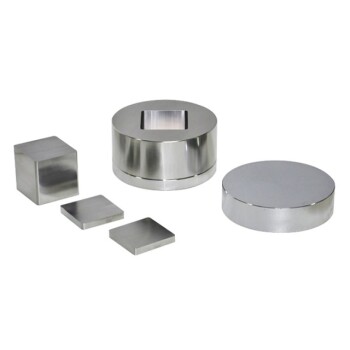
Graphite molds function as the critical interface between the raw material and the sintering equipment during vacuum hot pressing. Their primary role is to act as a high-temperature resistant container that fixes the copper/graphene powder mixture into a precise geometric shape, such as a circular disk, while enduring the extreme environment of the furnace. Simultaneously, they serve as a conductive medium that regulates the thermal profile and transmits the mechanical force necessary to consolidate the powder into a solid composite.
The graphite mold is not merely a passive container; it is an active thermal and mechanical component. Its ability to balance high thermal conductivity with structural rigidity under extreme pressure is the defining factor in achieving a dense, homogeneous copper/graphene composite.
The Role of Geometric Containment
Defining the Composite Structure
The most immediate function of the graphite mold is to define the final shape of the composite. It fixes the loose mixed powders into a specific molded form, ensuring the final product meets precise dimensional specifications, such as a 20mm diameter disk.
High-Temperature Structural Integrity
To maintain this shape, the mold must possess exceptional thermal stability. It acts as a rigid vessel capable of withstanding sintering temperatures (often exceeding 1000°C) without deforming or losing its structural strength.
Thermal Regulation and Conductivity
Ensuring Uniform Heat Transfer
Graphite is selected for these molds specifically for its excellent electrical and thermal conductivity. This allows the mold to act as an efficient heat exchanger, transferring thermal energy uniformly from the heating source to the internal composite powder.
Preventing Thermal Gradients
By distributing heat evenly, the mold prevents the formation of localized "hot spots" or "cold zones" within the sample. This uniformity is critical for consistent sintering quality, ensuring that the copper matrix melts or diffuses evenly around the graphene reinforcement across the entire specimen.
Mechanical Load Transmission
Transmitting Uniaxial Pressure
During vacuum hot pressing, the mold serves as the primary medium for force transmission. It must transfer significant axial pressure—ranging from 15 MPa to 50 MPa—from the hydraulic system directly onto the powder mixture.
Driving Material Densification
The mold's ability to withstand this mechanical load without failure is vital for the densification process. By applying consistent pressure, the mold collapses voids between particles, facilitating the diffusion reactions required to create a solid, non-porous material.
Understanding the Trade-offs
Chemical Stability and Demolding
A distinct advantage of using graphite is its chemical inertness in reducing atmospheres. It does not easily bond with the copper matrix, which is essential for the smooth demolding of the finished composite samples, preventing surface damage during extraction.
Mechanical Limits
While graphite is robust, it has finite mechanical limits compared to metal dies. The mold design must carefully account for the specific pressures applied (e.g., keeping within 25–50 MPa ranges) to prevent fracture during the load-bearing phase of the sintering cycle.
Making the Right Choice for Your Goal
When designing or selecting molds for copper/graphene composites, consider your specific processing priorities:
- If your primary focus is Dimensional Accuracy: Prioritize high-density graphite grades that offer maximum rigidity to prevent even micro-deformations under axial load.
- If your primary focus is Material Homogeneity: Ensure the mold wall thickness is uniform to maximize the benefits of graphite’s thermal conductivity, ensuring the core of the sample sinters at the same rate as the edges.
Successful vacuum hot pressing relies on viewing the graphite mold not just as tooling, but as an integral part of the thermal processing system.
Summary Table:
| Function | Description | Key Benefit |
|---|---|---|
| Geometric Containment | Defines final shape and fixes powder position | Ensures dimensional precision and structural integrity |
| Thermal Regulation | Distributes heat uniformly via high conductivity | Prevents thermal gradients and ensures material homogeneity |
| Mechanical Load | Transmits axial pressure (15-50 MPa) to powder | Drives densification and eliminates internal voids/porosity |
| Chemical Stability | Provides an inert interface during high-temp sintering | Facilitates easy demolding and prevents surface contamination |
Elevate Your Material Research with KINTEK Precision Tooling
Achieving the perfect copper/graphene composite requires more than just high temperatures; it demands the right engineering. KINTEK specializes in high-performance laboratory equipment, providing the vacuum hot pressing systems and precision graphite molds necessary for advanced material densification.
From hydraulic presses and high-temperature furnaces to specialized PTFE and ceramic consumables, we offer the complete toolkit for your research and production needs. Let our experts help you optimize your sintering process for superior density and performance.
Ready to upgrade your lab? Contact KINTEK today for a customized solution!
Related Products
- Ball Press Mold for Lab
- Lab Infrared Press Mold
- Carbon Graphite Plate Manufactured by Isostatic Pressing Method
- Double Plate Heating Press Mold for Lab
- Anti-Cracking Press Mold for Lab Use
People Also Ask
- What are the advantages of using a laboratory hydraulic press for hot pressing? Achieve Peak Nano-Composite Density
- How to use a press mold? Master the Art of Creating Consistent Ceramic Forms
- What is the press mould method? A Guide to Consistent, Detailed Ceramic Forms
- What is the purpose of specialized pressure devices in sulfide solid-state batteries? Ensure Chemo-Mechanical Stability
- Why are pressure molds with non-conductive resin inner walls required for battery testing? Ensure Data Accuracy