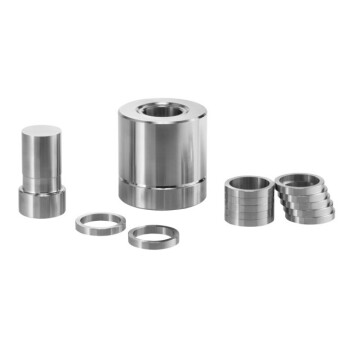
High-purity graphite molds serve as the fundamental processing interface in the vacuum hot pressing sintering of titanium composites. Their primary function is to act as a shaping container for titanium powder while simultaneously transmitting mechanical pressures of up to 30 MPa at temperatures reaching 1300°C.
By leveraging high-temperature resistance and superior thermal conductivity, graphite molds transform loose powder into a densified, dimensionally accurate composite. They effectively bridge the gap between the application of extreme mechanical force and the thermal environment required for sintering.
The Mechanics of Shaping and Densification
Acting as a Precision Containment Vessel
The most immediate function of the graphite mold is to define the geometry of the final product. It acts as a rigid container, holding the loose titanium powder in a specific shape prior to and during the sintering process. This ensures that as the material consolidates, it adheres to precise dimensional specifications.
Transmitting Mechanical Pressure
Beyond simple containment, the mold is an active participant in the densification process. It serves as the medium through which the hydraulic system transmits uniaxial pressure—up to 30 MPa—directly to the powder. This pressure is critical for forcing particles into close contact, reducing porosity, and achieving a solid composite structure.
Thermal Management Roles
Withstanding Extreme Processing Environments
Titanium composites require high sintering temperatures to bond effectively. The graphite mold must maintain its structural integrity and mechanical strength at temperatures reaching 1300°C. Unlike many other materials, graphite does not soften or deform significantly under these specific thermal and pressure conditions, ensuring the mold does not collapse during the cycle.
Ensuring Uniform Heat Distribution
The quality of the final composite relies heavily on how heat is applied. The excellent thermal conductivity of high-purity graphite ensures that thermal energy is distributed evenly throughout the mold and the powder within it. This prevents localized "hot spots" or "cold spots," leading to uniform densification and consistent material properties across the entire component.
Understanding the Trade-offs
The Necessity of High Purity
While graphite is chemically stable, the "high-purity" designation is not optional for titanium processing. Titanium is highly reactive at elevated temperatures. Using lower-grade graphite with impurities can lead to contamination of the composite matrix, compromising the mechanical properties of the final part.
Mechanical Limits and Consumability
Although graphite is robust, it is subjected to simultaneous high heat (1300°C) and high pressure (30 MPa). Over repeated cycles or under excessive load, graphite can experience wear or degradation. It acts as a sacrificial or semi-permanent tool that prioritizes the integrity of the titanium part over its own indefinite lifespan.
Making the Right Choice for Your Goal
To maximize the effectiveness of graphite molds in your specific sintering project, consider the following:
- If your primary focus is Dimensional Accuracy: Ensure the graphite grade chosen has high density and strength to resist deformation under the 30 MPa load.
- If your primary focus is Material Purity: Verify the graphite source is certified "high-purity" to prevent adverse chemical reactions or carbon contamination at 1300°C.
The success of your titanium composite relies on the mold's ability to remain invisible to the chemistry while being physically unyielding to the pressure.
Summary Table:
| Function | Parameter/Requirement | Impact on Titanium Composite |
|---|---|---|
| Shaping | Rigid Geometry | Ensures precise dimensional accuracy and final part shape |
| Pressure Transmission | Up to 30 MPa | Facilitates particle densification and reduces porosity |
| Thermal Stability | Up to 1300°C | Prevents mold collapse or deformation during sintering |
| Heat Distribution | High Thermal Conductivity | Ensures uniform material properties and prevents hot spots |
| Purity Control | High-Purity Graphite | Prevents chemical contamination of the reactive titanium matrix |
Elevate Your Material Research with KINTEK
Achieving peak performance in vacuum hot pressing requires precision-engineered tools. KINTEK specializes in high-quality laboratory equipment and consumables designed for extreme environments. Whether you are working with titanium composites or advanced ceramics, our high-temperature furnaces, hydraulic hot presses, and high-purity graphite consumables provide the reliability your lab demands.
Our value to you:
- Comprehensive Solutions: From vacuum furnaces to precision crushing and milling systems.
- Expert Engineering: Consumables like ceramics, crucibles, and graphite molds tailored for 1300°C+ applications.
- End-to-End Support: Equipping your facility with everything from ULT freezers to electrolytic cells and battery research tools.
Ready to optimize your sintering process? Contact us today to find the perfect solution for your lab!
Related Products
- Ultra-High Temperature Graphite Vacuum Graphitization Furnace
- 2200 ℃ Graphite Vacuum Heat Treat Furnace
- High Purity Pure Graphite Crucible for Evaporation
- Anti-Cracking Press Mold for Lab Use
- High Purity Pure Graphite Crucible for Electron Beam Evaporation
People Also Ask
- What is the disadvantage of graphite furnace? Managing Reactivity and Contamination Risks
- Is a graphite melting point high or low? Discover Its Extreme Thermal Resilience
- What are the advantages and disadvantages of graphite furnace? Unlock Extreme Heat Performance
- What are the disadvantages of graphite furnace? Key Limitations and Operational Costs
- What is the temperature of a graphite furnace? Achieve Extreme Heat Up to 3000°C