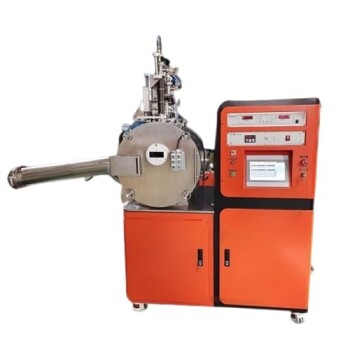
The primary process advantage of Spark Plasma Sintering (SPS) over traditional Hot Pressing lies in its ability to generate heat internally via pulsed current. This mechanism allows for extremely high heating rates and rapid thermal cycling, which drastically reduces the time materials must spend at peak temperatures compared to the slower external heating of Hot Press furnaces.
Core Takeaway By utilizing Joule heating to minimize residence time at high temperatures, SPS effectively prevents the coarsening of ceramic grains. This results in Ultra-High Temperature Ceramics (UHTCs) that possess a fine-grained structure and superior mechanical properties, overcoming the grain growth issues common in traditional, slower sintering methods.
The Mechanism: Internal vs. External Heating
Direct Joule Heating
The defining characteristic of an SPS system is the application of pulsed current directly through the graphite molds and the sample itself.
Instead of relying on external heating elements to radiate heat inwards, SPS generates Joule heat internally. This allows the energy to act directly on the material, facilitating rapid temperature increases.
Contrast with Traditional Hot Pressing
Traditional Hot Pressing (HP) typically relies on heating elements made of graphite to heat a furnace chamber.
While effective for densification, this method is inherently slower. For example, standard high-temperature furnaces may have maximum heating rates around 725°C/h (approx. 12°C/min). In contrast, the internal generation of heat in SPS enables rates that are orders of magnitude higher.
Impact on Microstructure and Quality
Inhibiting Grain Coarsening
The most critical outcome of rapid heating is the significant reduction in residence time at high temperatures.
In ceramic processing, prolonged exposure to high heat causes grains to grow and coarsen, which can weaken the material. Because SPS completes the thermal cycle quickly, it effectively inhibits this coarsening.
Finer Microstructure
The result of this abbreviated thermal cycle is a ceramic body with a fine-grained structure.
Maintaining a fine microstructure is essential for maximizing the mechanical performance of UHTCs. The rapid densification prevents the abnormal grain growth often seen in processes that require long soak times to eliminate pores.
Superior Mechanical Properties
The preservation of fine grains directly translates to superior mechanical properties.
By achieving densification without allowing the microstructure to degrade, SPS produces UHTC components that are mechanically more robust than those produced by methods involving longer thermal exposure.
Additional Process Efficiencies
Synchronized Densification
SPS combines rapid heating with synchronized pressing.
This capability allows for the effective elimination of pores between particles in a very short period. This creates a ceramic body close to theoretical density much faster than the coupled thermal and mechanical forces in a standard HP furnace.
Minimizing Chemical Reactivity
The speed of the SPS process offers advantages beyond just structure.
In composite materials, such as those reinforced with carbon nanotubes (CNTs), the short processing time minimizes harmful chemical reactions between the reinforcement and the matrix. This preserves the integrity of the constituent materials.
Understanding the Contextual Trade-offs
The Challenge of UHTCs
It is important to recognize why these advanced techniques are necessary. UHTCs generally possess strong covalent bonds, low self-diffusion coefficients, and high melting points.
The Role of Pressure
Both SPS and HP utilize pressure to overcome the difficulty of sintering these materials at atmospheric pressure.
While SPS offers speed and microstructural benefits, traditional HP remains a vital method for achieving densification through axial pressure (typically 20-30 MPa) in environments up to 2100°C. SPS is essentially an evolution of this concept, optimized for speed and microstructural control.
Making the Right Choice for Your Goal
When selecting between Spark Plasma Sintering and traditional Hot Pressing for UHTCs, consider your specific material requirements:
- If your primary focus is mechanical strength: Choose SPS to leverage rapid thermal cycling, which maintains fine grain sizes and boosts mechanical performance.
- If your primary focus is chemical stability in composites: Choose SPS to minimize the reaction time between the matrix and reinforcements, reducing harmful byproducts.
- If your primary focus is process efficiency: Choose SPS for its ability to achieve full densification in significantly shorter periods due to high heating rates.
SPS transforms the sintering process from a test of endurance into a precision operation, allowing you to achieve high density without sacrificing microstructural integrity.
Summary Table:
| Feature | Spark Plasma Sintering (SPS) | Traditional Hot Pressing (HP) |
|---|---|---|
| Heating Method | Internal (Pulsed Current/Joule Heat) | External (Radiation/Convection) |
| Heating Rate | Very High (Rapid Thermal Cycling) | Lower (Approx. 12°C/min) |
| Grain Structure | Fine-grained (Minimal coarsening) | Coarser (Longer residence time) |
| Process Duration | Short (Minutes) | Long (Hours) |
| Mechanical Performance | Superior (High density & fine grain) | Standard (High density) |
| Chemical Integrity | Preserves reinforcements (e.g., CNTs) | Risk of harmful reactions |
Elevate Your Advanced Ceramic Research with KINTEK
Maximize the potential of your Ultra-High Temperature Ceramics (UHTCs) and composite materials. KINTEK specializes in cutting-edge laboratory equipment, providing high-precision Spark Plasma Sintering (SPS) systems and hydraulic hot presses designed for superior densification and microstructural control.
From high-temperature furnaces and crushing/milling systems to specialized PTFE products and ceramics, our comprehensive portfolio ensures your lab achieves peak efficiency and material performance.
Ready to optimize your sintering process? Contact KINTEK today to discover how our expert solutions can transform your material science outcomes.
References
- Dewei Ni, Guo‐Jun Zhang. Advances in ultra-high temperature ceramics, composites, and coatings. DOI: 10.1007/s40145-021-0550-6
This article is also based on technical information from Kintek Solution Knowledge Base .
Related Products
- Spark Plasma Sintering Furnace SPS Furnace
- Vacuum Heat Treat and Pressure Sintering Furnace for High Temperature Applications
- Vacuum Heat Treat and Sintering Furnace with 9MPa Air Pressure
- Small Vacuum Heat Treat and Tungsten Wire Sintering Furnace
- Vacuum Dental Porcelain Sintering Furnace
People Also Ask
- What is SPS sintering method? A Guide to High-Speed, High-Performance Material Fabrication
- Why are Spark Plasma Sintering (SPS) furnaces or hot presses utilized in the preparation of Li3PS4 solid electrolytes?
- What is the difference between spark plasma sintering and flash sintering? A Guide to Advanced Sintering Methods
- What technical advantages does a Spark Plasma Sintering (SPS) furnace offer for LZP ceramics? Enhance Ionic Conductivity
- What is the theory of spark plasma sintering? A Guide to Rapid, Low-Temperature Densification