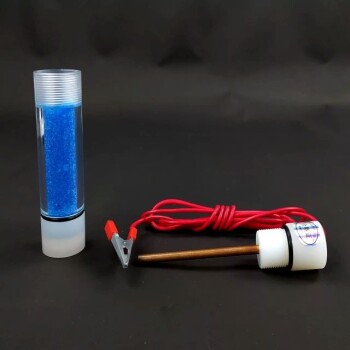
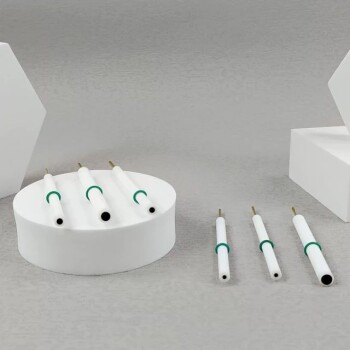
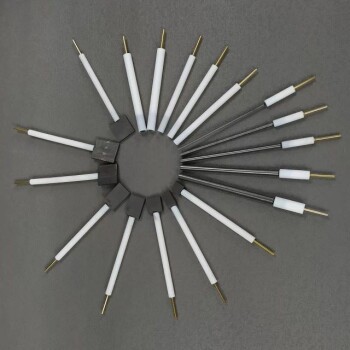
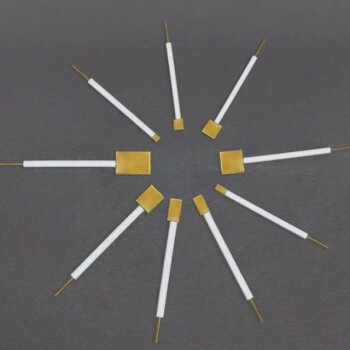
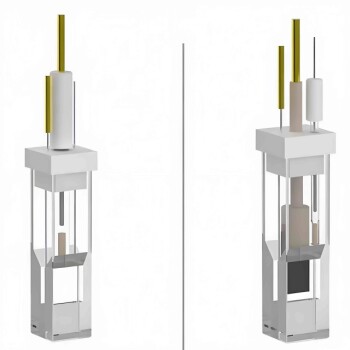
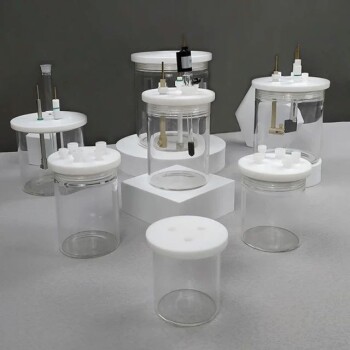
The Ag/AgCl reference electrode establishes a precise voltage baseline, while the Platinum (Pt) counter electrode facilitates the flow of electrical current.
In a standard electrochemical measurement system, these two components work in tandem to isolate voltage measurement from current flow. The Ag/AgCl electrode acts as a stable "ruler" against which potential is measured, while the Platinum electrode acts as a chemically inert "pump" that completes the circuit without contaminating the system.
Core Takeaway: Accurate electrochemical data relies on dividing labor between these two electrodes. The Ag/AgCl reference electrode ensures the potential readings are accurate and reproducible by providing a fixed standard, while the Platinum counter electrode bears the electrical load, utilizing its high conductivity and inertness to drive reactions without introducing interference.
The Ag/AgCl Reference Electrode: The Standard of Measurement
The primary function of the Silver/Silver Chloride (Ag/AgCl) electrode is to provide a fixed, known potential that does not change during the experiment.
Providing a Stable Baseline
The Ag/AgCl electrode offers an extremely stable reference potential. Because its potential remains constant, any change in voltage observed by the system can be attributed solely to the working electrode (the sample you are testing).
Ensuring Reproducibility
By anchoring measurements to this standardized potential, the Ag/AgCl electrode ensures data is comparable across different experimental conditions. This allows researchers to accurately identify critical oxidation and reduction potentials and compare their results against industry standards.
Precision in Polarization
This stability allows for precise control over the polarization state of the working electrode. Whether testing corrosion or catalysis, the Ag/AgCl electrode ensures the "potential coordinates" on your data plots (such as polarization curves) are accurate.
The Platinum (Pt) Counter Electrode: Completing the Circuit
The Platinum electrode, often referred to as the auxiliary electrode, functions to complete the electrical circuit with the working electrode.
Efficient Charge Conduction
Platinum is selected for its high electrical conductivity. It functions as a sink or source for electrons, balancing the charge transfer at the working electrode to maintain current flow. This efficiency allows the analyzer to detect even subtle electrical signals produced by the sample.
Chemical Inertness and Stability
The critical value of Platinum lies in its exceptional chemical stability. In environments ranging from organic electrolytes to strong alkaline solutions, Platinum resists oxidation and dissolution. This ensures the electrode does not degrade even when subjected to current loads.
Preventing Contamination
Because Platinum does not easily dissolve, it prevents the introduction of foreign metal ions into the electrolyte. This preserves the purity of the testing system, ensuring that measurements—such as passivation film impedance or cyclic voltammetry curves—reflect only the behavior of the sample, not the degradation of the counter electrode.
Understanding the Trade-offs
While this setup is the standard for accuracy, understanding the limitations is vital for rigorous testing.
Reference Electrode Drift
While the Ag/AgCl electrode is highly stable, it must be maintained properly. If the internal solution dries out or becomes contaminated, the reference potential can drift, rendering the "baseline" inaccurate and skewing all subsequent voltage data.
Counter Electrode Surface Area
The Platinum electrode facilitates the reaction opposite to the working electrode (e.g., hydrogen or oxygen evolution). Ideally, the counter electrode should have a surface area larger than the working electrode to ensure it does not limit the current flow or cause excessive polarization (resistance) within the cell.
Making the Right Choice for Your Goal
To maximize the quality of your electrochemical data, consider the specific requirements of your experiment.
- If your primary focus is comparative analysis: Rely on the Ag/AgCl electrode to provide the standardized baseline necessary to compare your data against published literature or industry norms.
- If your primary focus is system purity and kinetics: Depend on the Platinum counter electrode to drive high currents without dissolving, which prevents metal ion contamination from altering the reaction kinetics of your sample.
By allowing the reference electrode to simply "watch" the voltage while the Platinum electrode does the heavy lifting of carrying the current, you ensure your data remains both accurate and physically meaningful.
Summary Table:
| Electrode Component | Primary Role | Key Material Properties | Impact on Measurement |
|---|---|---|---|
| Ag/AgCl Reference | Voltage Baseline | Stable potential, reproducible | Ensures accurate and comparable potential data |
| Platinum (Pt) Counter | Charge Conduction | High conductivity, chemically inert | Completes circuit without system contamination |
Elevate Your Electrochemical Research with KINTEK
Precision in the lab starts with the right tools. KINTEK specializes in high-performance laboratory equipment, offering premium electrolytic cells, electrodes (including Ag/AgCl and Platinum), and advanced research tools designed for accuracy and durability. Whether you are conducting cyclic voltammetry or battery research, our solutions ensure your data remains pure and reproducible.
Our value to you:
- Comprehensive Portfolio: From high-temperature furnaces and reactors to specialized consumables like PTFE and ceramics.
- Unmatched Quality: Chemically inert materials that prevent contamination in sensitive systems.
- Expert Support: Tailored solutions for labs focusing on corrosion, catalysis, and energy storage.
Ready to optimize your experimental setup? Contact KINTEK today to find the perfect electrode and cell configuration for your specific application.
References
- Arup Kumar De, Indrajit Sinha. Cd-doped Ag<sub>2</sub>O/BiVO<sub>4</sub> visible light Z-scheme photocatalyst for efficient ciprofloxacin degradation. DOI: 10.1039/d2ra07200a
This article is also based on technical information from Kintek Solution Knowledge Base .
Related Products
- Reference Electrode Calomel Silver Chloride Mercury Sulfate for Laboratory Use
- Copper Sulfate Reference Electrode for Laboratory Use
- Electrolytic Electrochemical Cell Gas Diffusion Liquid Flow Reaction Cell
- Glassy Carbon Electrochemical Electrode
- Graphite Disc Rod and Sheet Electrode Electrochemical Graphite Electrode
People Also Ask
- What is the function of a reference electrode? Master Precision in Three-Electrode Reactor Reconstruction
- What is the recommended maintenance for the filling solution of a reference electrode? A Guide to Stable & Accurate Readings
- Which electrode is used as a ground reference? Master the Key to Accurate Electrochemical Measurements
- What is the reference electrode in potentiometry? The Key to Stable & Accurate Measurements
- Which electrode is used as a reference? A Guide to Accurate Electrochemical Measurements