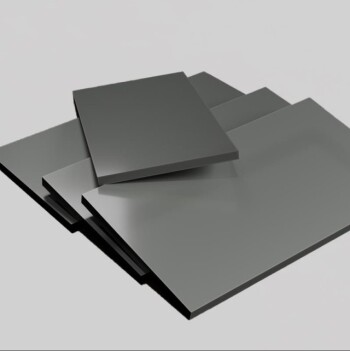
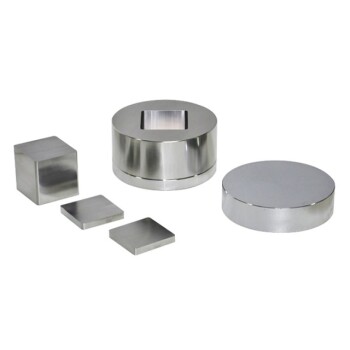
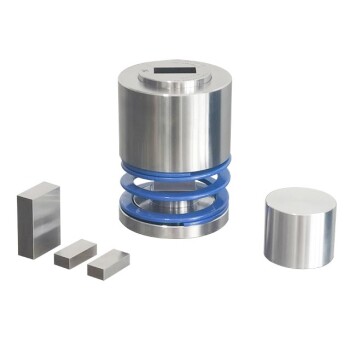
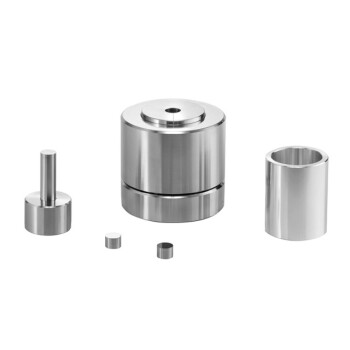
Graphite molds function as the critical structural and thermal interface during the hot press sintering of TiC10/Cu-Al2O3 composites. Specifically, they act as pressure-resistant containers that define the composite's geometry under axial load while simultaneously ensuring the uniform heat transfer necessary for consistent densification.
By combining high-temperature mechanical stability with excellent thermal conductivity, graphite molds transform loose powder into a dense, dimensionally accurate composite. They enable the simultaneous application of heat and pressure, which is the defining characteristic of the hot press sintering process.
The Mechanics of Containment and Shaping
Pressure-Resistant Vessel
The primary role of the graphite mold is to serve as a containment vessel capable of withstanding significant mechanical stress.
During the sintering process, the mold confines the TiC10/Cu-Al2O3 powder mixture. It must maintain structural integrity while subjected to the high axial loads required to densify the material.
Defining Dimensional Geometry
The mold is responsible for shaping the powder into its final dimensions.
Because the powder is compressed within a restricted space, the mold forces the particles into close contact. This ensures the final sintered product achieves the specific geometric shape and dimensional precision required for the application.
Thermal Dynamics and Stability
Uniform Heat Transfer
Graphite possesses excellent thermal conductivity, which is vital for processing Cu-Al2O3 composites.
The mold ensures that heat is transferred rapidly and uniformly from the heating elements to the powder core. This uniformity prevents thermal gradients that could lead to uneven sintering or structural defects in the composite.
High-Temperature Stability
The sintering of ceramic-metal composites requires extreme temperatures.
Graphite molds offer exceptional high-temperature stability, maintaining their strength and shape without deforming. This stability ensures that the axial pressure remains effectively transmitted to the powder throughout the entire heating cycle.
Critical Considerations: The Isolation Layer
Facilitating Demolding
While graphite is an excellent mold material, direct contact with the composite can complicate the removal of the finished part.
To address this, the process typically incorporates an alumina isolation layer between the mold and the TiC10/Cu-Al2O3 powder. This layer prevents sticking and ensures the demolding process is smooth and non-destructive after high-temperature treatment.
Making the Right Choice for Your Goal
To optimize the sintering of TiC10/Cu-Al2O3 composites, you must balance mechanical constraints with thermal requirements.
- If your primary focus is dimensional accuracy: Ensure your graphite grade has high compressive strength to resist deformation under axial loads.
- If your primary focus is process efficiency: Prioritize the application of a precise alumina isolation layer to prevent reaction and speed up the demolding phase.
Effective use of graphite molds ensures that your composite achieves both the structural homogeneity and the precise shape required for high-performance applications.
Summary Table:
| Role Category | Specific Function | Importance for Composites |
|---|---|---|
| Mechanical | Pressure Containment | Resists axial loads to ensure material densification. |
| Structural | Dimensional Shaping | Defines the geometry and final precision of the composite. |
| Thermal | Uniform Heat Transfer | Prevents thermal gradients for consistent material properties. |
| Chemical | Thermal Stability | Maintains mold integrity at extreme sintering temperatures. |
| Operational | Demolding Support | Uses isolation layers (like alumina) to prevent sticking. |
Optimize Your Materials Research with KINTEK
Precision in hot press sintering starts with the right equipment and materials. KINTEK specializes in high-performance laboratory solutions, offering a comprehensive range of hot presses, graphite molds, and high-temperature furnaces designed to meet the rigorous demands of ceramic-metal composite research.
Whether you are developing TiC10/Cu-Al2O3 composites or advanced battery materials, our portfolio of crushing and milling systems, isostatic presses, and specialized ceramic crucibles ensures your lab achieves superior structural homogeneity and dimensional accuracy.
Ready to elevate your material processing? Contact us today to find the perfect solution for your lab!
Related Products
- Double Plate Heating Press Mold for Lab
- Lab Infrared Press Mold
- Ball Press Mold for Lab
- Special Shape Press Mold for Lab
- Ring Press Mold for Lab Applications
People Also Ask
- How to use a press mold? Master the Art of Creating Consistent Ceramic Forms
- What is the process of mold press? A Step-by-Step Guide to Compression Molding
- What is the primary function of mold pressing for LAGP powders? Achieve High-Performance Solid Electrolytes
- Why are pressure molds with non-conductive resin inner walls required for battery testing? Ensure Data Accuracy
- What is the press mould method? A Guide to Consistent, Detailed Ceramic Forms