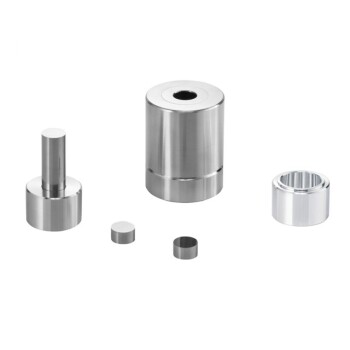
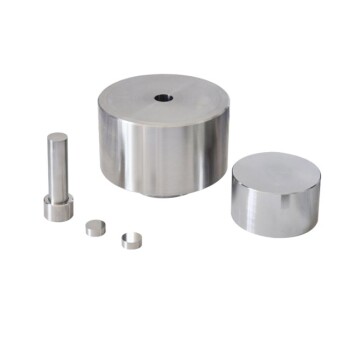
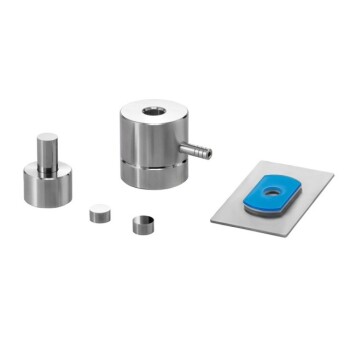
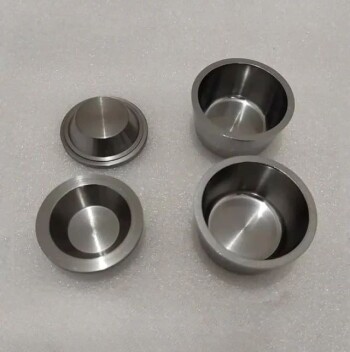
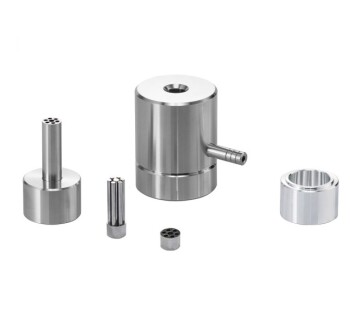
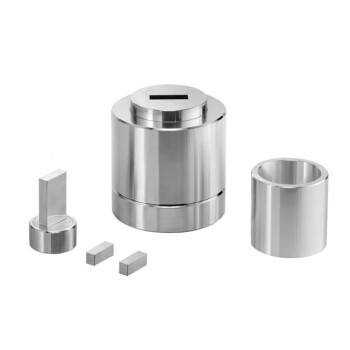
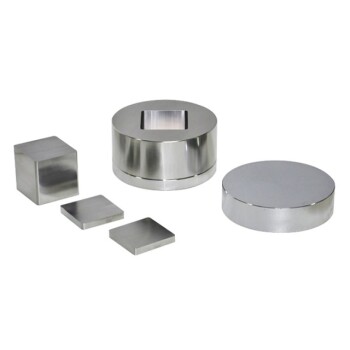
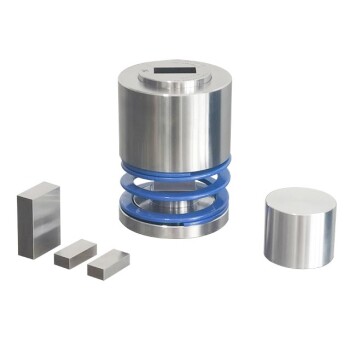
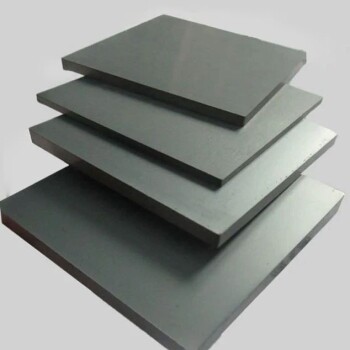
Tungsten carbide (WC) molds are the mandatory standard for high-temperature hot-pressing because they are among the few materials capable of withstanding extreme mechanical stress while facilitating precise thermal regulation. Specifically, they endure pressures of several hundred megapascals without undergoing plastic deformation, a critical requirement for densifying all-solid-state battery materials.
Core Insight: The necessity of tungsten carbide stems from its dual ability to act as an unyielding mechanical constraint and a highly efficient thermal conductor. This ensures that the battery powder is compressed to the correct density and cured uniformly, eliminating structural inconsistencies that would compromise performance.
Mechanical Resilience Under Load
Withstanding Extreme Pressure
The hot-pressing process subjects molds to immense force. Tungsten carbide is required because of its extreme hardness and high-temperature strength.
Unlike softer alloys or standard steels, WC can withstand pressures reaching hundreds of megapascals. It maintains its structural integrity under these conditions without yielding.
Preventing Plastic Deformation
A critical failure point in hot-pressing is the warping of the mold. If the mold material is not sufficiently hard, it will suffer plastic deformation under load.
WC molds resist this deformation entirely. This rigidity ensures that the pressure applied by the press is directed entirely into the powder sample, rather than being wasted on expanding or distorting the mold walls.
Thermal Management Properties
Rapid Heat Transfer
Mechanical strength alone is insufficient; the mold must also manage heat. Tungsten carbide possesses high thermal conductivity.
This property allows heat to flow rapidly from the hot press platens through the mold body. This minimizes the lag time between the machine heating up and the sample reaching the target temperature.
Ensuring Uniform Curing
Inconsistent heating leads to defects in battery materials. The thermal conductivity of WC ensures uniform heat transfer to the powder sample inside.
This uniformity is vital for the curing and densification of the cathode composite and electrolyte layers. It prevents thermal gradients that could cause uneven reaction rates or structural heterogeneity within the battery cell.
The Role of Pressure in Battery Performance
Simulating Stack Pressure
The use of a pressurized mold is not arbitrary; it simulates the stack pressure an all-solid-state battery experiences in a real working environment.
By maintaining high external pressure, the WC mold ensures tight physical contact between powder particles. It also secures the interface between the powder and the current collectors.
Accurate Performance Evaluation
Physical gaps between particles create artificial resistance. By forcing tight contact, the mold eliminates the interference of contact resistance.
This allows researchers to perform an accurate evaluation of the material's intrinsic ionic conductivity, ensuring the data reflects the chemistry of the material rather than the quality of the fabrication.
Common Pitfalls in Material Selection
The Risk of Thermal Insulators
Using a mold material with poor thermal conductivity creates uneven temperature zones. This results in parts of the battery composite being over-cured while others remain under-processed.
The Consequence of Mechanical Yield
If a mold material lacks the high-temperature strength of WC, the internal volume of the mold may change during pressing. This results in a loss of effective pressure on the powder, leading to low-density samples and poor particle-to-particle contact.
Making the Right Choice for Your Goal
When designing a fabrication process for all-solid-state batteries, the mold material dictates the quality of your data.
- If your primary focus is Structural Density: Rely on WC to prevent plastic deformation, ensuring every pascal of pressure contributes to particle compaction.
- If your primary focus is Electrochemical Accuracy: Use WC to guarantee uniform heating and tight particle contact, allowing for the precise measurement of intrinsic ionic conductivity.
By selecting tungsten carbide, you eliminate mechanical variables, ensuring your results are defined strictly by your material chemistry.
Summary Table:
| Feature | Tungsten Carbide (WC) | Standard Steel/Alloys | Impact on Battery Research |
|---|---|---|---|
| Pressure Resistance | Hundreds of MPa | Lower; prone to yielding | Ensures maximum material densification |
| Deformation | Resists plastic deformation | Warps under high load | Maintains consistent sample geometry |
| Thermal Conductivity | High | Low to Medium | Ensures uniform curing and faster heating |
| Application | High-temp hot-pressing | Standard cold-pressing | Eliminates contact resistance for accurate data |
Elevate Your Battery Research with KINTEK Precision Engineering
Achieve uncompromising accuracy in your all-solid-state battery fabrication. KINTEK specializes in high-performance laboratory equipment, providing the tungsten carbide molds and hydraulic pellet presses essential for achieving the extreme pressures and thermal stability your research demands.
Our comprehensive portfolio supports every stage of energy storage development, from battery research tools and consumables to high-temperature furnaces (muffle, vacuum, and CVD) and high-pressure reactors. Whether you need precise crushing and milling systems or reliable cooling solutions, KINTEK delivers the durability and expertise required for advanced material science.
Ready to eliminate mechanical variables and focus on your chemistry? Contact our technical experts today to find the perfect mold and pressing solution for your lab.
Related Products
- Carbide Lab Press Mold for Laboratory Applications
- Thermally Evaporated Tungsten Wire for High Temperature Applications
- Double Plate Heating Press Mold for Lab
- Anti-Cracking Press Mold for Lab Use
- Lab Infrared Press Mold
People Also Ask
- How to use a press mold? Master the Art of Creating Consistent Ceramic Forms
- What is the press mould method? A Guide to Consistent, Detailed Ceramic Forms
- What is the function of press molds during the preparation of SiCf/Ti-43Al-9V composites? Achieve Structural Precision
- What is a press mold used for? Achieve Repeatable Precision and Efficiency
- What is the purpose of specialized pressure devices in sulfide solid-state batteries? Ensure Chemo-Mechanical Stability