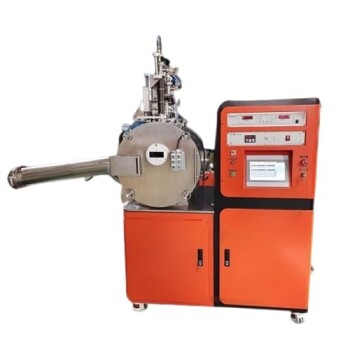
The primary technical advantage of using a vacuum induction melting (VIM) furnace is the creation of a strictly controlled, low-oxygen environment that prevents the degradation of reactive elements. For binary systems like iron-chromium or nickel-chromium, this apparatus is the only reliable method to ensure the final alloy matches the intended chemical design without significant oxidative loss.
Core Takeaway A vacuum induction melting furnace is essential for experimental metallurgy because it eliminates oxidative loss of reactive components like Chromium while simultaneously utilizing electromagnetic stirring to ensure total chemical homogeneity. This precision is the foundation for establishing accurate correlations between alloy composition and material performance.
Preserving Chemical Integrity
Preventing Elemental Loss
The most critical function of a VIM furnace is the prevention of high-temperature oxidation.
Chromium (Cr) is highly reactive and prone to rapid oxidation when melted in standard atmospheric conditions.
By operating in a high-vacuum, the furnace prevents oxygen from reacting with the melt, ensuring that the Chromium content remains stable and does not burn off as slag.
Eliminating Gaseous Impurities
Beyond preventing gross oxidation, the vacuum environment actively cleans the material.
The process significantly reduces the concentration of dissolved gases, specifically oxygen and nitrogen.
This results in a high-purity matrix free from gas-induced porosity or brittle nitride inclusions, which could otherwise skew experimental data.
Ensuring Structural Consistency
Electromagnetic Stirring
VIM furnaces utilize induction coils which generate a magnetic field to heat the metal.
A secondary benefit of this method is electromagnetic stirring, which vigorously circulates the molten metal.
This creates a consistent flow within the crucible, ensuring the iron/nickel and chromium are mixed perfectly rather than settling based on density differences.
Uniformity for Experimental Modeling
For research involving percolation thresholds or phase diagrams, material consistency is non-negotiable.
If the alloy is not chemically uniform throughout the ingot, the resulting data points will be unreliable.
VIM ensures that every section of the cast material represents the exact global composition of the melt.
Understanding the Trade-offs
The Necessity of Strict Parameters
While VIM offers superior control, it demands a rigorous adherence to process parameters.
The "advantage" of low oxygen is only realized if the vacuum seal and pumping systems are maintained to a high standard; even minor leaks can compromise the precise relationship between composition and performance.
Design versus Reality
Users must recognize that VIM guarantees the retention of elements, but not necessarily the creation of properties.
The furnace ensures the chemical composition matches the design ratios, but the final material performance still depends on subsequent processing steps (like heat treatment or rolling) that occur after the cast.
Making the Right Choice for Your Goal
To maximize the utility of a vacuum induction melting furnace for your experimental alloys:
- If your primary focus is Thermodynamic Modeling: Rely on VIM to ensure the chemical composition strictly matches designed ratios, eliminating variables caused by elemental burn-off.
- If your primary focus is Physical Property Mapping: Use the electromagnetic stirring feature to guarantee the homogeneity required to study sensitive phenomena like percolation thresholds.
Success in creating high-purity binary alloys depends on using vacuum induction to replace environmental unpredictability with absolute process control.
Summary Table:
| Feature | Technical Benefit | Impact on High-Purity Alloys |
|---|---|---|
| Vacuum Environment | Prevents high-temperature oxidation | Maintains exact Chromium levels and eliminates gaseous impurities |
| Induction Heating | Electromagnetic stirring | Ensures total chemical homogeneity and uniform material density |
| Process Control | Low-oxygen atmosphere | Reduces porosity and brittle nitride inclusions for cleaner matrices |
| Consistency | Compositional stability | Provides reliable data for thermodynamic modeling and property mapping |
Elevate Your Material Research with KINTEK Precision Metallurgy
Don't let oxidative loss or chemical segregation compromise your experimental data. KINTEK specializes in advanced vacuum induction melting (VIM) furnaces designed to deliver the absolute process control required for high-purity binary iron-chromium and nickel-chromium alloys.
Our extensive portfolio also includes high-temperature furnaces (muffle, tube, rotary, vacuum, CVD), crushing and milling systems, and hydraulic presses (pellet, hot, isostatic) to support every stage of your material synthesis. Whether you are mapping physical properties or establishing phase diagrams, KINTEK provides the reliability and precision your laboratory demands.
Ready to ensure your alloy composition matches your design? Contact our technical experts today to find the perfect melting solution for your research goals.
References
- Yusi Xie, K. Sieradzki. A percolation theory for designing corrosion-resistant alloys. DOI: 10.1038/s41563-021-00920-9
This article is also based on technical information from Kintek Solution Knowledge Base .
Related Products
- Lab-Scale Vacuum Induction Melting Furnace
- Vacuum Induction Melting Spinning System Arc Melting Furnace
- Vacuum Heat Treat Furnace and Levitation Induction Melting Furnace
- Non Consumable Vacuum Arc Induction Melting Furnace
- Vacuum Arc Induction Melting Furnace
People Also Ask
- How do vacuum induction or arc melting furnaces facilitate the synthesis of U-Al-C MAX phases? Precision Heat & Purity
- What is the primary function of a vacuum induction melting furnace in Ni-Mo-Cr-Fe master alloy prep? Ensure High Purity
- Why use VIM for rare earth steel? Essential Precision for Melting Reactive Lanthanum and Cerium
- What types of metals are typically processed in a vacuum induction melting furnace? High-Purity Alloys for Critical Applications
- What are the key components inside the vacuum chamber of a vacuum induction melting furnace? A Guide to the Core Melting Assembly