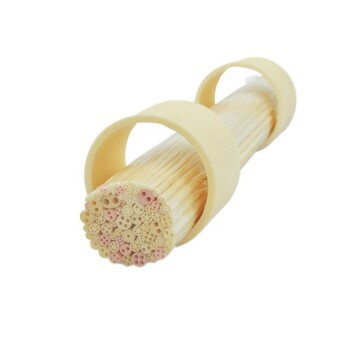
High-purity quartz tubes serve as the essential sealed reaction vessels for the vacuum chromization of superalloys. They function as a containment barrier that withstands extreme heat while strictly isolating the superalloy components from external atmospheric contaminants.
The success of vacuum chromization relies on maintaining a pristine, closed environment at high temperatures. Quartz tubes provide the necessary combination of thermal resistance and chemical inertness to sustain a vacuum seal and ensure the chromium deposition occurs without interference.
The Mechanics of Process Integrity
Withstanding Extreme Thermal Loads
The chromization process requires sustained high temperatures to be effective. High-purity quartz tubes are selected specifically for their ability to maintain structural integrity and a vacuum seal at temperatures up to 1100°C.
Ensuring Chemical Stability
Beyond heat resistance, the reaction vessel must remain neutral during the process. The chemical stability of quartz prevents the tube itself from reacting with the superalloy or the coating materials, ensuring a pure processing environment.
Controlling the Reaction Environment
Preventing Oxygen Contamination
One of the primary roles of the quartz tube is to act as a barrier against the outside atmosphere. It effectively prevents external oxygen from entering the reaction space, which is critical to avoid oxidizing the superalloys or the chromium agents.
Maintaining Activator Partial Pressure
For the coating process to work, specific pressure conditions must be met within the vessel. The quartz tube provides a closed reaction space that maintains the necessary activator partial pressure, which drives the chemical transport of the coating material.
Facilitating Controlled Deposition
The process involves the generation of a chromium chloride (CrCl2) gas phase via the reaction of chromium powder and an activator. The quartz tube ensures this gas phase deposits onto the superalloy in a completely controlled, interference-free environment.
Understanding the Operational Limits
Adhering to Temperature Ceilings
While quartz is highly resistant, it has a definitive upper limit in this application. It is critical to note that the material is rated to maintain a seal only up to 1100°C. Exceeding this threshold can compromise the vacuum integrity and the success of the coating process.
Ensuring Process Success
To maximize the effectiveness of your vacuum chromization process, consider the following regarding your reaction vessels:
- If your primary focus is Coating Purity: Ensure the quartz tube is perfectly sealed to prevent oxygen ingress, as this is the primary source of interference for the CrCl2 gas phase.
- If your primary focus is Process Stability: Strictly monitor your thermal profiles to ensure the reaction temperature never exceeds the 1100°C limit of the quartz material.
High-purity quartz is not just a container; it is an active component in maintaining the precise atmosphere required for high-performance alloy treatment.
Summary Table:
| Feature | Role in Vacuum Chromization |
|---|---|
| Material | High-Purity Quartz (SiO2) |
| Temperature Limit | Up to 1100°C |
| Primary Function | Sealed reaction vessel & atmospheric barrier |
| Chemical Benefit | Prevents oxidation; maintains activator partial pressure |
| Process Outcome | Ensures interference-free chromium (CrCl2) gas phase deposition |
Elevate Your Material Science with KINTEK Precision
Achieving the perfect chromium deposition on superalloys requires uncompromising environment control. At KINTEK, we specialize in the high-temperature laboratory equipment and consumables essential for advanced metallurgical processes.
Whether you need high-purity quartz tubes, custom CVD/PECVD systems, or specialized high-temperature furnaces, our solutions are engineered to withstand extreme thermal loads while ensuring process purity. From vacuum systems to ceramic crucibles and PTFE products, KINTEK provides the tools necessary for precision coating and research.
Ready to optimize your vacuum chromization or high-temperature research? Contact our technical experts today to discover how our comprehensive range of laboratory solutions can enhance your process integrity and efficiency.
References
- Xiaver Ledoux, Marc Wanger. Development of Chromium and Aluminum Coatings on Superalloys by Pack-Cementation Technique. DOI: 10.4028/www.scientific.net/amr.278.491
This article is also based on technical information from Kintek Solution Knowledge Base .
Related Products
- 1200℃ Split Tube Furnace with Quartz Tube Laboratory Tubular Furnace
- High Purity Pure Graphite Crucible for Evaporation
- Laboratory Rapid Thermal Processing (RTP) Quartz Tube Furnace
- High Temperature Resistant Optical Quartz Glass Sheet
- High Purity Alumina Granulated Powder for Engineering Advanced Fine Ceramics
People Also Ask
- What functions does a laboratory high-temperature tube furnace perform? Master Catalyst Synthesis & Carbonization
- What roles does a high-temperature tube furnace play in the synthesis of N/O co-doped carbon? Master Precise Doping
- How does a high-temperature tube furnace influence 253MA steel? Master Microstructure & High-Temp Creep Resistance
- What are the primary applications of muffle and tube furnaces in photocatalysts? Optimize Metal Loading & Support Synthesis
- Why is a high-temperature tube furnace required for the production of biochar from tobacco straw? Expert Pyrolysis Guide