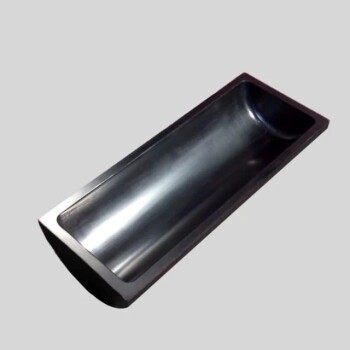
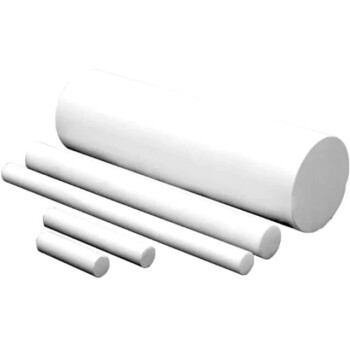
Graphite rods offer a critical combination of thermal stability and chemical inertness, making them the ideal choice for manipulating samples within high-temperature environments. Specifically, they maintain mechanical strength at temperatures reaching 1200°C, ensuring reliable operation where metal rods would deform, melt, or introduce contaminants.
The core value of using graphite push rods lies in their ability to facilitate precise mechanical movement in extreme heat without compromising the chemical purity of the reaction system.
Thermal Stability and Mechanical Integrity
High Refractoriness at 1200°C
The primary technical advantage of graphite is its high refractoriness. Unlike many metals that soften or melt at elevated temperatures, graphite rods retain their mechanical strength and structural integrity at operating temperatures of 1200°C.
Precision Through Low Expansion
Graphite possesses a notably low coefficient of thermal expansion. This means the rod does not significantly change in length or shape when transitioning from cold zones to hot zones.
Consistent Sample Manipulation
Because the rod does not warp or expand unpredictably, it allows for the precise movement of crucibles. Operators can confidently position samples in specific thermal zones without fear of the mechanism jamming or failing.
Process Purity and Efficiency
Eliminating Metallic Contamination
Standard metal push rods pose a risk of introducing metallic impurities into the reaction system via outgassing or physical degradation. Graphite is chemically inert in these applications, ensuring that the sample remains pure and the experimental data remains valid.
Preventing Mechanical Fusion
At high temperatures, materials often fuse or "stick" together. Graphite’s properties prevent the push rod from sticking to the furnace components or the crucible, ensuring smooth operation and easy retrieval of samples.
Rapid Reaction Kinetics
The structural reliability of graphite allows users to move samples quickly from a cold zone directly into the reaction temperature. This facilitates rapid heating, ensuring the sample reaches its target temperature immediately rather than ramping up slowly.
Understanding the Trade-offs
The Oxidation Factor
While graphite is mechanically robust, it is susceptible to oxidation in oxygen-rich environments at high temperatures. As noted in vacuum furnace applications, graphite is most effective in vacuum or inert gas atmospheres to prevent it from degrading or burning away.
Making the Right Choice for Your Goal
To determine if graphite push rods are the correct solution for your specific furnace operation, consider your primary objectives:
- If your primary focus is Chemical Purity: Choose graphite to eliminate the risk of metallic ions contaminating your sensitive reaction samples.
- If your primary focus is High-Temperature Reliability: Utilize graphite for operations up to 1200°C where maintaining rigid mechanical control is essential to the process flow.
Graphite provides the necessary thermal resilience to turn high-temperature variables into controlled, constant factors.
Summary Table:
| Feature | Advantage | Technical Benefit |
|---|---|---|
| Thermal Stability | High Refractoriness | Maintains mechanical strength up to 1200°C without deforming. |
| Thermal Expansion | Low Coefficient | Ensures precise sample positioning without jamming or warping. |
| Chemical Inertness | High Purity | Prevents metallic contamination and ensures reaction integrity. |
| Surface Properties | Anti-sticking | Prevents mechanical fusion between rods, crucibles, and furnace walls. |
| Heating Dynamics | Rapid Kinetics | Facilitates instant movement into hot zones for immediate target heating. |
Elevate Your Laboratory Precision with KINTEK
Don't let material degradation or contamination compromise your research results. KINTEK specializes in high-performance laboratory equipment, providing the thermal resilience your projects demand. Whether you are utilizing our high-temperature furnaces (muffle, tube, vacuum, or CVD) or require specialized graphite components and ceramics, we deliver solutions tailored to your extreme-heat applications.
From advanced high-pressure reactors to precision crushing and milling systems, our expert team is ready to equip your lab with tools that turn variables into constants.
Ready to optimize your high-temperature workflow? Contact KINTEK today for a customized consultation!
References
- Farshid Pahlevani, Veena Sahajwalla. Enhancing steel properties through in situ formation of ultrahard ceramic surface. DOI: 10.1038/srep38740
This article is also based on technical information from Kintek Solution Knowledge Base .
Related Products
- Horizontal High Temperature Graphite Vacuum Graphitization Furnace
- Ultra-High Temperature Graphite Vacuum Graphitization Furnace
- Vertical High Temperature Graphite Vacuum Graphitization Furnace
- High Purity Pure Graphite Crucible for Evaporation
- 2200 ℃ Graphite Vacuum Heat Treat Furnace
People Also Ask
- Can a horizontal furnace be used vertically? Understanding the Critical Design and Safety Factors
- What is a horizontal furnace? The Ideal Heating Solution for Tight Spaces
- Can a horizontal furnace be installed vertically? The Critical Safety Risks Explained
- Where is a horizontal furnace installed? A Guide to Space-Saving Heating Solutions
- Where are horizontal furnaces used? Achieve Superior Thermal Processing for Your Materials