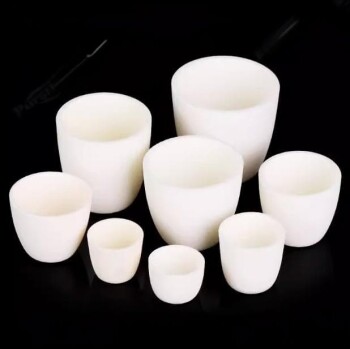
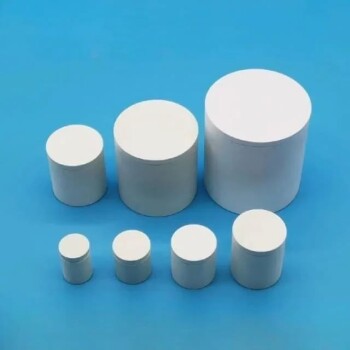
High-purity alumina crucibles offer a critical combination of exceptional thermal stability and chemical corrosion resistance, specifically essential for handling aggressive oxide-phosphate charges at temperatures exceeding 1000°C. By remaining chemically inert during the melting process, these vessels prevent the leaching of crucible material into the melt, ensuring the final glass-ceramic retains its exact intended chemical composition and physical properties.
The core value of using high-purity alumina is data integrity through isolation; it ensures that the properties of your final material are defined solely by your chemical formulation, rather than by contamination from the containment vessel.
Chemical Integrity and Contamination Control
Preventing Matrix Leaching
The primary technical risk in melting phosphate-based glass is the potential for the crucible to react with the melt. High-purity alumina acts as an inert barrier, ensuring the melt is not contaminated by the crucible material itself.
Preserving Stoichiometric Precision
In applications requiring high precision—such as the vitrification of radioactive waste simulants—maintaining exact chemical ratios is paramount. Alumina crucibles prevent alterations to the chemical composition, ensuring the final composite matrix performs exactly as modeled.
Protection in Sensitive Applications
Even trace amounts of container-related contamination can alter sensitive material properties. For example, in applications involving magnetic or optical specifications, high-purity alumina ensures that the final performance characteristics are not degraded by foreign impurities.
Thermal Stability Across Processing Stages
Performance at High Temperatures
Phosphate glass-ceramics often require processing temperatures of 1000°C and higher. High-purity alumina provides the necessary structural integrity to withstand these environments without softening or degrading, providing a stable platform for prolonged heating.
Stability During Pretreatment
The benefits of alumina extend to the lower-temperature pretreatment stages (around 300°C). During the heating of raw materials like iron phosphate or sodium aluminum phosphate, alumina resists corrosion from aggressive reagents such as ammonium dihydrogen phosphate.
Managing Volatile Off-gassing
During these pretreatment phases, alumina's inertness allows for the safe evaporation of ammonia and moisture. This controlled release prevents reactions that could lead to "violent boiling" during the subsequent high-temperature melting phase, securing the safety and consistency of the entire process.
Understanding the Trade-offs
The Necessity of "High Purity"
It is critical to distinguish between standard alumina and high-purity grades. Standard grades may contain trace binders or silica that could leach into aggressive phosphate melts.
Material Specificity
While alumina is exceptionally resistant to oxide-phosphate charges, it is not a universal solution for all glass types. For example, certain historical glass models (like SG3) processed at 1400°C may require platinum vessels to maintain purity. You must ensure that your specific phosphate chemistry is compatible with alumina's resistance profile.
Making the Right Choice for Your Goal
- If your primary focus is material purity: High-purity alumina is essential to prevent container leaching that would alter the chemical matrix of the glass-ceramic.
- If your primary focus is process safety: Alumina provides the necessary corrosion resistance to handle volatile off-gassing during raw material pretreatment without inducing violent reactions.
- If your primary focus is high-temperature synthesis: Choose this material for its structural ability to remain stable while holding oxide-phosphate charges above 1000°C.
High-purity alumina is not just a container; it is a passive assurance of quality in high-precision materials science.
Summary Table:
| Feature | Technical Advantage | Benefit for Glass-Ceramics |
|---|---|---|
| Chemical Inertness | Resists aggressive oxide-phosphate charges | Prevents contamination and matrix leaching |
| Thermal Stability | Withstands temperatures >1000°C | Maintains structural integrity during high-temp synthesis |
| Corrosion Resistance | Resists reagents like ammonium dihydrogen phosphate | Enables safe pretreatment and volatile off-gassing |
| Purity Grade | Minimized binders and trace silica | Ensures stoichiometric precision and data integrity |
Elevate Your Material Research with KINTEK Precision Solutions
Don't let container contamination compromise your stoichiometric precision. KINTEK specializes in high-performance laboratory equipment and consumables, offering premium high-purity alumina crucibles, ceramics, and PTFE products designed for the most demanding thermal environments.
Whether you are performing high-temperature synthesis in our advanced muffle or vacuum furnaces or require specialized high-temperature high-pressure reactors, we provide the tools necessary to ensure your data integrity. From battery research tools to precision milling and crushing systems, our experts are ready to help you select the ideal materials for your phosphate-based glass-ceramic applications.
Ready to achieve superior melting results? Contact KINTEK today for a consultation and quote!
References
- S. V. Yudintsev, V. I. Malkovsky. Thermal Effects and Glass Crystallization in Composite Matrices for Immobilization of the Rare-Earth Element–Minor Actinide Fraction of High-Level Radioactive Waste. DOI: 10.3390/jcs8020070
This article is also based on technical information from Kintek Solution Knowledge Base .
Related Products
- Arc-Shaped Alumina Ceramic Crucible High Temperature Resistant for Engineering Advanced Fine Ceramics
- High Purity Alumina Granulated Powder for Engineering Advanced Fine Ceramics
- High Purity Pure Graphite Crucible for Evaporation
- Engineering Advanced Fine Alumina Al2O3 Ceramic Crucible for Laboratory Muffle Furnace
- High Purity Pure Graphite Crucible for Electron Beam Evaporation
People Also Ask
- Why Use Alumina Crucibles & Powder Burial for NaSICON? Ensure Phase Purity and Prevent Elemental Volatilization
- What is the primary purpose of using alumina crucibles for LLTO ceramics? Optimize Your High-Temperature Sintering
- Why are alumina crucibles and mother powder essential for LATP sintering? Optimize Your Solid Electrolyte Performance
- Why are high-purity alumina crucibles used for liquid lead corrosion experiments? Ensure Data Accuracy at 550°C
- Primary considerations for choosing alumina crucibles and quartz tubes in indium intercalation: Ensure Material Purity