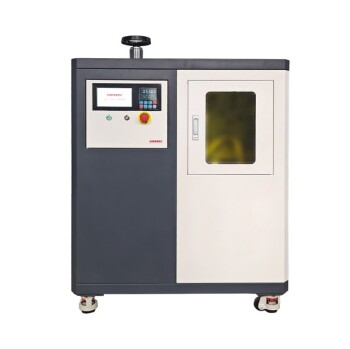
Knowledge What are the technical benefits of using a hot pressing furnace for NZTO? Achieve 98%+ Density and High Conductivity
Author avatar

Tech Team · Kintek Solution

Updated 4 days ago

What are the technical benefits of using a hot pressing furnace for NZTO? Achieve 98%+ Density and High Conductivity


The primary technical benefit of using a hot pressing furnace is the application of axial mechanical pressure simultaneously with thermal energy. Unlike pressureless sintering, which relies solely on thermal diffusion, this dual-action approach significantly enhances the sintering driving force. This allows the Na2Zn2TeO6 (NZTO) material to densify at much lower temperatures, preserving its chemical integrity.

Core Insight: The critical advantage of hot pressing NZTO is the ability to decouple densification from high temperature. By achieving high density below the threshold of sodium volatilization, you solve the trade-off between mechanical strength and chemical stability.

The Mechanics of Pressure-Assisted Sintering

Simultaneous Thermal and Mechanical Force

In a standard muffle furnace, densification is driven by high temperatures over long periods. A hot pressing furnace introduces axial mechanical pressure alongside heating. This mechanical force physically pushes particles together, accelerating the removal of pores.

Enhanced Sintering Driving Force

The addition of external pressure creates a significantly higher driving force for sintering than surface energy alone. This allows for rapid consolidation of the powder compact, reducing the time and energy required to reach near-theoretical density.

Solving the Sodium Volatilization Challenge

Lowering the Densification Temperature

A major challenge with NZTO electrolytes is that high temperatures can cause sodium (Na) to vaporize. Hot pressing permits successful densification at temperatures below 700°C.

Preserving Chemical Stoichiometry

By operating at these reduced temperatures, the process suppresses the volatilization of sodium elements. This ensures the final ceramic retains the correct chemical composition, which is vital for maintaining the material’s specific electrochemical properties.

Optimizing Microstructure and Conductivity

Eliminating Grain Boundary Voids

Pressureless methods often leave residual porosity, leading to high resistance. Pressure-assisted techniques (similar to Spark Plasma Sintering) can increase relative density from roughly 76% (cold press) to over 98%. This near-total elimination of voids is critical for efficient ion transport.

Constructing Robust Interfaces

The mechanical pressure forces better contact between grains. This promotes the construction of highly conductive solid-solid interfaces, significantly lowering grain boundary resistance and improving macroscopic ionic conductivity.

Understanding the Trade-offs

Directional Limitations

Hot pressing typically applies uniaxial pressure (from the top and bottom). Unlike Cold Isostatic Pressing (CIP), which applies uniform pressure from all sides using a liquid medium, uniaxial pressing can potentially lead to uneven density gradients or vertical deformation in complex shapes.

Geometric Constraints

While effective for flat discs or simple shapes, the axial nature of the pressure makes it difficult to sinter complex geometries without structural deformation. For complex 3D shapes, the isotropic pressure of a CIP followed by pressureless sintering might offer better geometric fidelity, albeit with different density challenges.

Making the Right Choice for Your Goal

When deciding between hot pressing and alternative sintering methods for NZTO, consider your priority:

  • If your primary focus is Maximizing Ionic Conductivity: Choose Hot Pressing. The high density and reduced grain boundary resistance derived from pressure-assisted sintering provide superior performance.
  • If your primary focus is Chemical Stability: Choose Hot Pressing. The ability to sinter below 700°C protects the sodium content from volatilizing.
  • If your primary focus is Geometric Uniformity: Consider Cold Isostatic Pressing (CIP). If you need to avoid directional deformation in complex shapes, isotropic pressure is superior, though you must carefully manage the subsequent sintering temperature.

Hot pressing is the definitive choice when the electrochemical performance of the heat-sensitive NZTO electrolyte is the non-negotiable priority.

Summary Table:

Feature Pressureless Sintering Hot Pressing Furnace
Driving Force Thermal energy only Thermal energy + Axial pressure
Densification Temp High (often >700°C) Low (below 700°C)
Relative Density ~76% >98%
Sodium Preservation Risk of volatilization Excellent (low temp suppression)
Ionic Conductivity Lower (due to voids) High (solid-solid interfaces)
Ideal For Complex geometries Maximum electrochemical performance

Elevate your material research with KINTEK’s precision engineering. From advanced hot pressing furnaces and hydraulic pellet presses to high-temperature reactors and battery research tools, KINTEK provides the specialized equipment needed to achieve near-theoretical density and optimal chemical stability in solid electrolytes. Whether you require muffle furnaces for standard sintering or isostatic presses for uniform geometry, our solutions ensure your NZTO ceramics reach peak ionic conductivity. Contact our experts today to find the perfect sintering solution for your lab!

Related Products

People Also Ask

Related Products

Vacuum Hot Press Furnace Machine Heated Vacuum Press

Vacuum Hot Press Furnace Machine Heated Vacuum Press

Discover the advantages of Vacuum Hot Press Furnace! Manufacture dense refractory metals & compounds, ceramics, and composites under high temp and pressure.

600T Vacuum Induction Hot Press Furnace for Heat Treat and Sintering

600T Vacuum Induction Hot Press Furnace for Heat Treat and Sintering

Discover the 600T Vacuum Induction Hot Press Furnace, designed for high-temperature sintering experiments in vacuum or protected atmospheres. Its precise temperature and pressure control, adjustable working pressure, and advanced safety features make it ideal for nonmetal materials, carbon composites, ceramics, and metal powders.

Vacuum Heat Treat and Sintering Furnace with 9MPa Air Pressure

Vacuum Heat Treat and Sintering Furnace with 9MPa Air Pressure

The air pressure sintering furnace is a high-tech equipment commonly used for the sintering of advanced ceramic materials. It combines vacuum sintering and pressure sintering techniques to achieve high-density and high-strength ceramics.

1400℃ Controlled Atmosphere Furnace with Nitrogen and Inert Atmosphere

1400℃ Controlled Atmosphere Furnace with Nitrogen and Inert Atmosphere

Achieve precise heat treatment with KT-14A controlled atmosphere furnace. Vacuum sealed with a smart controller, it's ideal for lab and industrial use up to 1400℃.

1200℃ Controlled Atmosphere Furnace Nitrogen Inert Atmosphere Furnace

1200℃ Controlled Atmosphere Furnace Nitrogen Inert Atmosphere Furnace

Discover our KT-12A Pro Controlled atmosphere furnace - high precision, heavy duty vacuum chamber, versatile smart touch screen controller, and excellent temperature uniformity up to 1200C. Ideal for both laboratory and industrial application.

Vacuum Heat Treat Sintering Brazing Furnace

Vacuum Heat Treat Sintering Brazing Furnace

A vacuum brazing furnace is a type of industrial furnace used for brazing, a metalworking process that joins two pieces of metal using a filler metal that melts at a lower temperature than the base metals. Vacuum brazing furnaces are typically used for high-quality applications where a strong, clean joint is required.

Vacuum Dental Porcelain Sintering Furnace

Vacuum Dental Porcelain Sintering Furnace

Get precise and reliable results with KinTek's Vacuum Porcelain Furnace. Suitable for all porcelain powders, it features hyperbolic ceramic furnace function, voice prompt, and automatic temperature calibration.

Laboratory Vacuum Tilt Rotary Tube Furnace Rotating Tube Furnace

Laboratory Vacuum Tilt Rotary Tube Furnace Rotating Tube Furnace

Discover the versatility of Laboratory Rotary Furnace: Ideal for calcination, drying, sintering, and high-temperature reactions. Adjustable rotating and tilting functions for optimal heating. Suitable for vacuum and controlled atmosphere environments. Learn more now!

Small Vacuum Heat Treat and Tungsten Wire Sintering Furnace

Small Vacuum Heat Treat and Tungsten Wire Sintering Furnace

The small vacuum tungsten wire sintering furnace is a compact experimental vacuum furnace specially designed for universities and scientific research institutes. The furnace features a CNC welded shell and vacuum piping to ensure leak-free operation. Quick-connect electrical connections facilitate relocation and debugging, and the standard electrical control cabinet is safe and convenient to operate.

2200 ℃ Tungsten Vacuum Heat Treat and Sintering Furnace

2200 ℃ Tungsten Vacuum Heat Treat and Sintering Furnace

Experience the ultimate refractory metal furnace with our Tungsten vacuum furnace. Capable of reaching 2200℃, perfect for sintering advanced ceramics and refractory metals. Order now for high-quality results.

Ultra-High Temperature Graphite Vacuum Graphitization Furnace

Ultra-High Temperature Graphite Vacuum Graphitization Furnace

The ultra-high temperature graphitization furnace utilizes medium frequency induction heating in a vacuum or inert gas environment. The induction coil generates an alternating magnetic field, inducing eddy currents in the graphite crucible, which heats up and radiates heat to the workpiece, bringing it to the desired temperature. This furnace is primarily used for graphitization and sintering of carbon materials, carbon fiber materials, and other composite materials.

Molybdenum Vacuum Heat Treat Furnace

Molybdenum Vacuum Heat Treat Furnace

Discover the benefits of a high-configuration molybdenum vacuum furnace with heat shield insulation. Ideal for high-purity, vacuum environments like sapphire crystal growth and heat treatment.

Vacuum Heat Treat Furnace with Ceramic Fiber Liner

Vacuum Heat Treat Furnace with Ceramic Fiber Liner

Vacuum furnace with polycrystalline ceramic fiber insulation liner for excellent heat insulation and uniform temperature field. Choose from 1200℃ or 1700℃ max. working temperature with high vacuum performance and precise temperature control.

1800℃ Muffle Oven Furnace for Laboratory

1800℃ Muffle Oven Furnace for Laboratory

KT-18 muffle furnace with Japan Al2O3 polycrystalline fibe and Silicon Molybdenum heating element, up to 1900℃, PID temperature control and 7" smart touch screen. Compact design, low heat loss, and high energy efficiency. Safety interlock system and versatile functions.

Horizontal High Temperature Graphite Vacuum Graphitization Furnace

Horizontal High Temperature Graphite Vacuum Graphitization Furnace

Horizontal Graphitization Furnace: This type of furnace is designed with the heating elements placed horizontally, allowing for uniform heating of the sample. It's well-suited for graphitizing large or bulky samples that require precise temperature control and uniformity.

Graphite Vacuum Furnace Bottom Discharge Graphitization Furnace for Carbon Materials

Graphite Vacuum Furnace Bottom Discharge Graphitization Furnace for Carbon Materials

Bottom-out graphitization furnace for carbon materials, ultra-high temperature furnace up to 3100°C, suitable for graphitization and sintering of carbon rods and carbon blocks. Vertical design, bottom discharging, convenient feeding and discharging, high temperature uniformity, low energy consumption, good stability, hydraulic lifting system, convenient loading and unloading.

Dental Porcelain Zirconia Sintering Ceramic Vacuum Press Furnace

Dental Porcelain Zirconia Sintering Ceramic Vacuum Press Furnace

Get precise dental results with Dental Vacuum Press Furnace. Automatic temperature calibration, low noise tray, and touch screen operation. Order now!

1400℃ Muffle Oven Furnace for Laboratory

1400℃ Muffle Oven Furnace for Laboratory

Get precise high-temperature control up to 1500℃ with KT-14M Muffle furnace. Equipped with a smart touch screen controller and advanced insulation materials.

Vacuum Sealed Continuous Working Rotary Tube Furnace Rotating Tube Furnace

Vacuum Sealed Continuous Working Rotary Tube Furnace Rotating Tube Furnace

Experience efficient material processing with our vacuum-sealed rotary tube furnace. Perfect for experiments or industrial production, equipped with optional features for controlled feeding and optimized results. Order now.

Graphite Vacuum Furnace High Thermal Conductivity Film Graphitization Furnace

Graphite Vacuum Furnace High Thermal Conductivity Film Graphitization Furnace

The high thermal conductivity film graphitization furnace has uniform temperature, low energy consumption and can operate continuously.


Leave Your Message