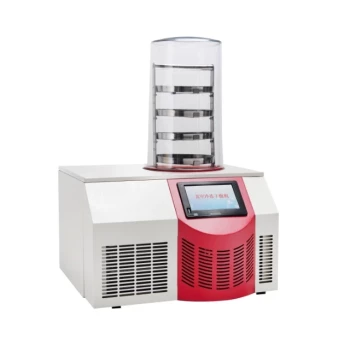
The vacuum drying oven acts as the definitive purification stage in the fabrication of PEO-RPPO composite membranes, serving the singular purpose of eliminating volatile contaminants. Specifically, it is used to completely remove organic solvents, such as acetonitrile, and trace residual moisture from the cast membrane under controlled thermal and negative pressure conditions.
This step is non-negotiable because Ruddlesden–Popper perovskite oxide (RPPO) electrolytes are highly sensitive to moisture, and any remaining solvent will degrade the electrochemical performance and mechanical integrity of the final composite.
Core Takeaway The vacuum drying oven transforms a fragile, solvent-heavy cast into a robust, electrochemically active solid electrolyte. By lowering the boiling point of solvents, it achieves deep drying without thermal damage, ensuring the PEO-RPPO composite remains chemically stable and mechanically self-supporting.
The Mechanics of Purification
Eliminating Organic Solvents
The casting process typically involves dissolving the polymer binder (PEO) and the RPPO ceramic filler in a solvent like acetonitrile.
While necessary for shaping, this solvent becomes a liability once the membrane is cast.
The vacuum oven lowers the atmospheric pressure surrounding the membrane. This significantly drops the boiling point of the acetonitrile, allowing it to evaporate rapidly and completely at moderate temperatures (often around 45–60°C) without melting or degrading the polymer matrix.
Neutralizing Moisture Sensitivity
Both components of the composite have a critical weakness regarding water.
Polyethylene oxide (PEO) is hygroscopic, meaning it naturally absorbs moisture from the air. Furthermore, the RPPO ceramic fillers are chemically sensitive to water.
The vacuum drying environment provides the deep desiccation required to prevent hydrolysis of the ceramic and ensures the lithium salts remain active.
Ensuring Structural Integrity
Preventing Void Formation
If solvents evaporate too quickly at ambient pressure, or if air is trapped during casting, the membrane will develop internal bubbles.
The negative pressure of the vacuum oven draws trapped air and solvent vapors out of the slurry.
This results in a dense, uniform, and self-supporting membrane with a smooth surface, which is essential for consistent ionic conductivity.
Mechanical Stability
The presence of residual liquid acts as a plasticizer, making the membrane too soft or gel-like.
By thoroughly removing these residuals, the vacuum oven solidifies the composite.
This ensures the membrane has the necessary mechanical strength to suppress dendrite growth and maintain physical contact with the electrodes.
Optimizing Electrochemical Performance
Widening the Voltage Window
Trace solvents are often less stable than the polymer electrolyte itself.
If left inside, these solvents will decompose at lower voltages, narrowing the electrochemical stability window.
Vacuum drying ensures a pure electrolyte composition, allowing the battery to operate at higher voltages without side reactions.
Protecting the Lithium Interface
Residual moisture is a safety hazard in solid-state batteries.
Even minute amounts of water can react violently with lithium metal anodes.
The vacuum drying process eliminates this risk, preventing interfacial side reactions that would otherwise compromise cycling stability and safety.
Understanding the Trade-offs
The Risk of Thermal Damage
While the vacuum allows for lower drying temperatures, applying heat is still necessary.
If the temperature is set too high in an attempt to speed up the process, you risk degrading the PEO polymer chain or altering the crystal structure of the RPPO filler.
The process relies on a balance: enough heat to drive off moisture, but low enough to preserve the materials.
The Danger of Rushing
Vacuum drying is rarely a quick process; it often requires 24 to 48 hours.
A common pitfall is removing the membrane too early.
While the surface may appear dry, deep-seated solvent molecules trapped within the polymer chains may remain, leading to delayed failure during battery cycling.
Making the Right Choice for Your Project
To maximize the effectiveness of the vacuum drying stage, tailor your approach to your specific performance metrics:
- If your primary focus is Safety and Cycle Life: Prioritize longer drying times (48+ hours) to ensure absolute moisture removal, preventing reactions with the lithium anode.
- If your primary focus is Ionic Conductivity: Focus on moderate temperatures and high vacuum levels to prevent bubble formation, ensuring a dense, uniform path for ion transport.
The vacuum drying oven is not merely a drying tool; it is the environment that stabilizes the chemistry of the PEO-RPPO interface, bridging the gap between a raw chemical slurry and a functional solid-state electrolyte.
Summary Table:
| Feature | Impact on PEO-RPPO Membrane |
|---|---|
| Solvent Removal | Eliminates acetonitrile to prevent electrochemical degradation. |
| Moisture Control | Protects moisture-sensitive RPPO fillers from hydrolysis. |
| Negative Pressure | Removes trapped air to prevent voids and internal bubbling. |
| Low-Temp Drying | Preserves PEO polymer chains while ensuring deep desiccation. |
| Structural Stability | Enhances mechanical strength to better suppress dendrite growth. |
Elevate Your Battery Research with KINTEK Precision
Precision is paramount when fabricating PEO-RPPO composite electrolytes. KINTEK provides industry-leading vacuum drying ovens and high-temperature furnaces designed to meet the rigorous demands of solid-state battery research. Whether you are optimizing ionic conductivity or ensuring mechanical stability, our advanced solutions—including crushing and milling systems, hydraulic presses, and battery research consumables—empower your lab to achieve superior results.
Ready to refine your fabrication process? Contact KINTEK today to discover how our high-performance equipment can enhance your lab's efficiency and material integrity.
Related Products
- 56L Vertical Laboratory Vacuum Drying Oven
- 23L Laboratory Vacuum Drying Oven
- Laboratory Scientific Electric Heating Blast Drying Oven
- Benchtop Laboratory Vacuum Freeze Dryer
- Dental Porcelain Zirconia Sintering Ceramic Vacuum Press Furnace
People Also Ask
- Why is a laboratory vacuum drying oven recommended for rice straw residues? Protect Your Biomass Integrity
- What role does a laboratory vacuum drying oven play in the preparation of modified multi-walled carbon nanotubes?
- What is the importance of using a laboratory vacuum drying oven? Preserving Slow-Release Microcapsule Integrity
- Why is a Laboratory Vacuum Drying Oven recommended for PBAT microspheres? Protect Sensitive Polymer Integrity
- What role does a laboratory vacuum drying oven play in processing nanoparticle powder samples? Protect Sample Integrity