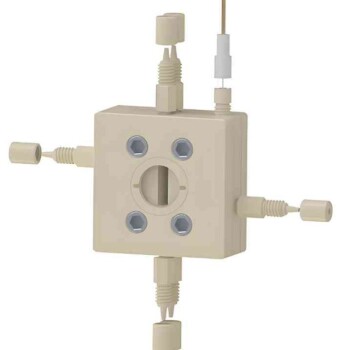
Flow capillaries act as the primary control mechanism for ensuring uniform gas distribution across parallel fixed-bed reactor systems. They function by introducing a high, calculated pressure drop upstream of the reactor beds, which forces an identical flow rate through every channel regardless of physical variations in the catalyst samples.
In parallel catalyst testing, inevitable variations in bed packing naturally lead to uneven flow. Length-optimized flow capillaries solve this by creating a dominant pressure drop that overrides these minor inconsistencies, ensuring every sample is tested under strictly identical conditions.
The Challenge of Parallel Reactor Consistency
The Inevitability of Physical Variation
Even with the most rigorous preparation, no two fixed-bed reactors are physically identical. Small differences in catalyst packing density, particle size distribution, or the exact length of the bed are unavoidable.
The Problem of Flow Resistance
These physical differences create varying levels of flow resistance in each reactor channel. Without intervention, reaction gas will naturally follow the path of least resistance.
The Impact on Data
If flow is uncontrolled, loosely packed beds receive too much gas, while tightly packed beds receive too little. This renders comparative data invalid, as catalysts are no longer being tested under the same space velocity.
How Capillaries Standardize Flow
Dominating the System Pressure
Flow capillaries are engineered to produce a pressure drop that is significantly higher than the pressure drop occurring across the catalyst beds themselves.
Masking Bed Inconsistencies
Because the capillary provides the overwhelming majority of the total resistance in the line, the small variations in resistance between different catalyst beds become mathematically negligible.
Length-Optimized Control
To achieve this precise control, the capillaries are length-optimized. By adjusting the length of the capillary tubing, engineers can tune the resistance to the exact level required to equalize flow across all channels.
Understanding the Trade-offs
High Pressure Requirements
Because the capillaries function by creating high resistance, the system requires sufficient upstream pressure to push the gas through. Your gas supply and pumping infrastructure must be capable of overcoming this intentional pressure drop.
Sensitivity to Capillary Integrity
The system's reliability depends entirely on the condition of the capillaries. If a capillary becomes obstructed or damaged, the flow balance for that channel is lost, as the catalyst bed's resistance is too low to self-regulate the flow.
Ensuring Data Integrity in High-Throughput Testing
To maximize the reliability of your catalyst screening:
- If your primary focus is comparative accuracy: Ensure your capillaries are designed to generate a pressure drop that dwarfs the maximum expected resistance of your densest catalyst bed.
- If your primary focus is experimental setup: Attempt to standardize particle size and packing as much as possible to ensure the capillaries remain the dominant resistance factor.
By effectively rendering physical bed variations irrelevant, flow capillaries serve as the guarantor of validity in parallel catalyst testing.
Summary Table:
| Feature | Function in Parallel Reactors | Impact on Data Integrity |
|---|---|---|
| Pressure Drop | Creates a dominant resistance upstream of beds | Ensures identical flow rates across all channels |
| Flow Regulation | Overrides variations in catalyst packing | Maintains consistent space velocity for all samples |
| Length Optimization | Precise tuning of flow resistance | Allows for exact equalization of gas distribution |
| System Integration | Acts as the primary control mechanism | Guarantees valid comparative results for screening |
Maximize Your Catalyst Research Accuracy with KINTEK
Don't let flow inconsistencies compromise your high-throughput screening results. KINTEK specializes in advanced laboratory solutions designed for precision and reliability. Whether you require sophisticated high-temperature high-pressure reactors, specialized fixed-bed systems, or precision-engineered flow components, we provide the tools necessary to ensure your data is accurate and reproducible.
From high-performance crushing and milling systems for uniform catalyst preparation to our industry-leading furnaces and hydraulic presses, KINTEK is your partner in material science and battery research.
Ready to optimize your parallel reactor setup? Contact our technical experts today to discover how our comprehensive range of equipment and consumables can elevate your laboratory's performance.
References
- Markus Hammes, Wilhelm F. Maier. Niobium: Activator and Stabilizer for a Copper‐Based Deacon Catalyst. DOI: 10.1002/cctc.201300697
This article is also based on technical information from Kintek Solution Knowledge Base .
Related Products
- Customer Made Versatile CVD Tube Furnace Chemical Vapor Deposition Chamber System Equipment
- Customizable CO2 Reduction Flow Cell for NRR ORR and CO2RR Research
- Multi Heating Zones CVD Tube Furnace Machine Chemical Vapor Deposition Chamber System Equipment
People Also Ask
- What is a CVD tube furnace? A Complete Guide to Thin-Film Deposition
- What is the function of a high-temperature CVD tube furnace in 3D graphene foam prep? Master 3D Nanomaterial Growth
- How does a CVD tube furnace inhibit the sintering of silver supports? Boost Membrane Durability and Performance
- What is the function of a tube furnace in CVD SiC synthesis? Achieving Ultra-Pure Silicon Carbide Powders
- What is the difference between hot wall CVD and cold wall CVD? Choose the Right System for Your Process