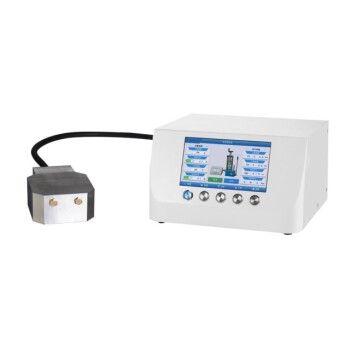
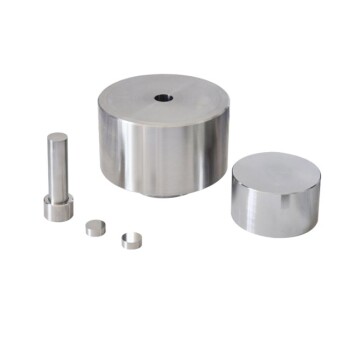
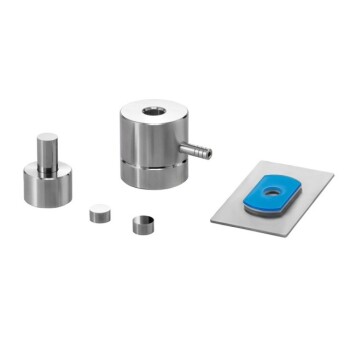
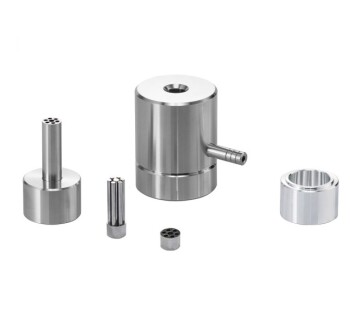
In the context of vacuum hot pressing CoCr-based composites, a high-strength graphite mold functions primarily as both a structural container and a mechanical transmission medium. It holds the composite powder in the desired geometry while simultaneously transferring mechanical pressure to the sample, maintaining stability at processing temperatures of 1100 °C.
The mold serves as the critical interface between the processing equipment and the material; its dual ability to conduct heat uniformly and transmit pressure without deforming ensures the loose powder consolidates into a dense, homogeneous solid.
The Mechanics of Consolidation
Containment and Geometric Definition
The fundamental role of the high-strength graphite mold is to serve as a containment vessel. It restricts the loose CoCr-based composite powder within a defined space.
By limiting lateral displacement, the mold forces the powder to conform to specific geometric dimensions. This ensures that the final sintered product achieves the required shape and net-shape precision.
Axial Pressure Transmission
Beyond simple containment, the mold acts as the primary medium for transmitting force. It transfers mechanical pressure—typically from hydraulic rams—directly to the powder.
Because high-strength graphite retains its rigidity under load, it ensures this axial pressure is distributed effectively. This force is necessary to eliminate voids between particles and drive the densification of the composite.
Thermal Management Roles
Structural Stability at High Temperatures
Vacuum hot pressing of CoCr-based composites requires significant heat, specifically around 1100 °C. Standard metal molds would deform or lose strength under these conditions.
High-strength graphite possesses excellent high-temperature resistance. It remains structurally stable at these elevated temperatures, ensuring the mold does not warp or fail during the sintering cycle.
Uniform Heat Distribution
Graphite is utilized for its superior thermal conductivity. In a vacuum environment where convection is absent, conductive heat transfer is vital.
The mold facilitates uniform heating across the entire sample. This prevents thermal gradients (hot or cold spots), ensuring that the microstructure of the CoCr composite remains consistent throughout the material.
Understanding the Trade-offs
Mechanical Limitations
While graphite is strong, it is also brittle. It handles compressive loads exceptionally well but has low tensile strength.
If the mold design includes sharp corners or if the pressure is applied unevenly (shear stress), the graphite is prone to cracking or catastrophic fracture.
Reactivity Risks
Although generally stable, graphite is carbon-based. At high temperatures, there is a potential risk of carbon diffusion into the metallic matrix.
While this is sometimes desired for carbide formation, unintended reactions can alter the surface chemistry of the CoCr composite, potentially requiring additional machining or finishing to remove a carburized layer.
Making the Right Choice for Your Goal
When designing your vacuum hot pressing process, consider how the mold functions relative to your specific outcomes:
- If your primary focus is Microstructural Homogeneity: Prioritize graphite grades with the highest possible thermal conductivity to ensure even heating across the CoCr matrix.
- If your primary focus is Dimensional Precision: Ensure the mold wall thickness is sufficient to resist hoop stress at 1100 °C without elastic deformation.
The success of your sintering process relies not just on the powder chemistry, but on the thermal and mechanical integrity of the graphite interface.
Summary Table:
| Function | Description | Key Benefit |
|---|---|---|
| Structural Containment | Limits lateral displacement of CoCr powder. | Ensures net-shape precision and geometric accuracy. |
| Pressure Transmission | Transfers axial hydraulic force to the sample. | Drives densification and eliminates internal voids. |
| Thermal Stability | Maintains integrity at processing temps of 1100 °C. | Prevents mold warping or deformation during sintering. |
| Heat Distribution | High thermal conductivity for uniform heating. | Prevents thermal gradients for a consistent microstructure. |
| Material Interface | Serves as the conductive medium in vacuum. | Ensures efficient sintering where convection is absent. |
Elevate Your Material Synthesis with KINTEK
Achieving the perfect density in CoCr-based composites requires more than just heat—it requires precision engineering. At KINTEK, we specialize in the advanced laboratory equipment and consumables essential for high-performance metallurgy.
From our robust high-temperature vacuum hot presses to our premium high-strength graphite molds and crucibles, we provide the tools needed to ensure uniform heat distribution and structural integrity at 1100 °C and beyond. Our extensive portfolio also includes crushing systems, hydraulic pellet presses, and CVD/PECVD solutions designed to optimize your research workflow.
Ready to achieve superior microstructural homogeneity? Contact our technical experts today to find the ideal sintering solution for your lab’s unique requirements.
References
- Gongjun Cui, Ziming Kou. Nano-TiO2 reinforced CoCr matrix wear resistant composites and high-temperature tribological behaviors under unlubricated condition. DOI: 10.1038/s41598-020-63918-4
This article is also based on technical information from Kintek Solution Knowledge Base .
Related Products
- Ball Press Mold for Lab
- Ultra-High Temperature Graphite Vacuum Graphitization Furnace
- 2200 ℃ Graphite Vacuum Heat Treat Furnace
- Horizontal High Temperature Graphite Vacuum Graphitization Furnace
- Vertical High Temperature Graphite Vacuum Graphitization Furnace
People Also Ask
- What are the advantages of using a laboratory hydraulic press for hot pressing? Achieve Peak Nano-Composite Density
- How to use a press mold? Master the Art of Creating Consistent Ceramic Forms
- What is the press mould method? A Guide to Consistent, Detailed Ceramic Forms
- What is the purpose of specialized pressure devices in sulfide solid-state batteries? Ensure Chemo-Mechanical Stability
- Why are pressure molds with non-conductive resin inner walls required for battery testing? Ensure Data Accuracy