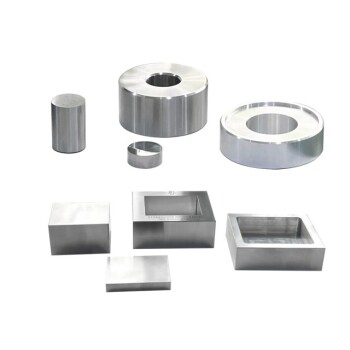
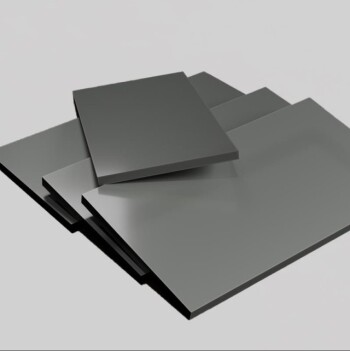
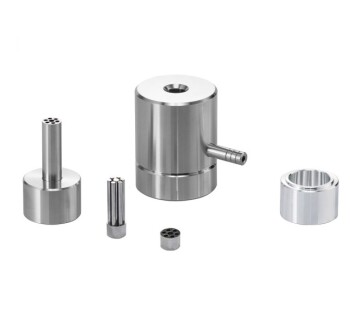
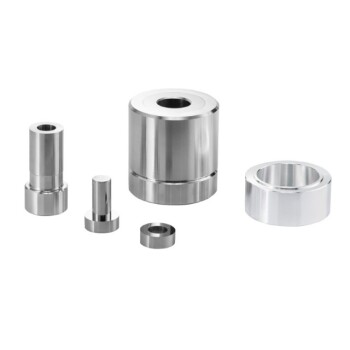
High-strength molds act as critical pressure vessels during the hot pressing of nanocopper, serving functions that go far beyond simple containment. Their primary role is to transmit immense external mechanical pressure—typically ranging from 0.5 to 1 GPa—directly to the nanocopper powder while strictly prohibiting any lateral expansion.
Core Takeaway High-strength molds are the mechanical enablers of densification; by providing a rigid lateral constraint, they force the nanocopper into a state of plastic flow, effectively closing large-scale pores that atomic diffusion alone cannot eliminate.
The Mechanics of Pressure Transmission
For nanocopper to achieve high density, the mold must act as an unyielding transmission medium.
Overcoming Atomic Diffusion Limits
Standard sintering relies on atomic diffusion to bond particles. However, in nanocopper, diffusion is often insufficient to remove large-scale pores.
This is particularly true for pores caused by differences in lattice orientation. The mold allows the application of extreme pressure (up to 1 GPa) to mechanically force these stubborn voids to close.
Inducing Plastic Flow
The application of high pressure changes the material's behavior.
Instead of just compressing, the nanocopper is forced to undergo plastic flow. The mold ensures this force is applied uniformly, pushing the material into every available void and significantly increasing the final density of the compact.
The Role of Structural Constraint
The ability to withstand pressure is useless if the mold deforms. The "high-strength" aspect is critical for maintaining geometry.
Lateral Confinement
As vertical pressure is applied, the powder naturally wants to expand outward.
The mold provides a lateral constraint environment. By physically blocking outward expansion, the mold redirects that energy internally. This redirection is what drives the plastic flow necessary for high-performance densification.
Dimensional Accuracy and Shaping
Beyond the micro-level physics, the mold defines the macroscopic shape of the product.
Acting as a high-temperature resistant container, it holds the loose powder in the desired geometry. It ensures that the final sintered sample maintains precise dimensional accuracy despite the extreme thermal and mechanical stress.
Thermal Functions (Secondary Role)
While mechanical constraint is the primary driver for nanocopper densification, the mold also plays a vital thermal role.
Thermal Conductivity
Materials like high-purity graphite exhibit excellent thermal conductivity.
This ensures that heat is transferred efficiently from the furnace (or heating element) to the internal powder mixture. Uniform heating is essential to prevent internal stress or uneven sintering within the copper matrix.
High-Temperature Integrity
The mold must maintain its strength at elevated temperatures.
Whether operating at 800°C or higher, the mold must not soften or crack. If the mold fails thermally, the pressure transmission is interrupted, and the densification process will fail.
Understanding the Trade-offs
When selecting molds for nanocopper processing, you are balancing mechanical rigidity against process limitations.
The Limits of Diffusion vs. Pressure
A common pitfall is relying too heavily on temperature (diffusion) rather than pressure. The primary reference clarifies that for nanocopper, atomic diffusion is not enough.
If the mold cannot withstand the required 0.5 to 1 GPa range, you will likely be left with residual porosity. You cannot simply compensate for a weak mold by increasing the temperature, as this may not resolve pores caused by lattice orientation mismatches.
Material Compatibility
While graphite is excellent for non-wetting and thermal transfer, it must be of high purity. Impurities in the mold can contaminate the nanocopper at high temperatures, effectively ruining the high-purity nature of the nanomaterial.
Making the Right Choice for Your Goal
To maximize the quality of your nanocopper molding process, align your mold selection with your specific technical objectives.
- If your primary focus is Maximum Density: Prioritize molds rated for pressures exceeding 1 GPa to ensure complete plastic flow and pore elimination.
- If your primary focus is Dimensional Precision: Ensure the mold material has a low coefficient of thermal expansion and high creep resistance at operating temperatures.
- If your primary focus is Process Speed: Select mold materials with high thermal conductivity to facilitate rapid heating and cooling cycles.
The success of nanocopper molding relies not just on the powder, but on the mold's ability to force the material beyond the limits of natural diffusion.
Summary Table:
| Function | Description | Key Performance Metric |
|---|---|---|
| Pressure Transmission | Transmits external mechanical force to eliminate large pores. | 0.5 to 1 GPa |
| Lateral Constraint | Prohibits expansion to force material into plastic flow. | Rigid Dimensional Stability |
| Structural Integrity | Maintains geometry under extreme thermal and mechanical stress. | High Creep Resistance |
| Thermal Conductivity | Ensures uniform heat transfer to prevent internal stress. | Efficient Heating/Cooling |
| Purity Control | Prevents contamination of the copper matrix. | High-Purity Graphite Grade |
Precision-engineered molds are the foundation of successful nanomaterial densification. At KINTEK, we specialize in providing high-performance laboratory equipment, including high-strength graphite molds, high-temperature furnaces, and advanced hydraulic presses designed to withstand the extreme 1 GPa pressures required for nanocopper processing. Whether you need reliable crushing and milling systems or specialized high-temperature high-pressure reactors, our team ensures your lab is equipped for peak efficiency and superior material quality. Contact KINTEK today to optimize your research workflow!
Related Products
- Special Heat Press Mold for Lab Use
- Ball Press Mold for Lab
- Double Plate Heating Press Mold for Lab
- Anti-Cracking Press Mold for Lab Use
- Carbon Graphite Plate Manufactured by Isostatic Pressing Method
People Also Ask
- How to use a press mold? Master the Art of Creating Consistent Ceramic Forms
- What is the press mould method? A Guide to Consistent, Detailed Ceramic Forms
- What is a press mold used for? Achieve Repeatable Precision and Efficiency
- What is the function of press molds during the preparation of SiCf/Ti-43Al-9V composites? Achieve Structural Precision
- What is the purpose of specialized pressure devices in sulfide solid-state batteries? Ensure Chemo-Mechanical Stability