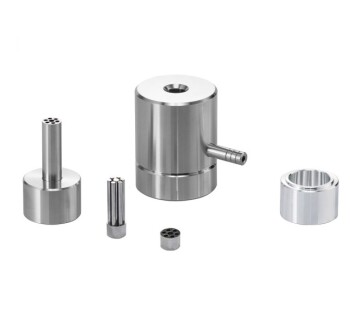
High-temperature molds primarily serve as precision positioning containers and pressure-transmitting media. During the vacuum hot pressing of metal layered composites, these molds secure the alignment of multi-layer foil stacks to prevent structural shifting. Crucially, they act as an intermediary buffer that distributes the hydraulic load uniformly across the sample surface, ensuring consistent material density and bonding throughout the sintering process.
The mold is not merely a passive container; it is an active mechanical interface. Its ability to convert uniaxial hydraulic force into uniform surface pressure is the single most critical factor in preventing fatal defects like local non-bonding and uneven thickness.
Ensuring Structural Integrity and Alignment
Precise Layer Positioning
Metal layered composites rely on the exact arrangement of foil stacks.
The mold acts as a positioning container, holding the multi-layer stack in place. This strict confinement prevents lateral movement or misalignment of the layers during the initial stages of the vacuum process.
Defining Geometric Dimensions
The mold is responsible for the final shape of the composite.
Graphite is typically used because it maintains high mechanical strength even at elevated temperatures (often exceeding 650°C). By resisting deformation under load, the mold ensures the composite material cures to the exact required dimensions.
The Mechanics of Force Transmission
Uniform Load Distribution
This is the most significant technical function of the mold, as highlighted by the primary reference.
A hydraulic press applies force in a single direction (uniaxial). The mold acts as a pressure-transmitting medium, spreading this force evenly across the entire surface area of the composite plate.
Preventing Bonding Defects
Uneven pressure is the primary cause of composite failure.
If the mold fails to distribute pressure uniformly, "pressure shadows" or weak spots can occur. This leads to local non-bonding (delamination) or variations in thickness, compromising the mechanical properties of the final part.
Thermal and Chemical Stability
Efficient Heat Transfer
Beyond pressure, the mold manages the thermal profile of the process.
Graphite possesses excellent thermal conductivity. This allows the mold to transfer heat from the furnace elements to the inner composite core efficiently, ensuring the material sinters evenly from the outside in.
Protection and Demolding
The chemical properties of the mold material play a vital role in surface quality.
High-purity graphite is chemically stable and creates a slight reducing atmosphere in a vacuum. This helps protect metal powders (like aluminum) from oxidation and facilitates easy demolding after the process is complete.
Understanding the Trade-offs
Material Degradation
While graphite is robust, it is ultimately a consumable.
Repeated cycling at high temperatures and pressures (35-70 MPa) causes mechanical wear and oxidation over time. A worn mold can introduce surface irregularities or fail to hold dimensional tolerances, requiring strict replacement schedules.
Strength vs. Cost
Not all graphite is equal.
High-strength, high-purity graphite is required to withstand significant mechanical pressure without deformation. Using lower-grade molds to save costs risks structural failure under load, which can destroy the composite sample and damage the hot press equipment.
Making the Right Choice for Your Goal
To maximize the performance of your metal layered composites, select your mold strategy based on your specific defects:
- If your primary focus is Bonding Integrity: Prioritize mold designs with perfect parallelism to ensure pressure is distributed without gradients, eliminating non-bonding zones.
- If your primary focus is Dimensional Precision: Select high-density, high-strength graphite grades that allow for minimal deformation under peak hydraulic pressures.
The mold functions as the critical bridge between the raw energy of the hot press and the delicate microstructure of your composite.
Summary Table:
| Function | Description | Key Benefit |
|---|---|---|
| Positioning | Secures multi-layer foil stacks in alignment | Prevents structural shifting & misalignment |
| Force Transmission | Converts uniaxial hydraulic load to uniform surface pressure | Eliminates local non-bonding and delamination |
| Geometric Definition | Resists deformation at high temperatures (>650°C) | Ensures exact dimensional tolerances |
| Thermal Management | Efficiently transfers heat from furnace to core | Promotes uniform sintering and material density |
| Chemical Stability | Creates a reducing atmosphere in vacuum | Protects against oxidation & facilitates demolding |
Maximize Your Composite Performance with KINTEK Precision Solutions
Achieving flawless bonding and dimensional accuracy in metal layered composites requires the perfect synergy between your mold and furnace. KINTEK specializes in high-performance laboratory equipment, including vacuum hot presses, hydraulic presses, and high-temperature furnaces (muffle, tube, and vacuum) designed for rigorous material research.
Whether you are refining sintering processes or developing advanced battery tools, our comprehensive range of high-purity graphite molds, ceramics, and crucibles provides the mechanical integrity your lab demands.
Ready to eliminate bonding defects and elevate your research results? Contact our technical experts today to find the ideal equipment and consumables for your specific application.
Related Products
- 2200 ℃ Graphite Vacuum Heat Treat Furnace
- Ultra-High Temperature Graphite Vacuum Graphitization Furnace
- Vertical High Temperature Graphite Vacuum Graphitization Furnace
- Horizontal High Temperature Graphite Vacuum Graphitization Furnace
- Large Vertical Graphite Vacuum Graphitization Furnace
People Also Ask
- Why do you heat treat in a vacuum? Achieve Perfect Surface Finish and Material Integrity
- How does heat transmit in a vacuum? Mastering Thermal Radiation for Purity & Precision
- What is the process of vacuum heat treating? Achieve Superior Hardening with a Clean, Bright Finish
- How does a vacuum heat treat furnace work? Achieve Pristine, Oxide-Free Metal Parts
- What is graphite heating? A Guide to Durable, High-Temp Industrial Furnace Solutions