Knowledge laboratory mill What is a hammer mill used for in pharmaceuticals? Achieve Precise Particle Size Control for Better Drug Efficacy
Author avatar

Tech Team · Kintek Solution

Updated 3 months ago

What is a hammer mill used for in pharmaceuticals? Achieve Precise Particle Size Control for Better Drug Efficacy


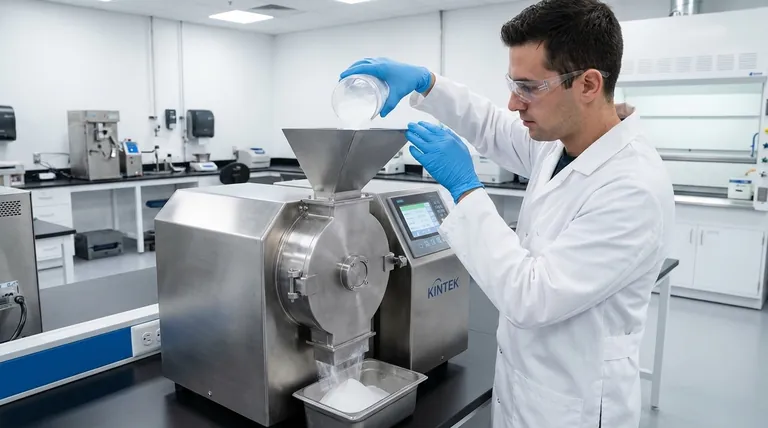
In pharmaceuticals, a hammer mill is a crucial piece of equipment used for particle size reduction, also known as comminution. Its primary function is to break down large solid particles of Active Pharmaceutical Ingredients (APIs) or excipients into smaller, more uniform pieces. This process is fundamental for improving drug efficacy, manufacturability, and final product quality.

The core purpose of using a hammer mill is not just to make particles smaller, but to precisely control their size distribution. This control directly impacts how a drug dissolves in the body, how uniformly it can be mixed into a tablet, and how efficiently it can be processed during manufacturing.
What is a hammer mill used for in pharmaceuticals? Achieve Precise Particle Size Control for Better Drug Efficacy

The Core Principle: How a Hammer Mill Works

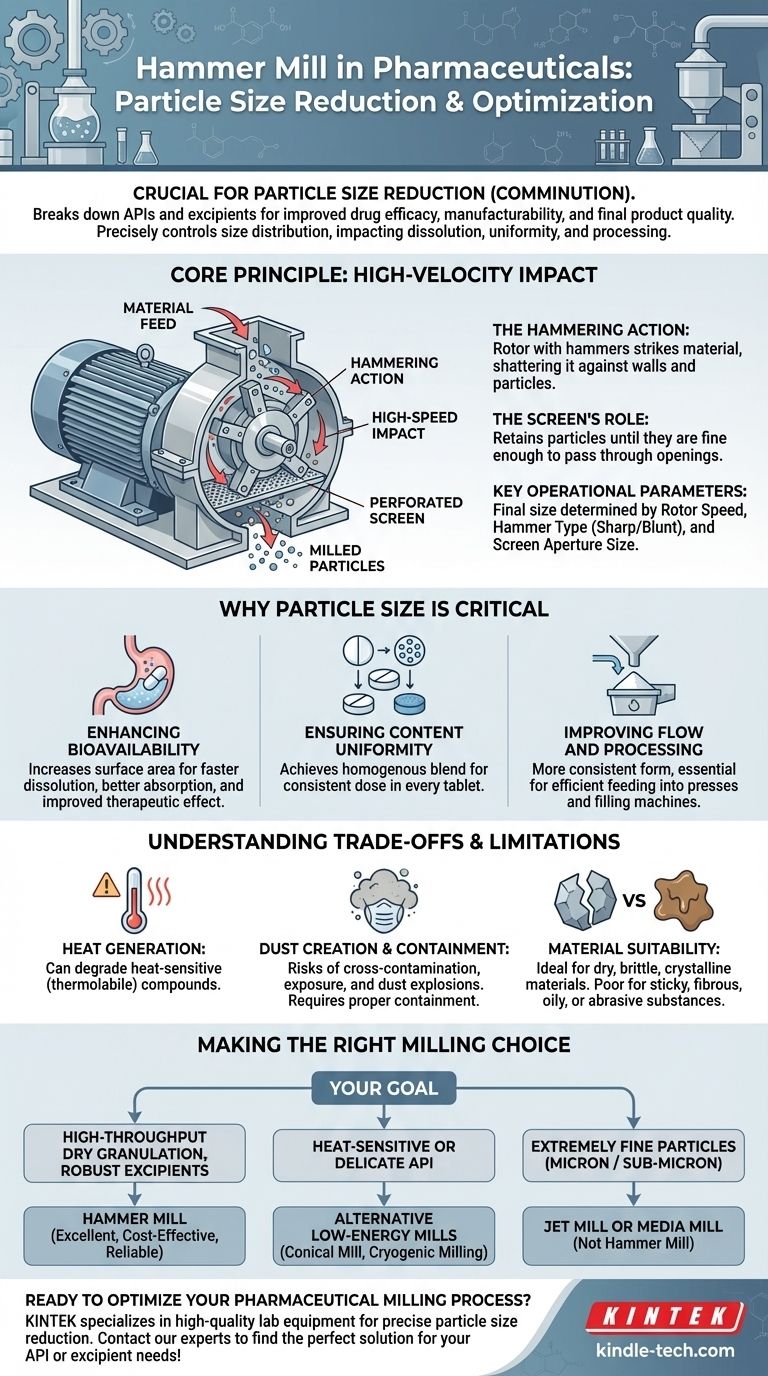
A hammer mill operates on the principle of high-velocity impact. It is a mechanically simple yet effective device for pulverizing a wide range of dry, crystalline, or granular materials.

The Hammering Action

Material is fed into a chamber where a central rotor spins at high speed. This rotor is fitted with numerous swinging or fixed hammers. As the material enters, these hammers strike it with immense force, shattering it against the chamber's inner walls and other particles.

The Screen's Role

The bottom of the milling chamber is enclosed by a perforated screen or mesh. Milled particles remain in the chamber, continuously struck by the hammers, until they are fine enough to pass through the openings in this screen.

Key Operational Parameters

The final particle size is determined by three main factors: rotor speed, hammer type (sharp vs. blunt edge), and the screen's aperture size. A faster speed, sharper hammer edge, and smaller screen opening will all result in a finer powder.

Why Particle Size is Critical in Pharmaceuticals

Controlling particle size is a non-negotiable aspect of drug development and manufacturing. The hammer mill is a key tool for achieving this control, which has several critical downstream effects.

Enhancing Bioavailability

For poorly soluble drugs, reducing the particle size dramatically increases the surface area available for dissolution. A larger surface area allows the drug to dissolve faster in the body, leading to better absorption and improved therapeutic effect, or bioavailability.

Ensuring Content Uniformity

Imagine trying to mix a small amount of fine API powder with a large volume of coarse excipient granules. The mixture will likely be non-uniform. By milling all components to a similar particle size range, manufacturers can achieve a homogenous blend, ensuring that every tablet contains the exact same dose.

Improving Flow and Processing

Milling can break down irregularly shaped particles and aggregates into a more consistent form. This improves the powder's flowability, which is essential for efficient and consistent feeding into tablet presses and capsule-filling machines.

Understanding the Trade-offs and Limitations

While versatile, the hammer mill is not a universal solution. An objective assessment requires understanding its potential downsides.

Heat Generation

The high-speed impact generates significant heat. This can be problematic for thermolabile (heat-sensitive) compounds, potentially causing degradation of the API or unwanted physical changes in the material.

Dust Creation and Containment

The aggressive milling action can create a large amount of fine dust. In a pharmaceutical setting, this poses risks of cross-contamination, operator exposure, and even dust explosions with certain materials. Proper containment and dust collection systems are mandatory.

Material Suitability

Hammer mills are ideal for dry, brittle, or crystalline materials. They perform poorly with sticky, fibrous, oily, or highly abrasive substances, which can clog the screen or rapidly wear down the hammers.

Making the Right Milling Choice for Your Goal

Selecting the correct milling technology depends entirely on your material's properties and your final product requirements.

  • If your primary focus is high-throughput dry granulation or milling of robust excipients: The hammer mill is an excellent, cost-effective, and reliable choice.
  • If your primary focus is milling a heat-sensitive or delicate API: You should consider alternative low-energy mills, such as a conical mill, or cryogenic milling where the material is cooled with liquid nitrogen.
  • If your primary focus is achieving extremely fine particles (micron or sub-micron range): A hammer mill is not the right tool; you would need to use a jet mill or a media mill.

Ultimately, choosing the right particle reduction technology is a critical decision that directly influences the safety, quality, and efficacy of the final pharmaceutical product.

Summary Table:

Key Function Benefit in Pharmaceuticals
Particle Size Reduction Improves drug dissolution and bioavailability.
High-Impact Milling Breaks down dry, crystalline materials efficiently.
Screen-Based Control Allows for precise control over final particle size distribution.
High-Throughput Processing Enables fast and reliable milling of APIs and excipients.

Ready to optimize your pharmaceutical milling process? KINTEK specializes in high-quality lab equipment, including hammer mills designed for precise particle size reduction. Our expertise ensures you achieve the uniformity and efficiency critical for drug development and manufacturing. Contact our experts today to find the perfect milling solution for your API or excipient needs!

Visual Guide
What is a hammer mill used for in pharmaceuticals? Achieve Precise Particle Size Control for Better Drug Efficacy Visual Guide

Related Products

People Also Ask

Related Products

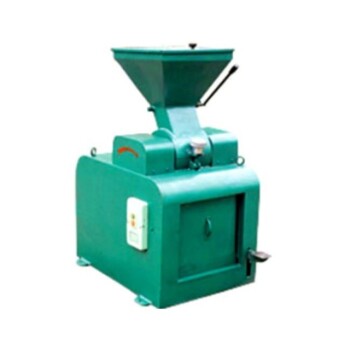
Laboratory Sealed Hammer Crusher for Efficient Sample Preparation

Laboratory Sealed Hammer Crusher for Efficient Sample Preparation

Discover the Laboratory Sealed Hammer Crusher for efficient sample preparation. Ideal for coal, metallurgy, and research, this crusher ensures high production efficiency and environmental friendliness.

Laboratory Single Horizontal Jar Mill

Laboratory Single Horizontal Jar Mill

KT-JM3000 is a mixing and grinding instrument for placing a ball milling tank with a volume of 3000ml or less. It adopts frequency conversion control to realize timing, constant speed, direction change, overload protection and other functions.

Laboratory Ball Mill Jar Mill with Metal Alloy Grinding Jar and Balls

Laboratory Ball Mill Jar Mill with Metal Alloy Grinding Jar and Balls

Grind and mill with ease using metal alloy grinding jars with balls. Choose from 304/316L stainless steel or tungsten carbide and optional liner materials. Compatible with various mills and features optional functions.

Vibrating Disc Mill Small Laboratory Grinding Machine

Vibrating Disc Mill Small Laboratory Grinding Machine

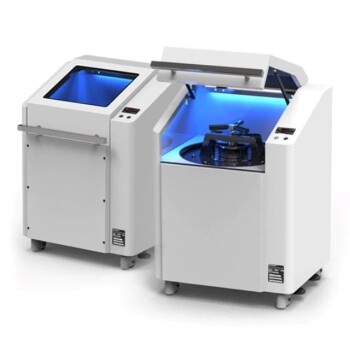
Discover the versatile Vibrating Disc Mill for efficient laboratory grinding. Ideal for geology, metallurgy, biology, and more. Explore now!

Laboratory Four-Body Horizontal Jar Mill

Laboratory Four-Body Horizontal Jar Mill

The four-body horizontal tank mill ball mill can be used with four horizontal ball mill tanks with a volume of 3000ml. It is mostly used for mixing and grinding laboratory samples.

High Energy Vibratory Ball Mill for Lab Use

High Energy Vibratory Ball Mill for Lab Use

The high-energy vibrating ball mill is a high-energy oscillating and impacting multifunctional laboratory ball mill. The table-top type is easy to operate, small in size, comfortable and safe.

Laboratory Disc Cup Vibratory Mill for Sample Grinding

Laboratory Disc Cup Vibratory Mill for Sample Grinding

The vibrating disc mill is suitable for non-destructive crushing and fine grinding of samples with large particle sizes, and can quickly prepare samples with analytical fineness and purity.

High Energy Vibratory Laboratory Ball Mill Grinding Mill Single Tank Type

High Energy Vibratory Laboratory Ball Mill Grinding Mill Single Tank Type

High-energy vibration ball mill is a small desktop laboratory grinding instrument.It can be ball-milled or mixed with different particle sizes and materials by dry and wet methods.

Laboratory Ten-Body Horizontal Jar Mill for Lab Use

Laboratory Ten-Body Horizontal Jar Mill for Lab Use

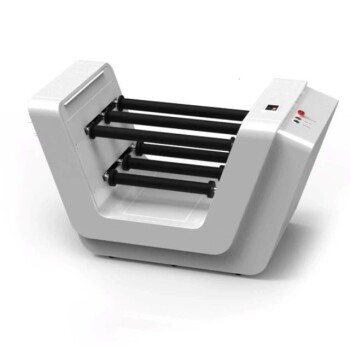
The Ten-body horizontal jar mill is for 10 ball mill pots (3000ml or less). It has frequency conversion control, rubber roller movement, and PE protective cover.

Hybrid High Energy Vibratory Ball Mill for Lab Use

Hybrid High Energy Vibratory Ball Mill for Lab Use

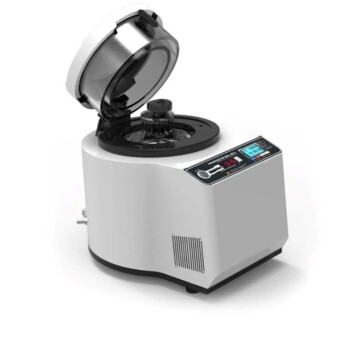
KT-BM400 is used for rapid grinding or mixing of dry, wet and frozen small amount of samples in the laboratory. It can be configured with two 50ml ball mill jars

Laboratory Jar Mill with Agate Grinding Jar and Balls

Laboratory Jar Mill with Agate Grinding Jar and Balls

Grind your materials with ease using Agate Grinding Jars with Balls. Sizes from 50ml to 3000ml, perfect for planetary and vibration mills.

Laboratory High Throughput Tissue Grinding Mill Grinder

Laboratory High Throughput Tissue Grinding Mill Grinder

KT-MT is a high-quality, small, and versatile tissue grinder used for crushing, grinding, mixing, and cell wall breaking in various fields, including food, medical, and environmental protection. It is equipped with 24 or 48 2ml adapters and ball grinding tanks and is widely employed for DNA, RNA, and protein extraction.

High Energy Vibratory Laboratory Ball Mill Double Tank Type

High Energy Vibratory Laboratory Ball Mill Double Tank Type

High-energy vibration ball mill is a small desktop laboratory grinding instrument. It uses 1700r/min high-frequency three-dimensional vibration to make the sample achieve the result of grinding or mixing.

Disc Cup Vibrating Mill Multi-Platform for Lab

Disc Cup Vibrating Mill Multi-Platform for Lab

The multi-platform vibrating disc mill is suitable for non-destructive crushing and fine grinding of samples with large particle sizes. It is suitable for crushing and grinding applications of medium-hard, high-hard, brittle, fibrous, and elastic materials.

Three-dimensional electromagnetic sieving instrument

Three-dimensional electromagnetic sieving instrument

KT-VT150 is a desktop sample processing instrument for both sieving and grinding. Grinding and sieving can be used both dry and wet. The vibration amplitude is 5mm and the vibration frequency is 3000-3600 times/min.

Laboratory Grinding Mill Mortar Grinder for Sample Preparation

Laboratory Grinding Mill Mortar Grinder for Sample Preparation

KT-MG200 mortar grinder can be used for mixing and homogenizing powder, suspension, paste and even viscous samples. It can help users realize the ideal operation of sample preparation with more regularization and higher repeatability.

High-Energy Omnidirectional Planetary Ball Mill Milling Machine for Laboratory

High-Energy Omnidirectional Planetary Ball Mill Milling Machine for Laboratory

The KT-P4000E is a new product derived from the vertical high-energy planetary ball mill with a 360° swivel function. Experience faster, uniform, and smaller sample output results with 4 ≤1000ml ball mill jars.

High Energy Planetary Ball Mill Milling Machine for Laboratory

High Energy Planetary Ball Mill Milling Machine for Laboratory

The biggest feature is that the high energy planetary ball mill can not only perform fast and effective grinding, but also has good crushing ability

High Energy Planetary Ball Mill Milling Machine for Laboratory

High Energy Planetary Ball Mill Milling Machine for Laboratory

Experience fast and effective sample processing with the F-P2000 high-energy planetary ball mill. This versatile equipment offers precise control and excellent grinding capabilities. Perfect for laboratories, it features multiple grinding bowls for simultaneous testing and high output. Achieve optimal results with its ergonomic design, compact structure, and advanced features. Ideal for a wide range of materials, it ensures consistent particle size reduction and low maintenance.

Laboratory Horizontal Planetary Ball Mill Milling Machine

Laboratory Horizontal Planetary Ball Mill Milling Machine

Improve sample uniformity with our Horizontal Planetary Ball Mills. KT-P400H reduces sample deposition and KT-P400E has multi-directional capabilities. Safe, convenient and efficient with overload protection.


Leave Your Message