Knowledge What is the ASTM standard for sieving? Master the Two Pillars for Accurate Particle Analysis
Author avatar

Tech Team · Kintek Solution

Updated 1 week ago

What is the ASTM standard for sieving? Master the Two Pillars for Accurate Particle Analysis


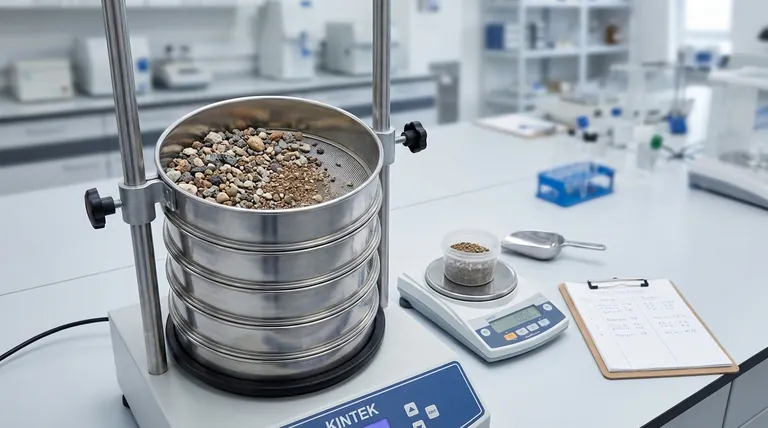
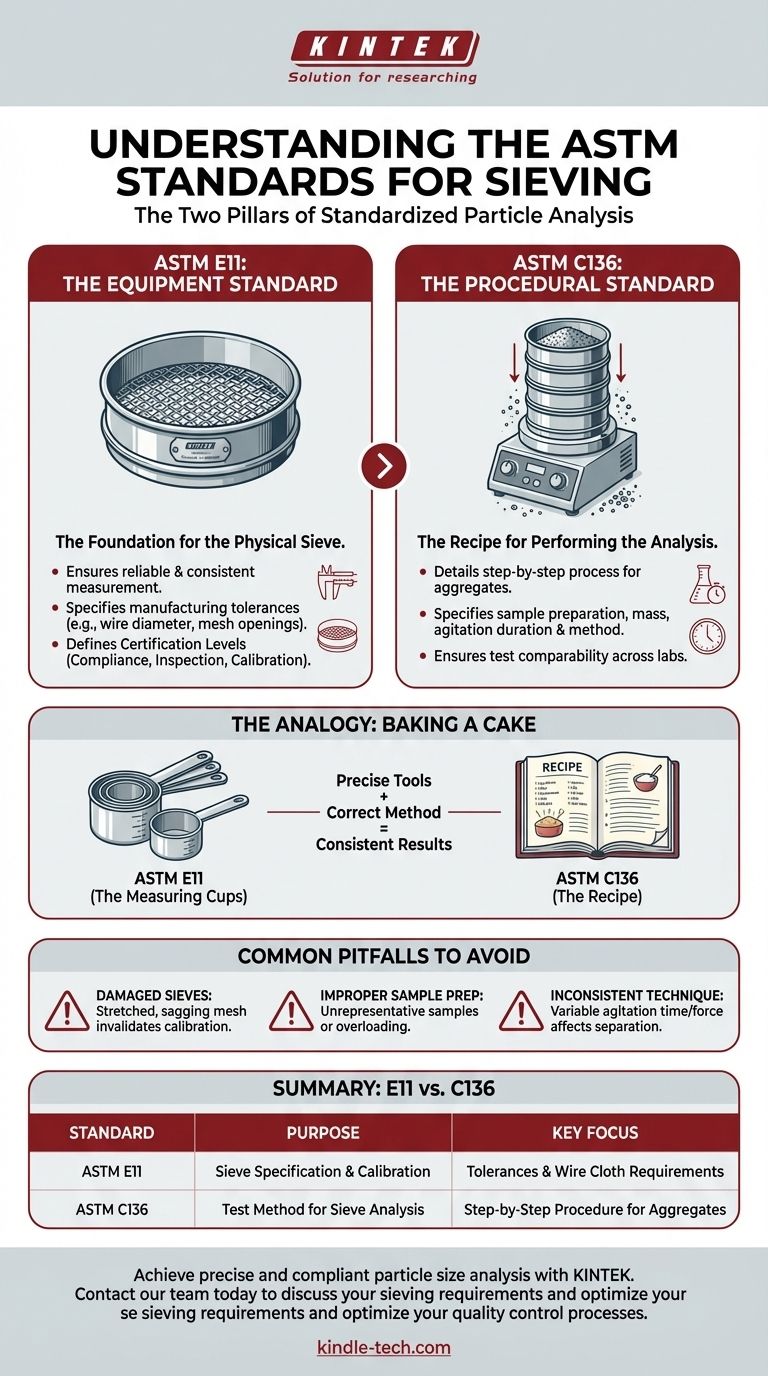
The primary ASTM standard for sieving is not a single document, but rather a pair of standards that work together. The most critical standard for the physical sieve is ASTM E11, which specifies the manufacturing and calibration of the sieve itself, while ASTM C136 is the most common standard test method for conducting a sieve analysis on aggregates.

To achieve accurate and repeatable results, you must understand that standardization applies to both the tool and the technique. Using a certified sieve (ASTM E11) is pointless without a consistent, documented procedure (like ASTM C136), and vice versa.
What is the ASTM standard for sieving? Master the Two Pillars for Accurate Particle Analysis

The Two Pillars of Standardized Sieving

A common point of confusion is believing there is one single "sieving standard." In reality, achieving a valid result relies on two independent but codependent standards: one governing the equipment and one governing the process.

ASTM E11: The Standard for the Sieve Itself

ASTM E11, "Standard Specification for Woven Wire Test Sieve Cloth and Test Sieves," is the foundational standard for the physical equipment. It does not tell you how to perform a test.

Instead, ASTM E11 ensures that a sieve from any manufacturer is a reliable and consistent measuring device. It specifies critical parameters like the permissible variations in wire diameter and the average opening size of the mesh.

The standard defines different levels of certification. Compliance Sieves are manufactured to meet the specification, while higher-grade Inspection Sieves and Calibration Sieves have been measured and verified to have tighter tolerances.

ASTM C136: The Standard for the Test Method

ASTM C136 / C136M, "Standard Test Method for Sieve Analysis of Fine and Coarse Aggregates," provides the recipe for performing the analysis. This is the procedural standard.

This document details the step-by-step process, including how to prepare the material sample, the proper mass to use based on particle size, and the required duration and method of agitation.

It also outlines the necessary calculations for determining the particle size distribution and fineness modulus. Following C136 ensures that a test performed in one lab is directly comparable to a test performed in another.

Why This Distinction is Critical

Think of it like baking a cake. ASTM E11 is the standard that ensures your measuring cups are accurate. ASTM C136 is the recipe that tells you how to use them.

If your measuring cups are inaccurate (non-compliant sieves), you can follow the recipe perfectly and still get the wrong result.

Conversely, if you have perfect measuring cups (E11-certified sieves) but don't follow the recipe (deviate from the C136 method), your results will be inconsistent and unreliable.

Common Pitfalls in Sieve Analysis

Even with the correct standards, errors can invalidate your results. Adherence to the process is paramount.

Using Non-Compliant or Damaged Sieves

The integrity of the sieve is non-negotiable. A sieve with stretched, sagging, or torn mesh, or one with a distorted frame, is no longer a calibrated instrument.

Regular visual inspection for damage, cleanliness, and tautness of the mesh is a critical first step before any analysis.

Improper Sample Preparation

The sample being tested must be a true representation of the entire batch of material. Using proper sampling techniques, like quartering or using a sample splitter, is essential.

Furthermore, C136 specifies the appropriate sample size. A sample that is too large will overload the sieves, preventing particles from having a chance to pass through the openings, a phenomenon known as "blinding."

Inconsistent Sieving Technique

The standard specifies how long and how aggressively the sample must be agitated. Insufficient sieving time will result in a sample that is not fully separated.

Whether using a mechanical shaker or agitating by hand, the technique must be consistent for results to be comparable over time. This is a primary reason mechanical shakers are preferred for quality control environments.

Making the Right Choice for Your Goal

To ensure your results are defensible and accurate, you must consider both the equipment and the procedure.

  • If your primary focus is equipment purchasing and calibration: Source sieves that are certified as compliant with ASTM E11 and implement a regular inspection and verification schedule.
  • If your primary focus is performing daily tests: Adhere strictly to the methodology in ASTM C136, paying special attention to sample size, sieving time, and preventing sieve overloading.
  • If your primary focus is quality assurance and compliance: Require both E11-compliant sieves and the C136 test procedure in your quality management system and internal training documents.

By understanding and applying both the equipment and procedural standards, you ensure your particle size analysis is not just a measurement, but a verifiable fact.

Summary Table:

Standard Purpose Key Focus
ASTM E11 Sieve Specification & Calibration Defines manufacturing tolerances and wire cloth requirements for the sieve itself.
ASTM C136 Test Method for Sieve Analysis Provides the step-by-step procedure for conducting the analysis on aggregates.

Achieve precise and compliant particle size analysis with KINTEK.

Understanding the nuances of ASTM standards is just the first step. Consistent, reliable results depend on using high-quality, certified sieves and following rigorous procedures.

KINTEK specializes in supplying a full range of ASTM E11-compliant test sieves and reliable lab equipment to meet your specific needs. Our experts can help you select the right tools and establish best practices based on standards like ASTM C136.

Ensure your lab's data is accurate and defensible. Contact our team today to discuss your sieving requirements and optimize your quality control processes.

Visual Guide
What is the ASTM standard for sieving? Master the Two Pillars for Accurate Particle Analysis Visual Guide

Related Products

People Also Ask

Related Products

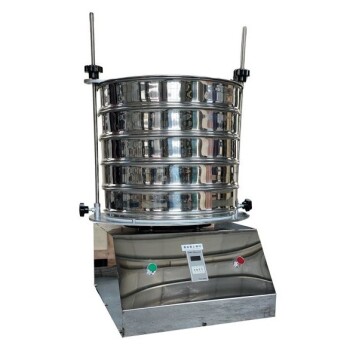
Laboratory Test Sieves and Sieving Machines

Laboratory Test Sieves and Sieving Machines

Precision lab test sieves & sieving machines for accurate particle analysis. Stainless steel, ISO-compliant, 20μm-125mm range. Request specs now!

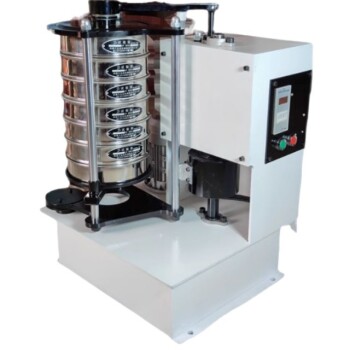
Laboratory Vibratory Sieve Shaker Machine Slap Vibrating Sieve

Laboratory Vibratory Sieve Shaker Machine Slap Vibrating Sieve

KT-T200TAP is a slapping and oscillating sieving instrument for laboratory desktop use, with 300 rpm horizontal circular motion and 300 vertical slapping motions to simulate manual sieving to help sample particles pass through better.

Laboratory Single Horizontal Jar Mill

Laboratory Single Horizontal Jar Mill

KT-JM3000 is a mixing and grinding instrument for placing a ball milling tank with a volume of 3000ml or less. It adopts frequency conversion control to realize timing, constant speed, direction change, overload protection and other functions.

Laboratory Sterilizer Lab Autoclave Vertical Pressure Steam Sterilizer for Liquid Crystal Display Automatic Type

Laboratory Sterilizer Lab Autoclave Vertical Pressure Steam Sterilizer for Liquid Crystal Display Automatic Type

Liquid crystal display automatic vertical sterilizer is a safe, reliable and automatic control sterilization equipment, which is composed of heating system, microcomputer control system and overheating and overvoltage protection system.

Laboratory Sterilizer Lab Autoclave Pulse Vacuum Lifting Sterilizer

Laboratory Sterilizer Lab Autoclave Pulse Vacuum Lifting Sterilizer

The pulse vacuum lifting sterilizer is a state-of-the-art equipment for efficient and precise sterilization. It uses pulsating vacuum technology, customizable cycles, and a user-friendly design for easy operation and safety.

HFCVD Machine System Equipment for Drawing Die Nano-Diamond Coating

HFCVD Machine System Equipment for Drawing Die Nano-Diamond Coating

The nano-diamond composite coating drawing die uses cemented carbide (WC-Co) as the substrate, and uses the chemical vapor phase method ( CVD method for short ) to coat the conventional diamond and nano-diamond composite coating on the surface of the inner hole of the mold.

Benchtop Laboratory Vacuum Freeze Dryer

Benchtop Laboratory Vacuum Freeze Dryer

Benchtop laboratory freeze dryer for efficient lyophilization of biological, pharmaceutical, and food samples. Features intuitive touchscreen, high-performance refrigeration, and durable design. Preserve sample integrity—consult now!

High Energy Planetary Ball Mill Machine for Laboratory Horizontal Tank Type

High Energy Planetary Ball Mill Machine for Laboratory Horizontal Tank Type

The KT-P2000H uses a unique Y-axis planetary trajectory, and utilizes the collision, friction and gravity between the sample and the grinding ball.

High Energy Planetary Ball Mill Milling Machine for Laboratory

High Energy Planetary Ball Mill Milling Machine for Laboratory

Experience fast and effective sample processing with the F-P2000 high-energy planetary ball mill. This versatile equipment offers precise control and excellent grinding capabilities. Perfect for laboratories, it features multiple grinding bowls for simultaneous testing and high output. Achieve optimal results with its ergonomic design, compact structure, and advanced features. Ideal for a wide range of materials, it ensures consistent particle size reduction and low maintenance.

High Energy Planetary Ball Mill Milling Machine for Laboratory

High Energy Planetary Ball Mill Milling Machine for Laboratory

The biggest feature is that the high energy planetary ball mill can not only perform fast and effective grinding, but also has good crushing ability

High-Energy Omnidirectional Planetary Ball Mill Milling Machine for Laboratory

High-Energy Omnidirectional Planetary Ball Mill Milling Machine for Laboratory

The KT-P4000E is a new product derived from the vertical high-energy planetary ball mill with a 360° swivel function. Experience faster, uniform, and smaller sample output results with 4 ≤1000ml ball mill jars.

High-Energy Omnidirectional Planetary Ball Mill Machine for Laboratory

High-Energy Omnidirectional Planetary Ball Mill Machine for Laboratory

The KT-P2000E is a new product derived from the vertical high-energy planetary ball mill with a 360°rotation function. The product not only has the characteristics of the vertical high-energy ball mill, but also has a unique 360°rotation function for the planetary body.

High Energy Vibratory Laboratory Ball Mill Grinding Mill Single Tank Type

High Energy Vibratory Laboratory Ball Mill Grinding Mill Single Tank Type

High-energy vibration ball mill is a small desktop laboratory grinding instrument.It can be ball-milled or mixed with different particle sizes and materials by dry and wet methods.

Benchtop Laboratory Freeze Dryer for Lab Use

Benchtop Laboratory Freeze Dryer for Lab Use

Premium benchtop laboratory freeze dryer for lyophilization, preserving samples with ≤ -60°C cooling. Ideal for pharmaceuticals & research.

Precision Machined Zirconia Ceramic Ball for Engineering Advanced Fine Ceramics

Precision Machined Zirconia Ceramic Ball for Engineering Advanced Fine Ceramics

zirconia ceramic ball have the characteristics of high strength, high hardness, PPM wear level, high fracture toughness, good wear resistance, and high specific gravity.

Vacuum Hot Press Furnace Machine for Lamination and Heating

Vacuum Hot Press Furnace Machine for Lamination and Heating

Experience clean and precise lamination with Vacuum Lamination Press. Perfect for wafer bonding, thin-film transformations, and LCP lamination. Order now!

Anti-Cracking Press Mold for Lab Use

Anti-Cracking Press Mold for Lab Use

The anti-cracking press mold is a specialized equipment designed for molding various shapes and sizes of film using high pressure and electric heating.

915MHz MPCVD Diamond Machine Microwave Plasma Chemical Vapor Deposition System Reactor

915MHz MPCVD Diamond Machine Microwave Plasma Chemical Vapor Deposition System Reactor

915MHz MPCVD Diamond Machine and its multi-crystal effective growth, the maximum area can reach 8 inches, the maximum effective growth area of single crystal can reach 5 inches. This equipment is mainly used for the production of large-size polycrystalline diamond films, the growth of long single crystal diamonds, the low-temperature growth of high-quality graphene, and other materials that require energy provided by microwave plasma for growth.

Small Injection Molding Machine for Lab Use

Small Injection Molding Machine for Lab Use

The small injection molding machinehas fast and stable movements; good controllability and repeatability, super energy saving; the product can be automatically dropped and formed; the machine body is low, convenient for feeding, easy to maintain, and no height restrictions on the installation site.

CVD Diamond Cutting Tool Blanks for Precision Machining

CVD Diamond Cutting Tool Blanks for Precision Machining

CVD Diamond Cutting Tools: Superior Wear Resistance, Low Friction, High Thermal Conductivity for Non-Ferrous Materials, Ceramics, Composites Machining


Leave Your Message